

By Cheri Sicard
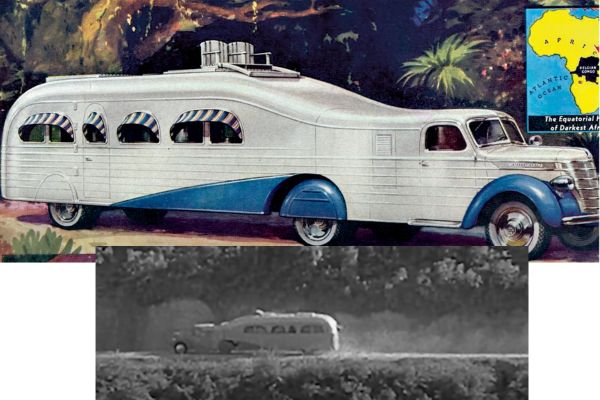
In 1938, two of the most ambitious vehicles ever to roll through the world’s wild places made their way into the heart of the African jungle. Known as the Jungle Yachts, these massive luxury RVs offered a travel experience few could imagine at the time. With air conditioning, a fully equipped kitchen, a tiled bathroom, twin bedrooms, a living space, a library, and a well-stocked bar, they brought a slice of modern convenience to the untamed wilderness.
In today’s video, Calum Raasay shares historical footage and recreates what they might have looked like inside.
Meet Attilio Gatti: Explorer and storyteller
Attilio Gatti was born in 1896 in Voghera, Italy. Although his early years are a bit mysterious, by the 1930s he had earned a reputation as a determined explorer, a skilled photographer, and a talented publicist. Gatti thrived in front of a camera as much as behind it, focusing more on capturing Africa’s beauty with film and photos rather than hunting. He stood out from other European adventurers by “stalking with a camera instead of a gun,” documenting wildlife and cultures across the continent.
For his tenth African expedition, Gatti landed major backing from International Harvester, an American manufacturer famous for its rugged vehicles. They supplied a fleet that included the showpiece Jungle Yachts—two streamlined trailers designed for supreme comfort. The man behind their look was Count Alexi de Sakhnoffsky, a Russian-American designer well-known for stylish vehicles. Early sketches and magazine advertisements reveal just how futuristic these vehicles were for their time.
The Jungle Yachts were built from stainless steel, a rare choice in the late 1930s, making them both durable and modern. Each one boasted:
- Hot and cold air conditioning
- A compact kitchen where the cook could reach every appliance without leaving the seat
- A spacious, tiled bathroom with a full-length tub
- A radio control, letting travelers listen to music while relaxing in the bath
- Dining area, bar, lounge, and library in the sitting trailer
- Two bedrooms and full bath in the sleeping trailer
Each trailer cost about $115,000, equivalent to several million today. With electric lighting, strong generators, a phone line connecting the trailers, and sturdy Fleet Wheels Co. manufacturing, they were high-tech travel machines few could equal.
Public debut and journey to Africa
Before heading to Africa, the Jungle Yachts created a sensation at an exhibition in Manhattan. Crowds and dignitaries marveled at their size and style. Finally, the vehicles were loaded onto the freighter West Lashway and shipped across the Atlantic to the Belgian Congo.
The 1930s Belgian Congo had a troubled history, but, by then, the Belgian government wanted to showcase it as a “Model Colony.” Gatti’s dramatic adventure, with its science-focused public image, fit their goals. Supported by officials, the expedition planned an 18-month journey, starting from Matadi port and heading deep into the interior.
Traveling from paved roads to rugged dirt tracks, the convoy pressed into remote areas with the Jungle Yachts performing impressively. The juxtaposition between the air-conditioned comfort and sophisticated technology inside and the wild, humid African jungle outside was striking. As Gatti later recalled, “giant trailers… their overall length was 42 feet,” with a weight of more than 10 tons each—their size alone made them stand out.
By late 1939, World War II brought everything to a halt. Tensions made supplies and communications tricky, forcing Gatti and his wife to call off the trip months early. Shipping the huge trailers home from Matadi turned out to be impossible, so they stayed behind in the Congo—abandoned, at least for the moment.
When Italy entered the war, Gatti’s Italian citizenship made things complicated. Officials in the Belgian Congo seized the Jungle Yachts, quickly converting them into a mobile hospital for use in the East African Campaign. Fitted with operating theaters, dental clinics, and X-ray machines, and staffed by medical teams, these luxury vehicles became part of the war effort—a sharp contrast to their original purpose.
The disappearance of the Jungle Yachts
What really became of the Jungle Yachts? After 1942, their trail fades. Most likely, they broke down or were scrapped as spare parts ran out. Somewhere, perhaps in an archive or a dusty ledger, the final records might yet be hiding. Their story remains an enticing historical riddle.
The Jungle Yachts lived on through Gatti’s film “Jungle Yachts of the Belgian Congo” and widespread coverage in magazines. Publications like Esquire, Popular Mechanics, and Picture Post helped build their legend. The designer, Alexis de Sakhnoffsky, also influenced similar luxury vehicles, including streamlined buses of the same era.
Even compared to today’s RVs, the 1930s Jungle Yachts stand out. With their advanced features and comfort, they truly were “trailers of tomorrow”—technological marvels rolling through another era.
RELATED
- All aboard! The Orient Express vintage trailer is a sight to behold
- Interior designer beautifully restores a 1956 Spartan Imperial Mansion
- You’ve got to see this vintage trailer-turned-houseboat
- RVer’s Spartan trailer restoration highlights the legacy of a WWII classic
RVDT2939

Thank you for finding and summarizing the video, Cheri. Thank you for re-running this Emily. Very interesting stuff. Unlike an RV, people rode inside the yachts while they were in motion. Too bad the yachts were lost in tbe mists of time. Have a great day and safe travels!
This is a wonderful slice of history. This can be added to the list of vanished airplanes and ships.