

By Cheri Sicard
In the video below, Peter and John, aka The RVgeeks, share their essential cold-weather RVing survival tips.
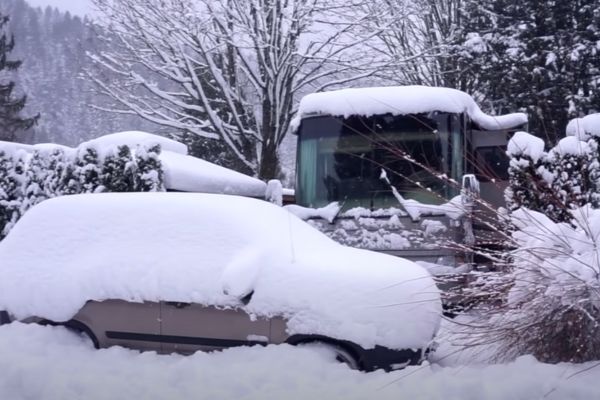
RVing in the winter is an entirely different animal than summertime RVing. The RVgeeks’ tips can help make sure you stay warm and comfortable when the temperature dips below the freezing point.
RVgeeks’ cold-weather RVing tips
Watch the video for additional details and recommendations on these tips. Also note, the RVgeeks are staying in a campground with full hookups for most of these tips, although they do talk about boondocking in the video.
#1 Fuel additives: The first tip began at the fuel station where Peter and John added some anti-gelling agent to their diesel fuel tank. The video shows what to buy and how to use it. If you have a gas engine, you instead look for a fuel line anti-ice additive. Don’t forget to run your generator, too, so that the additive runs through those lines as well.
#2 Water: The RVgeeks did a separate video about winter RVing and water issues when staying in one place. However, in this video, they were only going to be visiting with Jack Frost, not moving in, so they didn’t want to bother with things like heated water hoses. Instead, they took out their hose, filled the water tank, then put the hose away.
#3 Sewer: They did opt to keep their sewer hose hooked up during the visit. (I wouldn’t have. Instead, I would suggest a dump-and-put-it-away scenario just as with water, but it’s not my video.) However, they did some things to prevent freezing, starting with a sewer hose support to keep it off the ground and angled toward the dump pipe.
#4 Heat your water tank hack: Watch the video to see how Peter and John use a light bulb to heat their tanks and plumbing without having to turn on the propane furnace. They also suggest a remote temperature sensor in your RV’s basement for extra insurance. The sensor sends a signal inside so you will always be able to monitor your basement’s temperatures. If you see the basement’s temperatures getting too low, it’s time to fire up the RV’s propane furnace to keep things from freezing.
#5 Tires: Tire pressures read lower in cold climates. You can add air before leaving or when you park, knowing they are going to need it. Watch the video for details.
Do you have other cold-weather RVing tips? Be sure to drop them in the comments below.
##RVDT2276
Thank you, Cheri! I once left our sewer hose connected in freezing temperatures and it froze. The afternoon sun thawed it sufficiently to put away while it was pliable. I now do as you suggest; dump and put it away. Similarly, I add a bit more fresh water than we’ll likely need and then put away the hose. I plan to add a remote temperature sensor to our water bay before we travel in January. I hope that you and yours have a good Christmas! 🙂
Thank you Neal, Merry Christmas to you and yours too.
Earlier this year while coming back to Reno from Houston, we ran into unexpected (and un-forecasted) freezing temps (low 20s!) between Beatty, NV, and Tonopah, NV. Our trailer’s onboard water pipes froze up and when we finally set up for the night we were only able to get water out of the cold tap in the kitchen. No water at all anywhere else. No hot water, of course. We stayed put in Hawthorne, NV for three nights (luckily we have friends there). It took the entire next day before we started getting running water in the rest of the trailer. I’m not sure what we could have done to prevent this. We left the furnace on full blast the whole time we were hooked up.
You are lucky the pipes didn’t break. That happened in my old Airstream.
I know huh . . . Something about the type of ‘plastic’ they use now? Of course “now” refers to our 2012 trailer – 😀