

By Cheri Sicard
Picture a hungry hiker spotting a bush full of ripe berries and thinking, “That has to be safe.” In many cases, it is not. Many wild berries look juicy and harmless, yet a small handful of poisonous berries can send someone to the hospital or worse.
In the video at the end of this post, Alfie from Alfie Aesthetics walks us through the key features of around 30 common poisonous wild berries, based on real plants people meet while hiking, camping, or walking the dog. It focuses on simple visual clues: color, leaf shape, stems, and how the berries grow.
The nightshade family: deadly classics
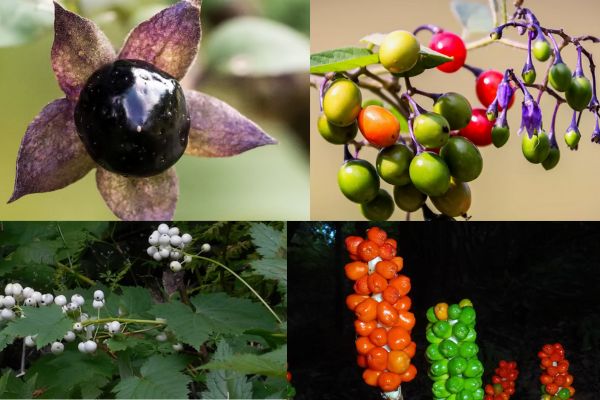
Deadly nightshade lives up to its name. It has large, black, shiny berries about 1 to 2 cm wide, each sitting alone on a pointed, star-shaped base. The leaves are broad and teardrop-shaped, and the flowers look like long purple bells. Only a few berries can kill a child or a dog, and half a handful is deadly for many adults, with solanine causing vomiting, stomach cramps, delirium, spasms, and convulsions.
Bittersweet nightshade, or woody nightshade, is its slightly less powerful cousin. The berries are smaller and more egg-shaped, starting green, then yellow or orange, and finally red. They hang in drooping clusters instead of sitting alone. The flowers are striking purple with a long, bright yellow style. Every stage of the berry is poisonous.
Jerusalem cherry also belongs to the nightshade family. It looks like a tiny tomato, with 2 to 3 cm orange to red berries and white flowers similar to bittersweet nightshade. The fruits are highly poisonous despite their familiar look.
Conifers, ground plants, and garden traps
Yew trees are evergreen with dark needles like spruce. Their red berries have a clear hole that exposes the seed in the center. The taxine toxins attack the heart and lungs, and people have died after eating them.
Lily of the valley is a low plant, about 6 to 12 inches tall, known for its small white bell flowers. These turn into 0.5 to 1 cm berries that go from green to orange to red on a leafless stem. All parts of the plant contain strong cardiac toxins.
Tutsan carries small, egg-shaped berries that ripen from red to black and sit above large, protruding sepals. The plant has bright yellow flowers with a burst of many stamens and a forked stigma, and the berries are poisonous.
Wild arum (Jack in the pulpit) grows spikes of tightly packed red berries on a short stalk. The plant is loaded with calcium oxalate crystals that feel like tiny needles in the mouth and throat.
Pokeweed looks a lot like elderberry. It has drooping, narrow bunches of small berries that turn from green to black on vivid purple stems. The berries often have a tiny crown of hairs at the tip. Every part of pokeweed is toxic. Elderberry, by contrast, has broader, fan-shaped clusters and serrated leaves.
Star marks, doll’s eyes, and white berry warnings
Cotoneaster is a shrubby bush with long, thin branches and leaves only slightly larger than its berries. The small red fruits have a clear five-pointed star on the bottom. They contain cyanide-releasing compounds that cause nausea and strong stomach pain.
White baneberry, also called doll’s eyes, is hard to forget. The white berries have a black dot like a pupil and often look slightly stretched instead of round. They grow on reddish-purple stems and contain powerful toxins that can stop the heart.
Red baneberry is almost the same plant, only with red berries on green stems. The bushes tend to stay low, often not much higher than knee to waist height. Both red and white forms are poisonous, even when the berries are white on green stems.
Snowberry, or ghost berry, produces soft 1 to 2 cm white berries on a shrub with broad oval leaves and small pink flowers. These berries, including pink varieties, are poisonous but are widely used in gardens. Creeping snowberry is a different, unrelated vine with small leaves and is edible, which is why leaf size and growth form matter.
Colorful vines and hedgerow hazards
Black bryony threads through other bushes on a soft green vine. The berries on one cluster can be green, yellow, orange, and red at the same time, like a little set of traffic lights. They contain calcium oxalate, which burns the mouth and gut.
February daphne flowers in late winter or early spring on bare stems. The pink blossoms sit directly on the stem, and later the plant carries bright red berries below a tuft of long, narrow leaves. Every part of the plant is poisonous, and touching it can cause skin rashes.
Common ivy climbs walls, trees, and fences. It has glossy, veined, triangular leaves and dense clusters of matte black or bluish berries that sometimes have pale speckles. The berries are toxic. Poison ivy is different, with the classic three leaflets and small tan- or straw-colored berries in bunches. Light contact with the leaves can cause painful rashes.
Common dogwood bears small, matte black berries with fine hairs on red stalks. Their flavor is bitter, and reports on edibility are mixed, so they are best avoided. Gray dogwood bears white berries that resemble white baneberry, although the clusters are looser and more grape-like. Both are toxic.
Fly honeysuckle has one of the easier ID clues. Pairs of opposite leaves often hold a little cluster of up to four shiny red berries right between them. The leaves are broad, oval, and smooth-edged. European and American fly honeysuckle varieties are toxic, and Tartarian honeysuckle shares the same pattern with translucent orange berries.
Winterberry looks close to a honeysuckle at a distance, yet its red berries tend to be more matte and not tied so neatly between leaf pairs. The leaves have a slightly serrated, crinkled look. The plant keeps its toxic berries into winter, which birds appreciate.
Box honeysuckle carries polished purple berries, like tiny glass marbles, on long, thin branches with small leaves. The berries are translucent and poisonous.
Holiday plants and bright red shrubs
Holly is easy to spot with its sharp, spiky evergreen leaves and pea-sized red berries. The berries are toxic to people. Some hollies grow as climbing vines and can wind through safe berry trees like hawthorn or rowan, so mixed branches need careful checking.
Pyracantha, often called firethorn, is a thorny shrub covered in clusters of small berries that ripen orange, yellow, or red. The leaves are glossy, narrow, and unlobed. People may confuse red pyracantha with hawthorn or rowan, but hawthorn has oak-like lobed leaves, and rowan grows as a tree with serrated, paired leaflets.
Spindle, or spindleberry, grows strange pink fruits that look like tiny segmented pumpkins. These outer shells split open to reveal bright orange seeds. The berries are striking but toxic.
Mistletoe forms big green clumps in tree branches. In winter, its 0.5 to 1 cm white berries show up clearly on segmented stems. Most white berries are not safe to eat, and mistletoe is no exception.
Creepers, laurels, and moonseed
Virginia creeper is a climbing vine that produces bright blue berries on purple stems. Its leaves are usually made of five leaflets that often turn red when the berries ripen. The fruits are toxic to humans and can be mistaken for grapes from a distance.
Common privet is a popular hedge plant with opposite, smooth-edged oval leaves and dense grape-like clusters of shiny, dark berries. These are poisonous but common in gardens and along paths.
Cherry laurel carries berries that shift from green through yellow and red to deep black, usually around 1 cm and a bit oval with a pointed end. The leaves are broad, evergreen, and glossy. Spotted laurel has similar oblong red berries, but the leaves are heavily blotched with yellow or pale green, giving a camo pattern. Both have toxic fruits.
Moonseed is a vine with triangular or lobed leaves and drooping clusters of black or bluish berries that often look dusty rather than glossy. It can resemble privet or cherry laurel fruit, but the vine growth and leaf shape give it away. Carolina moonseed, also called snail seed, is related and makes shiny red berries on a vine, with leaves that range from blunt arrowhead shapes to triangular lobes.
Simple rules for safer berry ID
For beginners, a few rough rules help reduce risk, even if they do not replace a good field guide:
- White berries are more often poisonous than not.
- Berries on purple or bright red stems are often toxic.
- Red berries on green or brown stems are a 50/50 mix of safe and unsafe.
- Birds eat many berries that humans cannot safely eat.
Leaves, stems, how the berries hang, and the shape of the flowers all matter. A pocket field guide and some time spent studying these details can prevent serious mistakes.
Knowing these poisonous wild berries helps keep campers, hikers, pets, and kids safer on the trail and at home. Once a reader learns to spot things like star-shaped berry bases, purple stems, doll’s eyes, or traffic light clusters, it becomes much easier to stay away from danger.
RELATED
- How to identify poison ivy, poison oak, and poison sumac
- Warning: This poisonous toad can kill your pet in Florida
- RVers, these poisonous plants could be lurking nearby. Look out!
- Got a bad travel itch? How to deal with poison ivy
RVDT2777

Blackberries are about the only one’s I would munch on. Huckleberries if the Bears haven’t eaten them all up.