


Dear Dave,
What is a grounding monitor interrupter (GMI) and how will it affect me and my rig?
From Dave:
This is a topic that has been discussed at length by many electrical experts. I have been monitoring it for the past year.
Grounding monitor interrupter requirement
The RVIA recently announced it has approved the Standards and Steering Committee’s recommendation for all new RVs to have a grounding monitor interrupter installed starting January 1, 2027. Here is the explanation of the requirement as listed in the RVIA press release.
It requires all RVs with 30A or 50A electrical service to install a grounding monitor interrupter (GMI), which is a loss-of-ground device. Before electrical current can pass into the RV, a GMI will check that the receptacle has a proper ground connection. During use, the GMI will monitor the ground connection to the RV and, if lost, will disconnect power to the RV….
The requirement was previously delayed because of a lack of fully developed, listed GMIs available for RV use in manufacturing at that time, making compliance with the original NEC date unrealistic. The Standards Steering Committee has continued to monitor the availability of GMIs and feel there will be availability of sufficient GMIs for use in RV manufacturing to meet the new effective date of January 1, 2027, and a mandatory enforcement at the start of each manufacturer’s respective model year 2028 production.
Misinformation in articles
From the research I have done, there is quite a lot of misinformation running through articles regarding where the device should be installed and if older units can be retrofitted. Currently, the only GMI devices are designed to be installed in the RV and not the campground pedestal. Also, there are no devices available to retrofit older units at this time. Efforts are being directed to installation on more than 300,000 new units.
What does this mean for the owner of a unit with a GMI installed?
If the campground source has a bad ground, loose wires, or reverse polarity, the GMI will automatically shut off the power to the rig and you will not be able to run any 120-volt component. It is permanently wired and cannot be disconnected or bypassed. Therefore, it is important for campgrounds to test each pedestal to ensure they are wired correctly.
It is also important for an owner to test the pedestal prior to plugging the unit in. This can be done with a multimeter or an existing emergency management system (EMS) such as the Hughes Power Watchdog or Southwire Surge Guard.
If 30-amp outlet doesn’t work, check the 50-amp outlet
Since the 30-amp outlet in campgrounds is typically used the most, it gets the most abuse, as well. Often these outlets are worn, loose, or corroded. If the 30-amp outlet tests defective and the GMI will not allow power to flow to the unit, it would be good to test the 50-amp outlet. It typically is a more heavy-duty component and may be wired properly. This would allow an owner to use a 50-30 amp adapter to still be able to get power. However, it is important to notify the campground of the faulty 30-amp outlet.
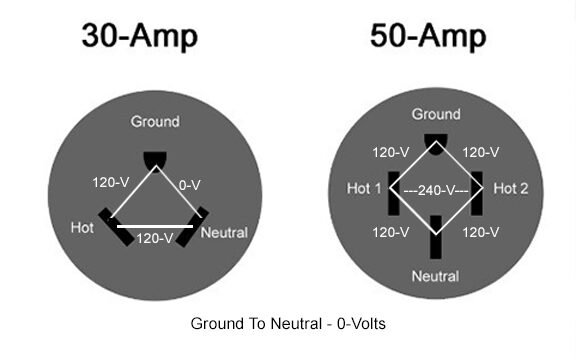
If you plan to use a multimeter to test the outlet, you should find the following voltage readings on a 30-amp and 50-amp outlet. Set the multimeter to the 200-volt AC setting. Place the black probe in the ground slot and red probe in the hot and check the voltage.
More on grounding monitor interrupters
- The RV industry just put a date on the GMI rollout. Here’s when buyers may start seeing the new devices
- New 2026 RV rule could leave you without power at some campgrounds
- Beyond the headlines with Tony Barthel: New RV safety standards are a good thing
- Prevent dangerous RV “hot skin” condition
DAVE HAS ANSWERED MORE THAN 1,000 readers’ maintenance and repair questions. Read a directory here. There is so much to learn!
Dave Solberg is a leading expert in the RV industry and the author of the “RV Handbook.”
HAVE A QUESTION FOR DAVE?
Send your inquiries to him using the form below.
RVDT2923


You can build an easy pedestal tester with two parts: a male 30A to female 15A adapter and this outlet tester. There are even less expensive testers, but they only check for correct wiring and do not indicate outlet voltage.
It is also possible to check 50A outlets with a male 50A to dual female 15A adapter. Verify the voltage is identical on each 15A outlets.
If the Hughes Power Watchdog performs a check of a pedestal electrical connection, doesn’t it do the same thing as this GMI device?
Thank you for the information, Dave. Seems a valuable development that should make the electrical components within the RV safer. Have a great day and safe travels!