


Dear Dave,
I have a general knowledge question for you, as I don’t use social media, and I respect your opinions. I’ll be headed to a new campsite tomorrow and it’s supposed to get below freezing temperatures overnight. I’ll obviously be using a heater inside the coach for warmth and the underside of the rig is mostly enclosed. Is it better to use the water hookups at the site or use the water tank in my Class A to avoid frozen water lines? —Bill, 2019 Winnebago Sightseer 33C
Dear Bill,
The heater of your Class A is ducted underneath the floor with heat registers. It also has a register that goes to the freshwater tank area with the water pump. You can use the campground source by protecting the hose with a heated supply line such as this model you can find on Amazon here.
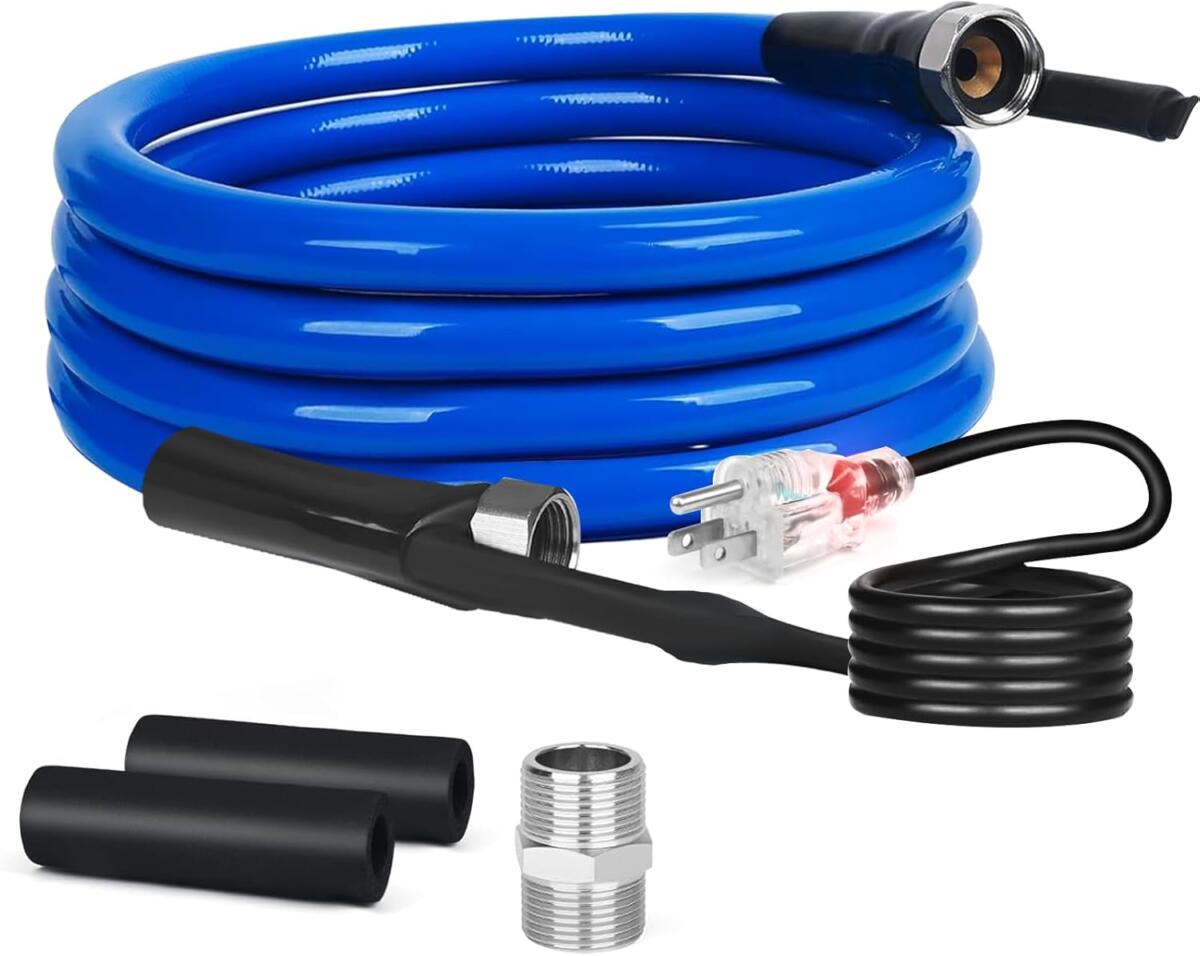
This is IF the campground still has the water turned on! Most campgrounds will shut the system down and drain the faucets in late fall or early winter to protect the lines from freezing. In that case, you would need to use your onboard freshwater tank and water pump.
A note of caution
Even though your furnace is ducted into the service compartment with the fresh water tank and water pump, that does not guarantee it will not freeze. I have had frozen water lines in mid-20-degree temperatures as the compartment did not have a very good airflow design and there were very cold “pockets”. The water line is only 1/2” and can freeze quickly. So I would also recommend supplementing the compartment with some type of heater, heat blanket, or a 60-watt light bulb.
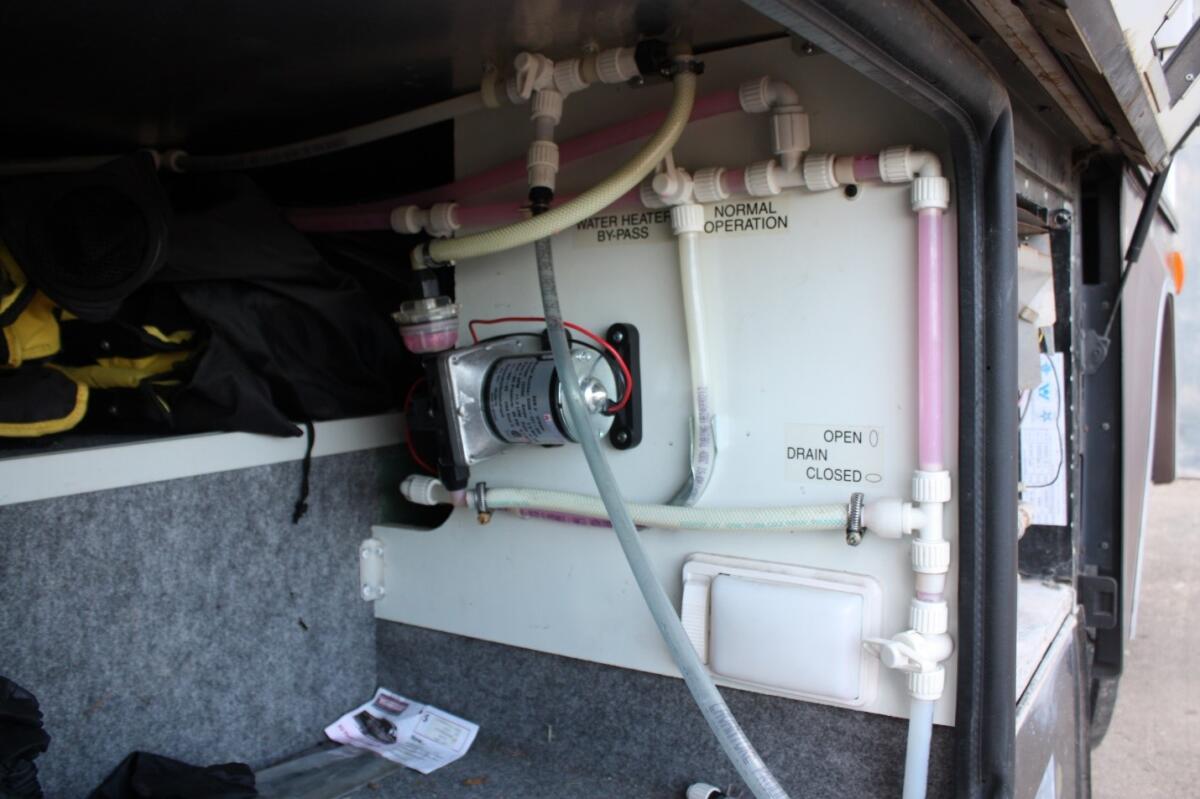
This photo is the service compartment in a comparable Winnebago Class A, and the lines are very close to the compartment door. These lines have been winterized with RV antifreeze (“pink stuff”). Even though the compartment door has insulation, it can still get cold enough inside that compartment to freeze. The good thing is the lines are PEX and can expand 1.5 times their normal size, so I did not have any busted pipes. However, I don’t recommend trying that!
You might also enjoy these posts from Dave
- How can I use my winterized RV in January and February?
- Your RV’s fresh water system: What you should know
- Is there a drip valve that prevents water from freezing in an RV?
- RV’s hot water lines aren’t working. Could water heater tank be frozen?
Dave Solberg is a leading expert in the RV industry and the author of the “RV Handbook.”
Read more from Dave here.
HAVE A QUESTION FOR DAVE?
Send your inquiries to him using the form below.
RVDT2651

And even if the campground still has water available (most likely because they have frost proof faucets), make sure to disconnect your hose overnight to allow water to drain down in the faucet to prevent the faucet from freezing.
We run off the fresh water tank and only have a hose connected for refilling or when there’s no chance of freezing. To help the furnace keep the wet bays warm, I plug a pair of 140 watt chicken coop heaters into a WiFi thermostat outlet. They produce nice radiant heat without the risk of contact scorching like what can come from a lightbulb. Because the thermostat is WiFi, I can manually turn the heaters on, check the bay temperature and adjust the thermostat settings. If my WiFi is off, it works like a regular thermostat, turning on and off at whatever it’s set at.
2 most observed mistakes with a heated hose: #1, putting the thermostat end inside the heated bay. Warm bay, hose heater turns off and freezes. #2, the hose only heats itself (and the water inside). Tap, regulator, filter may be unprotected. I put a loop of the heated hose from ground up over the tap. Unless inside a heated bay, include the regulator and filter. Then wrap a ‘space blanket’ around the works and secure with a bucket or garbage can, depending on tap height. Same as #1, make sure the thermostat is outside this heated space.
To give a definitive answer it would be good to know how low temps are supposed to go and also projected daytime temps. Bill does say “overnight,” which implies above freezing dropping to below for a time and then rising again. While this situation takes caution, having it get to 30°F for a few hours overnight and then back to 50 or 60F is a lot different than temps in the 30’s during the day going to teens or single digits overnight, then barely back above freezing.
I used to camp in some very cold temps in my Winnie Journey. I temporarily lined batt insulation along all the bay doors and also on the thin plastic water bay floor. I always ran off the water tank.
Thank you for sharing the question and your informed answer, Dave! As others have already said they do, I put water into the fresh water tank when it is above freezing. After draining the hoses, etc, I store them and run the water pump to use water from the fresh tank. Our tanks are well insulated and, so long as I have the diesel burner active, sufficient heat will be channeled to the water pump and water tanks to prevent freezing. However, we rarely travel in the RV if overnight lows are forecast in single digits (F). Have a great Memorial Day and safe travels!
Thanks for the response Dave, it was very much appreciated. While we spent 4 or 5 nights with below freezing temperatures, the days warmed up into the high 40’s and twice the low 50’s. I did shut off the water hookup overnight and used my tank supply, then resupplied from the site and used that as necessary.
All is well going forward!
Thanks also to the other responders for their useful information as well!