


If you’ve ever piloted your RV over Interstate 10 near Palm Springs, California, you’ve seen the huge landscape of commercial wind turbines. The San Gorgonio Pass Wind Farm had a peak of 4,200 turbines in 1987. As of last May, the number was down to 666 turbines. It begs the question, what is done with wind turbine blades when the machines are “decommissioned”? While the big machines help to produce power, their spent blades could be an environmental nightmare. But researchers say, the road to the future could be paved with turbine blades.
While other parts easily reused or recycled, wind turbine blades are a challenge
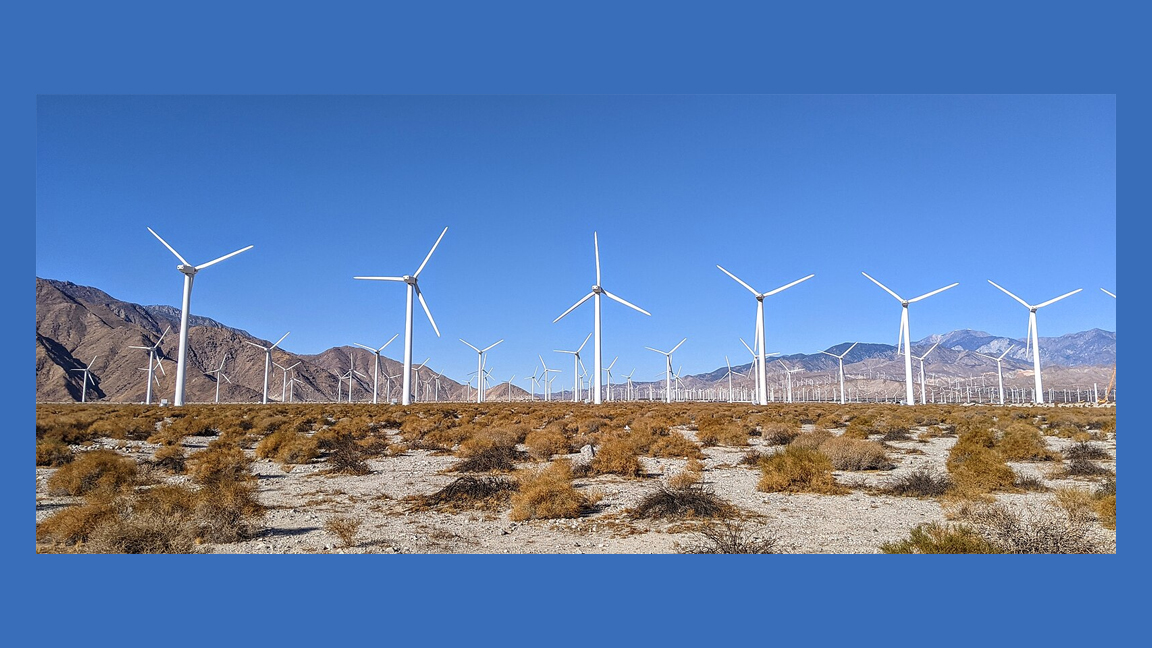
Much of the parts from out-of-date wind turbines can be recycled, or put to work in newer machines. That includes the nacelle, the shell, and metal-containing internal parts. But those long blades, which typically contain gobs of fiberglass, are another matter. While you may see “dead” blades at windfarm sites, they certainly won’t decompose anytime soon.
Could old turbine blades be put to use somehow? Researchers from the Lanzhou Institute of Chemical Physics at the Chinese Academy of Sciences say “Yes!” They’ve come up with a new process where the blades are crushed and chemically treated. The resulting material is then mixed with either asphalt or cement and turned into roads.
The theory was taken to the testing stage last year. In September, the Lanzhou engineers worked with road builders on the Qingfu Highway near Lanzhou, in China’s northwest. The new road built with old turbine blades has not developed problems like cracks or rutting.
Not just roads—other uses are already working
There are other uses for retired wind turbine blades. Much closer to home, a Kirkland, Washington, firm, Global Fiberglass Solutions, has its own recycling method. The company transforms dead blades into reinforcing material mixed with plastic pellets. The end product has been used to make manhole covers.
With headquarters in Knoxville, Tennessee, Carbon Rivers yanks strong reinforcing fibers out of old blades for reuse. They do it by heating up the dead blades, and the recovered fibers are then used to make heavy-duty parts for the automotive world.
A multi-national firm called Veolia processes the blades by shredding them into small pieces. These are fed into kilns and replace coal, sand, and clay needed to make cement.
What do you do with dead wind turbine blades? Bob Dylan started the question when he sang, “The answer is blowin’ in the wind.” Clever researchers and engineers are finding ways to deal productively with what might otherwise be a big wind-blown problem.
RELATED
- Quit tossing spent batteries. New places to recycle coming
- Los Angeles will recycle impounded RVs
- Brilliant ways RVers can reuse plastic straws
- 5 ways to reuse pull tabs while RVing
##RVT1197b


The possible reuse of the fiberglass and other parts sounds good if it can be economicly and energy efficiently scaled up. I suspect that the building, operation and decommining of each turbine uses as much energy as the turbine produced during it’s lifetime. Considering mining,fabricating,transporting (the trucks use oil and fuel) and the whole process in reverse. The reclaiming processes listed each use massive amounts of energy too especially the ones using heat. And you still end up with MICROPLASTICS – which turn the environmentalists pale. As the road wears glass fibers end up in the air and when the buildings using fiberglass in the cement are imploded ? Big clouds of dust.
Many wind turbines are a long way off-road, often along the top of otherwise undeveloped mountain ranges. The heavy, useless, blades are lying on the ground.It will take a lot of carbon-based fuel to remove them. The expense of removing them far outweighs any value in recycling them. Wind power in this day and age does nothing for the environment or for the ecosystem, it is simply taxpayer-funded virtue signaling that kills millions of birds.Those of us who served in our nuclear Navy know that clean, safe and efficient power is readily available from modern nuclear plants. In the meantime, domestic natural gas, abundantly available, provides clean power as well.
USN 1980 to 1986. NNPS Class 8104. SSN702. NEC 3351/3355
USNR 1973-1986. CVN69 1982-1983. Slept over reactor #2, lulled to sleep by the hum of the coolant pumps. Ton of respect for all the ‘nukes”.
I didn’t know there was a manhole shortage. All this ‘feel good’ energy stuff (both solar and wind) all end up going belly up in a relatively short time. Then the problem becomes what to do with this worn out stuff. Meantime, nuclear and gas generators go on and on – and on, virtually pollution and trouble free. How is it this all goes on unnoticed by our green deal government?
planned obsolescence…it’s all a scam
One word…money
If wind is the future why have so many wind mills been removed. Just wondering .
Compared to modern, large wind turbines, older windmills were significantly less powerful, generating only a fraction of the electricity. Older models produced power in the range of a few hundred watts to several kilowatts, while today’s large wind turbines can generate megawatts of power each. Essentially, a modern wind turbine can produce hundreds of times more electricity than an older windmill. Haven’t you notice the size of these new windmills compared to the ones back in the 80’s and 90’s??
Thank you for the news, Russ and Tina. A former training mate worked in “wind” within the U.S. Department of Energy. Unfortunately, we lost touch or I’d query him on the reasons wind vanes cannot be, or are not reused. Seems a bit of a puzzle. Have a great weekend and safe travels!
My lay understanding is that the blades eventually wear unevenly and become unbalanced, making them unsuitable for reuse.
Thank you, Richard! Safe travels!
Seems like a HUGE waste of resources…
I often wonder how much fossil energy we use to build, operate, and dispose of green energy systems. I do believe that many times we trade one pollutant for another. The thought of ground up fiberglass blowing around due to the wearing of roads does not give me a warm fuzzy feeling.
Row after row of them, only a handful in use at any given time. Once in a while a crew seen working on one over almost tens years traveling through the area weekly…
“666” turbines left? the mark of the beast!
A friend lives in mid Illinois and has 1 windmill on his property. He gets arond $ 6000 a year for havin it there. Im sure I heard him right but I cant imagine it ever made even a thousand dollrs of electricity