

Yesterday I got off on a tangent about all the new RV technologies and systems that I’ve seen that, I believe, might come to a campground near you. But the RV industry has been burning the midnight LED lights on some gadgets that you can touch and feel today.
Cool new RV features
Before we get into gadgets and gizmos, let’s talk about some design features. With that, I’m going to stop and stare at some of the ones I’ve seen in newer Alliance RV products. Alliance is a newer manufacturer that is still independent and that seems to be truly making some good stuff. The company started by surveying people about their own RVs and continues with things like testing every RV they make with full holding tanks on a road course. Nice.
It makes sense, then, that the company has really paid attention to their water systems. I love the fact that they’re using a manifold system that enables you to switch off any fixture in the rig and continue camping.
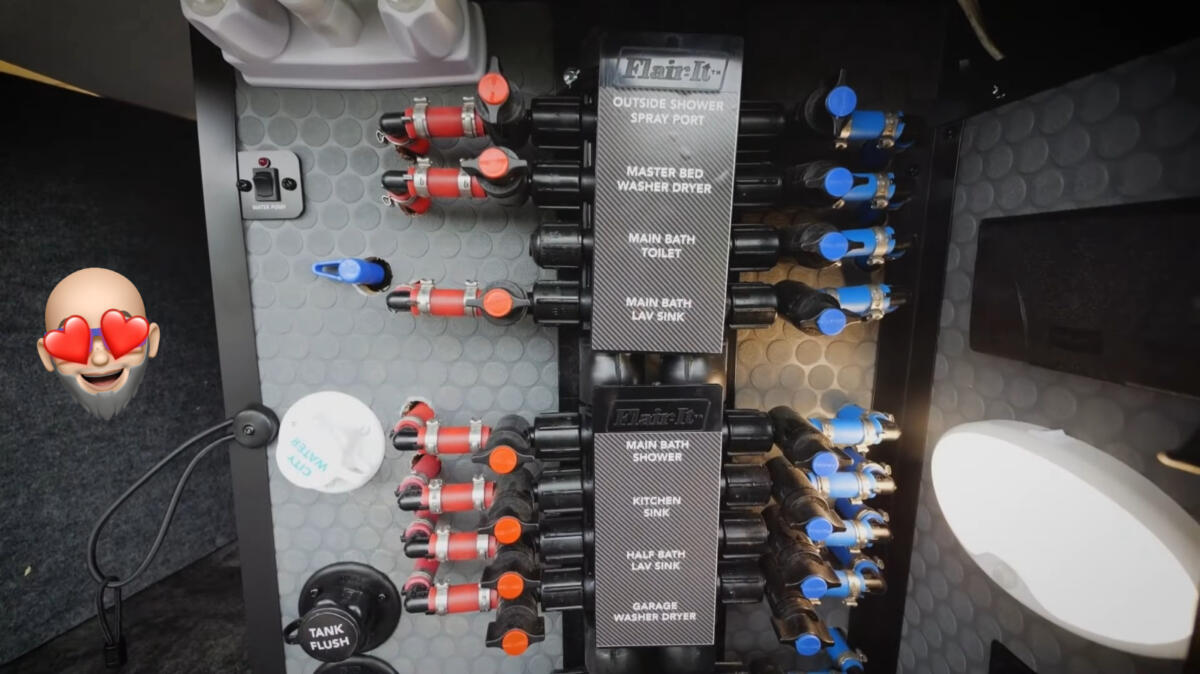
This would have proven to be a stress reducer on my own camper where two plumbing leaks at one stop meant spending the entire day chasing down a repair solution for these leaks. Grr. You can see this feature in our review of the Alliance RV Valor 44V14 fifth wheel, but this isn’t the only place they’re doing this.
Another thing they’re doing is putting in a recessed shower pan. While most RVs have a raised shower pan to accommodate plumbing, Alliance has figured out how to do the opposite, and that means more headroom in the shower.
While we’re here in the shower together (don’t drop the soap), I have also seen a few RVs where they are forgoing the skylight in the shower. Since this is one of the most common failure points in RV roofs, I’m all for it.
RV trends
If you’ve been reading my reviews lately, you’ll catch on that things are a-changin’ in the RV industry. Just two years ago it was typical that any towable RV would have a propane and electric refrigerator. Not anymore.
Now you’ll almost certainly find a 12-volt fridge in almost any towable RV. Why?
Some have said that these are cheaper, but they’re not, really. These 12-volt fridges are mostly hardened for life on the road, so they’re not cheap at all. Look online at anywhere that sells them and you’ll see they’re more expensive than some household fridges. So why is this happening?
A few reasons. Gas absorption fridges operate so differently from anybody’s home reefer that many people didn’t understand them. The often 12-hour delay between turning them on and them being cold enough to use befuddled a lot of people. There is also much more maintenance to a gas-electric fridge. By gosh, you actually have to open a door and check to see how clean the system is.
Despite all of you who have been running these fridges while driving, thereby leaving an open flame and a nice supply of propane available in a moving vehicle, it is a safety hazard. People love to sue people even when it’s their own misbehavior causing the issue.

And, 12-volt fridges aren’t particularly picky about being level. Plus, given a certain size of enclosure, a 12-volt fridge offers more usable space. So, this is what’s happening. Further, now there are larger and fancier 12-volt fridges that I’m seeing in even motorhomes and premium fifth wheels.
This makes sense. Many appliance repair people won’t work on residential appliances in an RV and many RV techs won’t work on residential appliances. Plus, if you’ve bought a residential fridge in the past few years, especially one of the Korean units, you know they don’t last.
And now you’re seeing an increasing number of higher-end 12-volt fridges with things like double doors and other upscale touches. There are also fridges whose doors open either way (think of the 1950s Philco fridge that did this!) and with other new features.
Other appliance trends
Another trend I’m seeing in appliances is in the cooking department. More and more I’m seeing convection microwaves coming online. In fact, Ember RV planned their kitchens around convection microwaves (they don’t have propane ovens), but those units didn’t come online until recently.
But now they are. And I’m seeing several offerings from different manufacturers and I think this is a good thing. However, you either have to be hooked to shore power or have access to a fair amount of reserves if you want to nuke your popcorn. On a plus note, though, how long do you actually run it for?
I defrosted some frozen meat a few days ago on battery power alone and it didn’t take much of our reserves. About 12 minutes of microwave power. No biggie.
I also just saw a convection electric oven that is a new feature from Suburban. This I’m on the fence about because you are going to run it for a while and it’s going to consume a fair amount of power. There are still a lot of people who only camp in RV parks and, for them, they’re fine.

You can see more about this in my RV review of the Cruiser RV MPG 2100RB. What I like about this is that you have the full use of the space in this smaller oven. There is no room needed for propane burners or heat shields, so the 17” oven is actually usable.
But with more campers and few new places to camp, a lot of RVers seem to be joining me off the grid and, for them, all-electric features have less appeal.
Another thing I’m seeing is more and more use of tankless water heaters. Not hot water heaters—if you had hot water you wouldn’t need a heater.
I’m not sure how I feel about this. On the plus side, this means a continuous stream of hot water. These are also often much easier to winterize than traditional water heaters. But this also means they’re always only gas-fired.
I’m a big fan of the six-gallon gas-electric water heater in my own RV. There’s plenty of hot water, I can take advantage of full hook-ups when I have them, and it’s a relatively simple device. So is the juice worth the squeeze with the newer tankless units? I’m not convinced yet.
Keeping you cool
When I attended RV Open House, I was in the Keystone Outback OBX 17BH talking to the rep from Keystone. I suddenly realized the A/C was on but it was almost dead quiet. The A/C in this unit is the Furrion Chill Cube, a remarkably efficient new A/C unit that produces 18,000 BTU of performance at a significantly reduced power consumption rate.

If you’re into boondocking and people ask how long your resources can power your RV, what they want to know, really, is how long you can run the A/C. The problem has been that RV A/C units are as advanced as that ’62 Rambler in your uncle’s garage. Finally, we’re seeing incentives to make these units more efficient.
The trend started with the Truma Aventa, but now I am seeing this Furrion unit coming along to challenge it. Not to be outdone, Truma also announced their Saphir unit, which is a below-deck heating and cooling unit that’s also fairly efficient. Rather than be a roof-top unit, this below-deck unit could help improve the aerodynamics of RVs by not being like a tumor on the roof.
I also was privy to some forthcoming units from other manufacturers. But I can’t share info on those—I’m only putting this here as a note of encouragement for the future.
More trends
Something else I’m seeing is ladders going away. Again, back to people suing RV companies for their own bad behavior—ladders aren’t really designed for dynamic loads. In other words, shaking loads while going down the road.
Things break off, people get sued. So I see more RV companies are putting a mount near the roof for a telescoping ladder. These just hook on when you’re using it and come off when you’re not. There’s no way to hook something to the ladder while driving, which solves another problem. Plus, the RV companies can put multiple mounts around the RV so you have multiple places to climb up to the roof.
I like this. Ember RV, in particular, is also putting mounts for the telescopic ladders on the sides of their RVs.
Hey, Siri and Alexa, check this out
If you’re nerdy like me, you may appreciate some sort of digital control system that can turn on lights or adjust the climate control in your home. Well, I’ve seen this technology migrate to RVs, which is probably inevitable.
The first place I saw it was at the RV Open House in the IBEX RV Suite. Then we caught it in a Jayco Pinnacle 35FBTS fifth wheel.
What I like about this technology in my house is that I can add it to a house without affecting the house or basic house functions. But if it were built in, as soon as the technology gets updated, the entire house would be out of date. And that’s why I’m not a fan of these systems built into vehicles.
However, do know that it’s coming and will be more common in short order as RV companies try to out-feature one another.
 Best RV of 2023
This is the first year that I was so inspired by an RV that I gave it an award. You could take one of my awards and five bucks and have yourself a cup of coffee at Starbucks, so that’s about what they’re worth. But still…
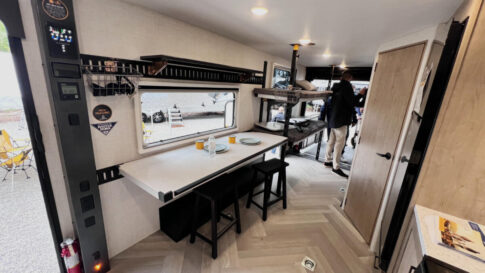
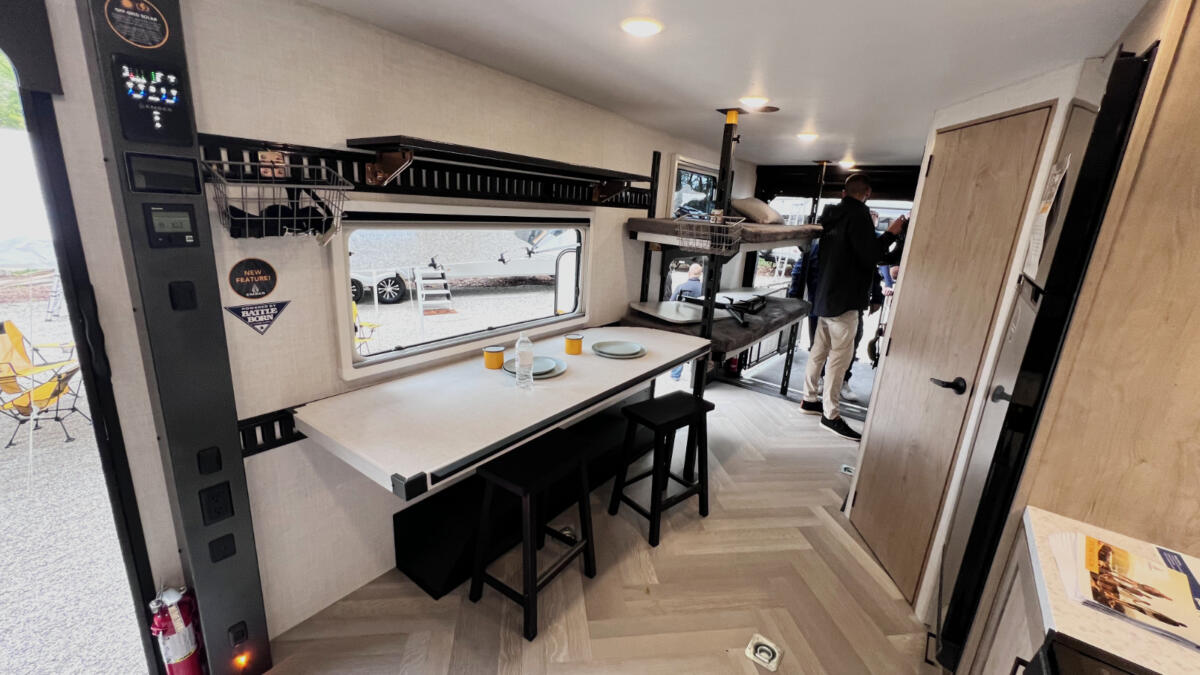
In my opinion, the best new RV I saw was the Ember RV 240TKR toy hauler. I liked this one because it was so flexible and reconfigurable. Need a bunkhouse with large bunks? No problem. Need an RV with an office? Done. Need a lot of prep space for some elaborate meal? Sure!
Want to go camping with your buddy and sleep in separate beds this weekend but then snuggle with your spouse the next? Yep. Done.
This was a promised model that I saw at Open House that had all those features and more. It was so uniquely different than any RV I have ever seen, I felt compelled to bestow my award of Best of Show on this unit.
Ember RV is a company whose decision makers all own their products and actually go camping. This is the kind of thinking that comes from that sort of practice.

Conclusions
Over the past couple of years, with RV companies being able to sell anything they could make, we saw a ladling on of features and functions, many of which we weren’t interested in. With sales back to more realistic levels, you’re seeing more and more RVs that are getting back to basics. I’m all for that.
But we’re also seeing meaningful innovation and progress, as well. In many ways I’m liking what I see but, notice, much of that innovation is coming from the newer players in the game.
I’ve also heard rumblings in the industry that some floor plans and even some brands are likely to go away, and I’m all for that. Well, other than it’ll give me fewer RVs to review. But the proliferation of brands and models and sub-brands, to me, is ridiculous. So, if some go by the wayside, so be it.
As always, I’m grateful for your readership and very happy to read your thoughts and comments. The best to you in 2024.
Make sure you read Part 1 of Tony’s The best (and not so best) RVs and gadgets of 2023 here.
More about these RV reviews
These RV reviews are written based on information provided by the manufacturers along with our writer’s own research. They are based on information from a single unit and may not reflect your actual experience. Shop your RV and dealership carefully before making a buying decision. We receive no money or other financial benefits from these reviews. They are intended only as a brief overview of the vehicle, not a comprehensive critique, which would require a thorough inspection and/or test drive.
Tony comes to RVtravel.com having worked at an RV dealership and been a life long RV enthusiast. He also has written the syndicated Curbside column about cars. He also works closely with a number of RV manufacturers to get an inside look at how things are done and is a brand ambassador for Rockwood Mini Lite with his wife, Peggy.
You can also check out his RV podcast with his wife, Peggy.
Got an RV we need to look at? Contact us today and let us know in the form below. Thank you!
-form broken-
##RVDT2286


Thank you, Tony! I didn’t think about it much, in fact I barely realized it, but we saw the departure of the shower skylight too. RV #1, a 2016 DP, had a skylight over the shower that was a bit of a problem during our 2019 Alaska trip. (We closed the bathroom door at night and solved the problem.) Thankfully, it never leaked. RV #2, a 2022 DP, has no skylight over the shower. Both had tankless water heaters. The 2016 had an Aqua-Hot diesel/electric furnace that also heated water. Similarly, the 2022 has an Oasis-branded system that acts identically but uses antifreeze of a different color (yellow?). Have a wonderfully blessed 2024, Tony! 🙂
Great follow up to yesterdays column Tony !
It’s good to see at least some in the industry are moving forward with some actual usable utilities and products…not in favor of the mechanical track system for moving around the furniture, etc. in your favorite choice of trailer though.
Two days of interestibg reviews, Tony. Are you going to sell your year-old Mini Lite and buy an Ember?
We love our Truma Comfort Plus water heater. Despite always using propane, we have no worries about running out of hot water when the two of us take back to back showers! And the electric heating element on the 6-gallon Suburban WHs on both of our previous RVs eventually burned out, so they were also propane only. Ie., for us, the pros of the Truma far outweigh the cons. Just like the pros of our 12v fridge far outweigh the cons when compared to our two previous propane-electric fridges.