

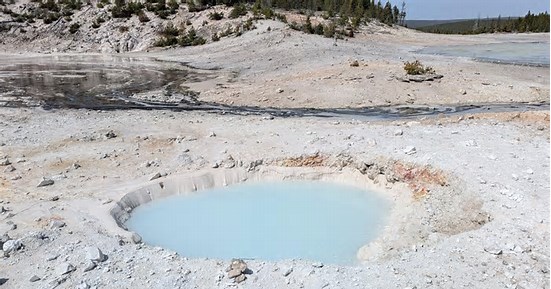
Yellowstone National Park surprised geologists this week with the unveiling of a brand-new, light-blue thermal pool.
Here’s what you need to know.
How the spring was discovered
It all began in mid‑April 2025. That’s when scientists from the U.S. Geological Survey’s Yellowstone Volcano Observatory conducted a routine temperature survey at the park. When the survey team checked Norris Geyser Basin’s Porcelain Basin, they noticed something new. It hadn’t been there the last time they checked (autumn 2024).
A quick infrared scan and temperature log pinpointed a roughly 13‑foot‑wide pool sitting at about 109 °F. Its milky‑blue hue immediately stood out against the usual earthy tones of silica and rock.
Retroactive analysis of high‑resolution satellite imagery confirmed that the pool formed between late December 2024 and early February 2025. Scientists think that a series of small hydrothermal explosions gradually ejected rock and silica mud before filling with mineral‑rich water.
Where you’ll find it
The new feature sits in the Porcelain Basin section of Norris Geyser Basin. The area is unofficially dubbed “Tree Island” by park geologists. It’s located a short stroll from the main boardwalk loop. The new spring measures about 13 feet across, and glows with a soft baby blue hue.
Rare discovery
Yellowstone is home to more than 10,000 active hydrothermal features. These include hot springs, geysers, mud pots and fumaroles. The hydrothermal pools make Yellowstone one of the planet’s most geothermally dynamic landscapes.
The emergence of an entirely new pool is noteworthy. Most features in Yellowstone are centuries old, and only a handful have been documented forming in the modern scientific era. Norris Geyser Basin, the park’s hottest and most volatile basin, has produced several new vents and pits over the past few decades. The newly discovered spring’s gentle, gradual birth sets it apart from more explosive predecessors.
RV camping and nearby facilities
If you need full hookups, Fishing Bridge RV Park is the only Yellowstone campground with water, sewer, and electrical connections. This park is about a one‑hour drive east from Norris. Plan to arrive early (before 9 a.m.) to snag a prime RV spot and beat the midday crowds.
Check out this national park site to find other campgrounds with minimal hookups.
Final tips
Timing: Early morning or late afternoon visits offer cooler temperatures and thinner crowds.
Preparation: Pack sturdy shoes and plenty of water. The ground can be hot and the air steamy.
Respect the park: Park features are delicate. Do not throw coins in or touch the water. Remember, leave no trace.
Yellowstone’s new “baby blue” hot spring is a reminder that the park’s underground magic is still very much alive. Even in 2025, Yellowstone continues to surprise us.
RELATED
- German Shepherd jumps from car window, chases wolf in Yellowstone
- Another Yellowstone tourist gored by bison
- Popular geothermal area in Yellowstone National Park closed for summer
- Driver 2.5x over blood alcohol limit in fatal Yellowstone-area wreck
- Food-conditioned grizzly bear trapped, killed in Yellowstone
- Florida man gored by bison at Yellowstone National Park
RVT1218b

Thank you for the news, Gail! If the picture can be taken at face value, then I find the color, shade quite pleasing. Have a great day and safe travels!