


Despite the wide variety of electric vehicle (EV) models now available—more than 75 options introduced in the past four years—AAA’s latest survey highlights buyers’ continued hesitation. Only 16% of U.S. adults report being “very likely” or “likely” to purchase a fully electric vehicle (EV) as their next car, the lowest percentage recorded of EV interest since 2019. The percentage of consumers indicating they would be “unlikely” or “very unlikely” to purchase an EV rose from 51% to 63%, the highest since 2022.
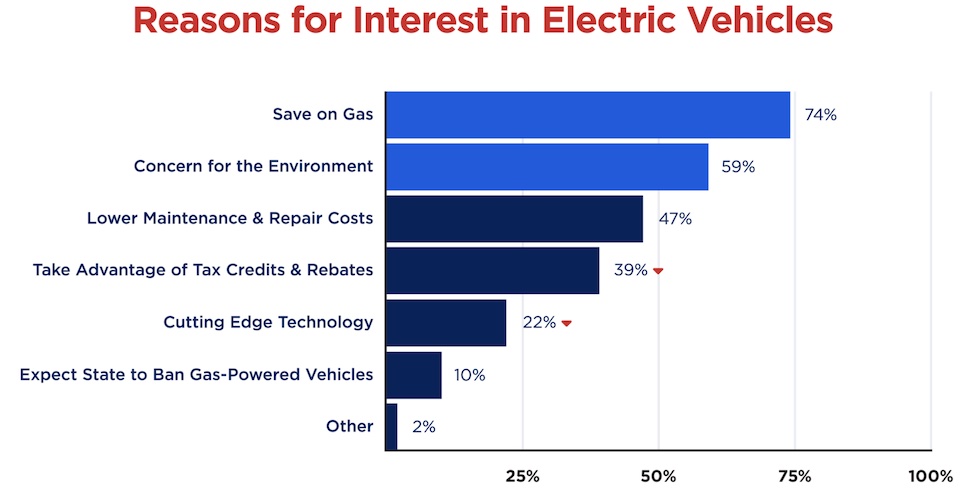
Reasons for interest
In 2022, gas prices reached $5, prompting many Americans to consider transitioning to electric vehicles (EVs) as a cost-effective option. In that year’s survey, 77% cited gas savings as their top motivation to purchase. Now, the national average for a gallon of regular ranges from $3.00 – $3.50, or even higher, depending on the state.
In this year’s survey, the primary reasons for buying EVs remain similar, with respondents citing gas savings, environmental concerns, and an appreciation for the lower maintenance costs associated with EVs. According to last year’s Your Driving Cost analysis, EVs had the lowest fuel cost of any vehicle type, based on a national average electricity price of 15.9 cents per kilowatt hour (kWh). EVs also had the lowest maintenance costs among all models.
Future of EVs
Despite advancements in the EV industry and the growing availability of models, public perception regarding the future of EVs remains uncertain. The percentage of U.S. drivers who believe that most cars will be electric within the next ten years has significantly declined from 40% in 2022 to 23% this year. Interest in EVs to take advantage of tax credits and rebates has decreased, dropping from 60% of those saying last year they are likely to buy an EV to 39% this year.
AAA’s recommendations
Many consumers may find hybrid or plug-in hybrid vehicles more appealing. These vehicles combine the advantages of traditional internal combustion engines with electric power, reducing range anxiety while providing an environmentally friendly alternative. This combination meets today’s diverse needs and preferences for drivers, allowing them to enjoy electric driving without losing the familiarity of conventional gas-powered vehicles.
Methodology
The survey was conducted March 6-10, 2025, using a probability-based panel designed to be representative of the U.S. household population overall. The panel provides sample coverage of approximately 97% of the U.S. household population. Most surveys were completed online; consumers without internet access were surveyed over the phone.
A total of 1,128 interviews were completed among U.S. adults, 18 years of age or older. The margin of error for the study overall is +/- 4% at the 95% confidence level. Smaller subgroups have larger error margins.
RELATED
- Would you consider buying an electric car or tow vehicle as your next car?
- Ford says e-pickups aren’t suited for towing; moves toward hybrid vehicles
- No Ford e-SUVs; company “pivots” to hybrids
- Lightship RV’s quarter-million all-electric RV offers innovation but lacks important features
- THOR unveils hybrid Class A motorhome with 500-mile range
RVT1215b


I’ve got no problem using electric propulsion – railroads have done it for decades. (there may be a few of us that don’t know that diesel locomotives are electric, the diesel motor just runs a generator). Yes, I would consider a hybrid tow vehicle – at least until they perfect a better way to supply electricity than batteries.
This is an excellent and informative article. Very good journalism indeed.
Look who’s running the country now…anything somehow “different” than burning fossil fuels is a no..no. Lobbyists have done their greedy job.
Yes! It’s miraculous what happens when Americans run the country. Slowly, the country will awaken from its slumber.
Thank you, RV Travel, for the survey results. DW wants no part of an EV. I have more interest. Meanwhile, have a great day and safe travels!
For city people an electric vehicle probably makes sense, but in rural northern environs not so much.
Amen! Couldn’t give me one. Too much pollution to produce and dispose-of, and way too much delicate whiz-bang electronic technology.
Wasn’t interested in the start up and surely not interested now. Like what was stated before it might work out for city dwellers. And as for trains diesel still being burned to produce electric still fossil fuel.
Once you drive a tesla or other EV you realize how much better they are. The torque and smoothness is incredible. Can’t wait until they get 500+ range and quick charging. Wait…it exists. Chinese manufacturers are already leaping the US to be the builders for the rest of the world and our manufacturers will decline. Build for the future
EVs have their place in fulfilling the market’s needs. It’s just not a big place yet. Every year improvements are incorporated. Distance between charges is lengthened and more charging stations, that do not depend on fossil fuels, are online. When EVs are truly able to stand toe-to-toe with fossil fuel vehicles, equals in utility, I will be interested.
As well as price
Too many environmental issues to mine, make and dispose of electric vehicles and their batteries, let alone enriching China. Internal combustion engine vehicles are American’s choice for the ease of fueling and driving long distances or driving in extreme heat or snow areas.
Hydrogen is the future. EV will be phased out and a lot of taxpayers $$$ will have been wasted.