

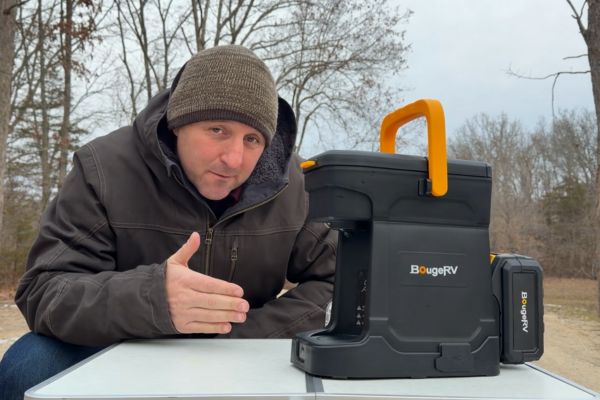
Camp coffee usually comes with a catch. A fast countertop pod machine needs a wall outlet. A propane stove boils water quickly, but then it turns into the whole pour-over routine.
In the video at the end of this post, the team from Adventure Gear TV set out to see if the BougeRV 18V Portable Coffee Maker offers a real third option: a cordless, off-grid single-serve brewer that avoids big power stations and propane tanks.
The “third path” idea: less gear, fewer compromises
The pitch is simple. Instead of bringing a 120V brewer and a heavy battery, or packing a stove and doing manual coffee steps, this unit tries to land in the middle. It runs on a dedicated 18V battery system and keeps the process to one button.
For people building a lean camp kit, the weight is part of the story. The setup comes in around 6 pounds total (about 3.6 pounds for the machine, plus 2.38 pounds for the battery). The trade is clear: It’s built for single servings, topping out around 8 ounces per brew. That is a sweet spot for someone who wants a simple morning cup and doesn’t want bulky gear.
Product links for reference:
Design details that matter in real camp use
This brewer is portable, but it is not a sealed travel bottle. With water in the reservoir, tipping it can spill water from multiple directions. The battery sits right next to that reservoir, so it rewards careful handling and upright storage.
It supports two basic brewing styles:
- Using a K-cup coffee pod
- Using a reusable basket for grounds (a bring-your-own coffee setup)
There is also a little learning curve with the cup adapter. The insert has to line up with the needle, and the tabs only allow it to seat one way. There’s also a small guide where the flip-up portion rests, so it takes a second to orient it correctly.
Power, charging, and what “off-grid” really looks like
With the battery installed, it’s ready to run. Press the power button, and it starts brewing. BougeRV claims about five to seven brews per full charge, which should cover a normal weekend unless someone is burning through cups all day.
It can also run plugged into a wall outlet like a normal machine, and it does not draw a huge amount of power. One key catch: When it’s plugged in with the battery attached, it does not recharge that battery. Charging requires removing the battery and plugging it into USB-C.
Brew speed, mug fit, and power draw numbers
On battery power, the brew is slow compared to a wall-outlet brewer, and slower than boiling water on propane. The video makes a point about why: Heating water takes similar energy either way; this unit just feeds that energy in more slowly.
Mug fit can also be a deal-breaker. Clearance under the brew head is about 5.12 inches, so taller travel mugs may not fit. The machine itself is about 10 inches tall, 5 inches wide, and 8 inches deep.
When run from an AC power station, the unit jumped to around 600 watts while brewing, and it seemed to brew faster. From a roughly 950-watt-hour power station, one brew used about 3 percent (around 30 watt-hours). The math lined up with the battery claim too: A roughly 144-watt-hour battery at five to seven brews lands around 20 to 30 watt-hours per cup.
Conclusion: Who it’s for, and who will hate it
This coffee maker makes the most sense for someone who wants simple, single-serve coffee at camp, a tailgate, or a kids’ soccer game, without packing a stove or dragging a big battery.
The downsides are real, though: It’s expensive for a coffee maker, it’s limited to about 8 ounces, it’s slow when on battery, and many favorite mugs (including taller porcelain-lined options) will not fit.
For the right person, the convenience is the point; for everyone else, the old methods will probably still win.
RELATED
- My new favorite gadget is the secret to the best coffee
- Best boondocking RV coffee makers—no hookups required
- Another French press with neat features: Stanley Boil + Brew coffee maker
- How to make Cowboy Coffee—The best campfire coffee
RVT1249

When we’re off the grid, it’s boil the water on the propane stove, then into the French press for two or more cups. Easier than a pour-over. Pour-over would be better for a single cup though.
That’s what my girlfriend does. Come on people, there’s beauty in simplicity. Convenience isn’t everything.
OMG! I have never thought our pour-over system was a hassle or a challenge. Certainly better than the percolator we used to use. Seems to us to be easier, and much less storage space, than a French press (we have collapsible rubber filter-holders). I guess we all have different levels of tolerance for doing simple tasks.
Makita has had a coffee maker very similar in looks to this one that runs on thier 18v battery system for several years now.
I use a pour-over whether I’m on or off the grid. The coffee goes into an insulated pitcher and that keeps it hot ALL DAY! I make 2, 3. or 4 cups in the morning and put it into a Contigo insulated mug. My coffee is always hot. And I only have to make it once a day.
My pour-over is a filter in a cone with coffee grounds. I usually only fill the mug (12oz) with half so when I’m ready for more, it’s very hot.