


Dear Dave,
Can you replace the water heater plug with a ball valve? I have a 1998 Jamboree. Are there ball valves available with the right screw threads that could replace the plastic plug? Any reason this might be a bad idea? —Judy, 1998 Jamboree
Dear Judy,
Since you indicated the water heater has a plastic drain plug, it should be an Atwood water heater that does not utilize an anode rod. The Suburban models have a magnesium anode rod that acts as a sacrificial probe for minerals in the hard water. The Atwood version has a different tank that does the same.
So, yes, you can replace the plastic plug with a ball valve, and I have seen this done several times. There are several adapters and reducers that can match threads with the water heater and the ball valve.
Installing a ball valve would make it convenient to drain the water heater without needing any tools, and you won’t lose the drain plug. Plus, sometimes the plastic plug gets really hot and literally melts the threads, making it tough to remove and sometimes even stripping the nut on the top.
Drawbacks to installing a ball valve
However, if you install a ball valve, it will limit the flow of draining water and you will also not be able to get a flush wand inside to flush out the sediment that collects on the bottom of the tank. Since the drain hole is not at the lowest point, it is important to get all the calcium and sediment out either when you drain it for winterizing, or before filling it up in the spring.
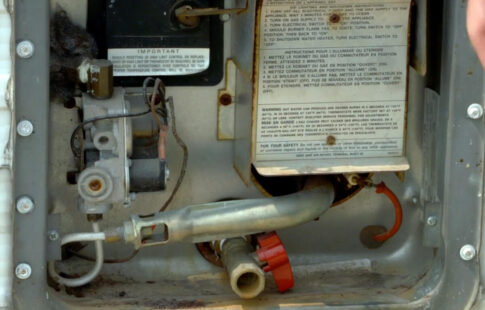
Here is a screen capture of one that was installed on the trailer we did videos on for RV Lifestyle & Repair. I’m not sure how the former owner installed it, as the handle hit the burner tube when we tried to remove it. We had to cut off the handle and remove the burner tube to get it out. We took it out, as this model was a Suburban and needed to have an anode rod and the former owner had swapped it out.
Follow-up to above
After sending the rough draft of my answer to Judy, she provided an update with some research she found:
After I sent the question, I did more research and there appears to be an issue with aluminum tanks and metal causing galvanic corrosion. They did mention using aluminum or bronze as soft metals. Plus, the valve may not allow all water to empty. I don’t think I’ll attempt this. Probably buy spare plug and tool to better handle the plug. —Judy
You might also enjoy these posts from Dave
- OK to leave RV water heater on when plugged into 120-volt power?
- No hot water pressure in back shower; cold is fine. Water heater too far away?
- Twelve Days of Christmas RV Tools—Third day: water heater flush wand
- Bad well water caused algae growth in RV water heater. Can’t get rid of it
- Will I ruin my water heater by running it with no water?
- Best way to clean and sanitize RV fresh water tank
- Your RV’s fresh water system: What you should know
- Where is RV fresh water tank’s low-point drain? I can’t find it
DAVE HAS ANSWERED MORE THAN 1,000 readers’ maintenance and repair questions. Read a directory here. There is so much to learn!
Dave Solberg is a leading expert in the RV industry and the author of the “RV Handbook.”
HAVE A QUESTION FOR DAVE?
Send your inquiries to him using the form below.
RVDT2906

After Dometic acquired Atwood, the water heater outlet was changed from a plug to a cap (still plastic). I am guessing this is to prevent people from using an anode rod. I did discover that I could thread on a PVC female threaded adapter. I built a 90 pipe to flush the tank with vinegar after some poor well water. But adding a ball valve would be no problem.
As stated you cannot mechanically flush the tank with a wand with any type of addition to the port.
For the few times I remove my anode rod to drain the tank, it is not a big deal. Should be about the same for the plastic plug.
One problem with using a valve is you may be tempted to drain the water while it is still hot.
The one time I wanted to drain the heater while the water was hot, I turned off the heater and opened a HW faucet til the water ran cold.
The water is between 130 and 140º. It will cause first degree burns.
My heater had a 1/4″ pipe plug in it. I put a brass car radiator draincock in it.
I did use a valve on my wh but when I empty it I always use the air compressor until I get it dry. Had no problem for last 5 years.