


I forgive you for thinking that 50–30 = 20, since that’s what we were all taught in elementary arithmetic. But when it comes to RV electric hookups, there’s a big difference between 30-amp (30A) and 50-amp (50A) power. Did you know a 50A hookup supplies more than three times as much power as a 30A hookup?
Know your plugs: Straight vs. twist-lock RV outlets
There are four common plugs/receptacles used for RV hookups: two for 30A, and two for 50A. Each amperage has a “straight” and a “twist-lock” version. Oftentimes, you’ll find twist-lock plugs on the RV itself and straight receptacles on the campground power pedestal. (A plug, by the way, has prongs; a receptacle has slots).
The straight 30A receptacle is a NEMA TT-30, which looks like this:

The twist-lock 30A plug is a NEMA L5-30, which looks like this:
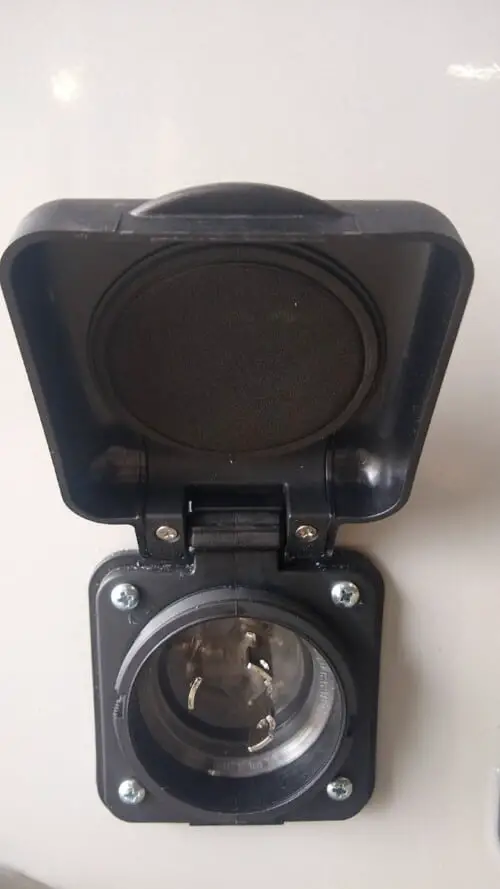
The straight 50A receptacle is a NEMA 14-50, which looks like this:

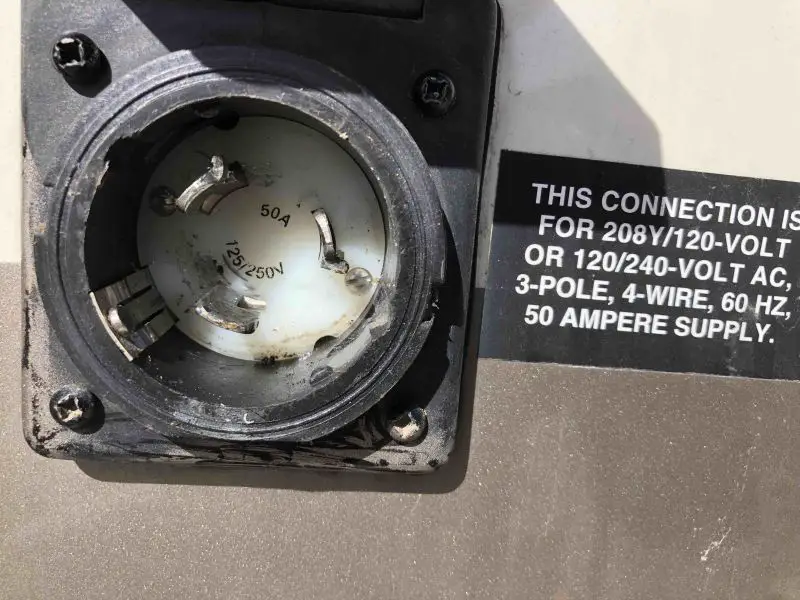
The twist-lock 50A plug is a NEMA SS2-50, which looks like this: (Don’t be fooled; that silver tab on the side counts as a “prong,” too.)
You can purchase adapters between straight and twist-lock outlets and vice versa. You can also purchase adapters between the 30A and 50A versions; but as you’ll see below, don’t expect to be doing the same kind of camping!
There are many other 30A and 50A outlets, such as a home dryer outlet, but most of these are NOT safe for your RV! Most other 30A and 50A outlets supply 240V, not 120V, and this voltage will fry your RV electrical system!
Here’s why a 50A RV hookup has 3x more power
With a 30A connection, your RV receives 120V across the Hot and Neutral wires in the receptacle. With a little help from Ohm’s law, 30A x 120V = 3,600 watts.
Watts measure power, so at any one time, your 30A RV is capable of consuming up to 3,600 watts (as long as the campground doesn’t have low voltage).
Now, with a 50A connection, you get four prongs, as you can see. That’s the critical difference. This is called a “240/120V split-phase” connection. If you’re clever about the wiring, you can actually get 50 amps at 120V twice, once between Leg 1 and the Neutral, and another time between Leg 2 and the Neutral.
With a little help from Ohm’s law, 50A x 120V x 2 = 12,000 watts.
RV 30A vs. 50A power: Why a 50A hookup always wins!
To summarize RV 30A vs. 50A power:
- RV 30A power supply can provide 3,600 watts
- RV 50A power supply can supply 12,000 watts
Wow! That’s 3.33x the power! This is why 30A RVs typically only have five AC branch circuits and a 50A RV commonly has up to 12. Whereas a 30A RV can’t run more than a single air conditioner and a microwave simultaneously, a 50A RV has no problem running two, even three air conditioners simultaneously!
One of the big takeaways is that if you run your 50A Class A motorcoach off a 30A hookup with an adapter, be prepared to make some compromises.
RELATED
- Plug your RV into a generator? Watch out for this!
- Burned by the plug: A wake-up call on shore power safety
- Plugging your RV into a range outlet: Good idea or recipe for disaster?
- RVelectricity: Always unplug your RV while working on wiring
- Plugged RV’s 30-amp shoreline cord into 50-amp outlet; now RV won’t run
RVDT2807
Thank you for the basic electricity lesson, Andrew! Have a great day, grand 2026, and safe travels!
As with many things- there are exceptions. Winnebago wires their 30a. rv’s so that you can run both a/c’s at the same time.
You are failing to address the REAL problem in power use; Continuous vs interminttent demand. Your examination is superficial and inadequate to the problem. THERE IS MORE. A system rating includes devices and wiring. A ’30A’ system CAN carry 30A but ONLY for no more than 3 hours of 24. The 30A system is only designed to carry 80% of the rated capacity ‘continuously’, (24A for a 30A system) defined for more than 3 hours in 24. The remaining 20% capacity can be ‘intermittent’, defined as less than 3 hours in 24. These intervals allow heat generated by a full capacity load to be dissipated. These limitations must be understood and complied by the user. This is why RV’s have frequent overheating
The full, correct NEMA identification of the plugs and receptacles includes an ‘R’ for receptacles and a ‘P’ for plugs at the end of ID number. A 30A travel trailer plug is ‘TT30P’. Similarly, a mating receptacle is ‘TT30R’. The NEWMA IDs, voltage and amperage ratings are molded into the connector face since many connectors appear similar.
When identifying load types, A/C units are ALLWAYS considered a ‘continuous’ duty load. Microwave’s are considered ‘intermittent’ loads. When determining if both can run simultaneously on a 30A shore connection, two things must be true. 1) the continuous load must not exceed 80% of the branch circuit’s capacity (24A – its continuous duty rating) AND 2) the additional intermittent load added to the continuous load, must not exceed the full capacity (30A).
Similarly, with 2 A/C’s, both being continuous loads, their combined load cannot exceed 24A, which they invariably do. If a user attempts it and ‘succeeds’, they will likely only do so for a short while because the circuit will overheat.