


Dear Dave,
We just had an electrician wire an RV plug at our daughter’s garage. He pigtailed off an existing 30-amp outlet. (He knew not to use 220v.) However, he did use a 50-amp receptacle because that’s what our plug is. Our surge protector shows correct wiring. The problem is the outlets won’t work unless I turn on the inverter. They will work on generator power. Is this because of the 50-amp receptacle on a 30-amp line? GFCI breakers also won’t reset when plugged in but will on generator. Thanks. —Dan, 2012 Winnebago Sightseer 33C
Dear Dan,
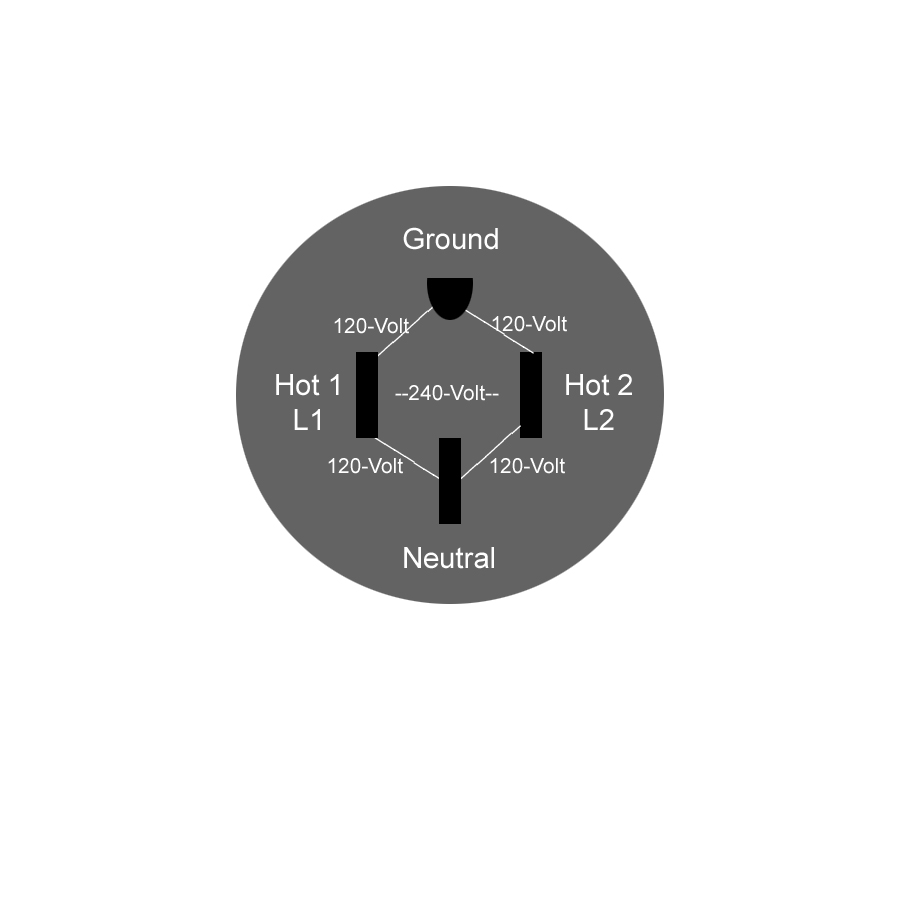
According to the information on the Winnebago website, your Sightseer came with a 50-amp distribution center; therefore, it would have a 50-amp shoreline cord. The diagram below shows how a 50-amp outlet should be wired. Typically, there would be two power or “hot” wires, one on each side as illustrated, and the ground and neutral. When you plug your shoreline cord into this receptacle, the Hot 1 wire provides 120 volts/50 amps to one side of the distribution center, and Hot 2 provides 120 volt/50 amps to the other side. This way the designers can split the air conditioners to prevent overloading.
It is a little hard to see, however, the two-pole breaker in this 50-amp distribution center has two 50-amp circuit breakers in the center, one for each side of the buss bar.

A 30-amp receptacle only has one power or Hot line that provides 120-volt/30-amp power.

If your electrician installed a traditional NEMA 14-50R receptacle using a 30-amp line, it would only have one power line coming in even though there are two slots. My concern is how he “pigtailed” off an existing outlet and what that outlet is ganged to or also powering in the garage. It would have been better, in my opinion, to just use the existing 30-amp outlet if it was a TT30 and use a 50-30 adapter for your rig.
Check with a multimeter
I would take a multimeter and verify 120-volt power at one of the “hot” slots and nothing at the other. This would explain why you have no power at the outlets as they would be on the “no power” side. GFCI outlets will not reset if there is no power.
When you turn the inverter on, it draws 12-volt power from the house batteries and provides 120-volt power to those outlets. When you turn on the generator, it also provides a Hot 1 and Hot 2 to the distribution center through the automatic transfer switch (ATS), which always switches to the generator power when present.
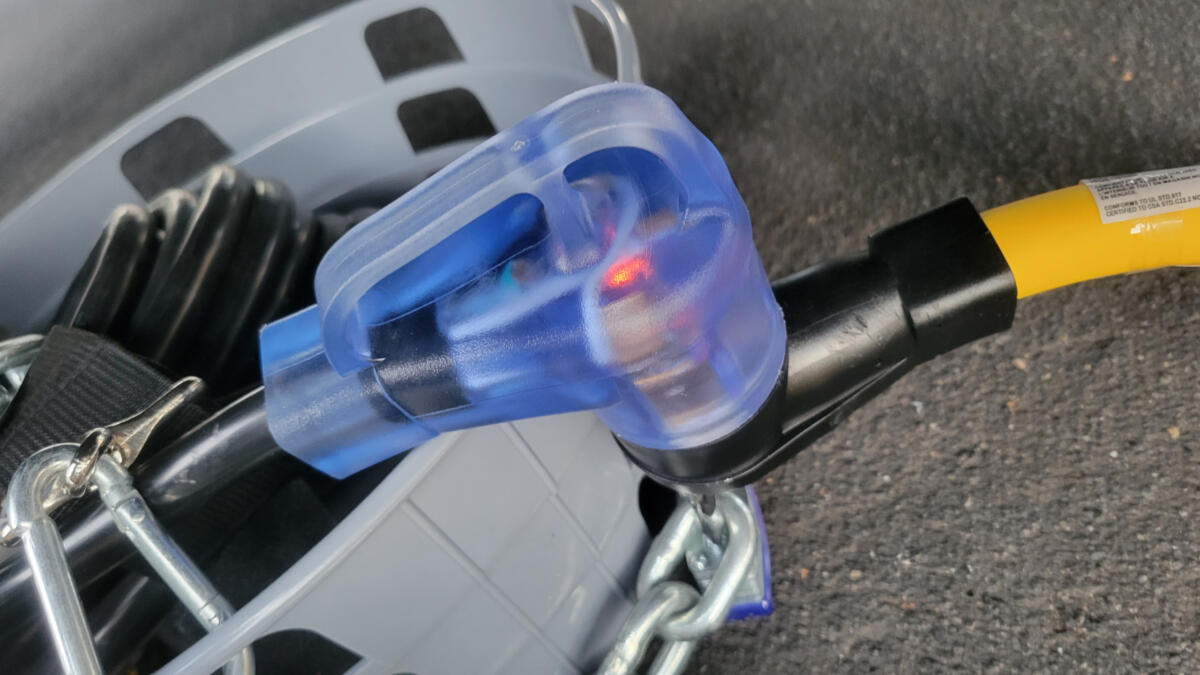
If you have a 30-amp receptacle and use a properly wired 50-30 adapter, it has a “jumper” wire that provides 120-volt/30-amp power to both sides of the distribution center. This photo shows the white jumper wire going to the other pin. This does not provide two “hot” lines, just a total of 120 volts/30 amps to the entire distribution center, so you would have to manage what you ran to stay under 30 amps.
I posted an article about this previously here.
I would recommend replacing the 50-amp receptacle with a TT30 and using a 50-30-amp adapter like the one available on Amazon here.
You might also enjoy this from Dave
RV plugged into garage outlet. What can, and can’t, I run?
Dear Dave,
I’m going to park my RV and hook it up to a garage outlet. I want to run my two rooftop A/C units, my 4-door refrigerator and my RV’s indoor lights. Is this enough amps to do this? —Ben, 2003 Monaco Knight, 34 feet
Dave Solberg is a leading expert in the RV industry and the author of the “RV Handbook.”
Read more from Dave here.
HAVE A QUESTION FOR DAVE?
Send your inquiries to him using the form below.
##RVDTxxxx

I am under the impression that the electrical code does not allow installing an outlet with a higher amperage rating than the circuit. If this is correct, the electrician who wired a 50 amp outlet to a 30 amp circuit did not comply with the code. Perhaps Mr. Sokul could clarify.
In most jurisdictions, a 50 amp receptacle wired to a 30 amp circuit is a electrical code violation because plugging a 50 amp appliance into a 30 amp circuit can more easily overload it and burn the house down if the circuit breaker fails to trip. And a 50 amp RV typically will measure 240 V between both hot slots or possibly measure zero volts if both hot slots are the same phase. I suggest using a licensed electrician to correct the situation.
If the electrician pulled power piggy back from a 30 amp source 230 volt. He does not have a neutral. 120 won’t work. Also some electronics will smoke. I experienced this with my new tailgator dish.
Neutral and ground not bonded in RV.
Solution- Get and pay a “certified, trained and experienced RV electrician”. I am a registered, licensed and insured Master Plumber, but it’s only plumbing- anybody can do it. Seems like the same thinking has spread to the electrical world. It’s only electricity- anybody can do it.
Do NOT hire that electrician to do anything. He is NOT qualified to be an electrician. Obviously, he HOT wired only to one side of the two sided 50 amp receptacle. Remember the saying, “You can’t fix STUPID”.
No, you can’t fix stupid, but duct tape will muffle the sound.
Thank you, Dave! 🙂
If the electrician miswired the outlet, it _could_ be wired exactly like a 50-30A adapter, with the same 120V circuit on both sides. But this: 1) takes someone competent and 2) as mentioned by others, probably isn’t to the National Electrical Code. Given that your insurance company and your municipality are really adamant about the NEC being followed, installing a properly-wired 30A RV socket and plugging in a 50-30A adapter is the code-compliant way to do it.
If you want to use more than 30A, you will need to do a service, panel, and wiring upgrade costing $10K or more. But you need that anyway, to charge that electric car 🙂