


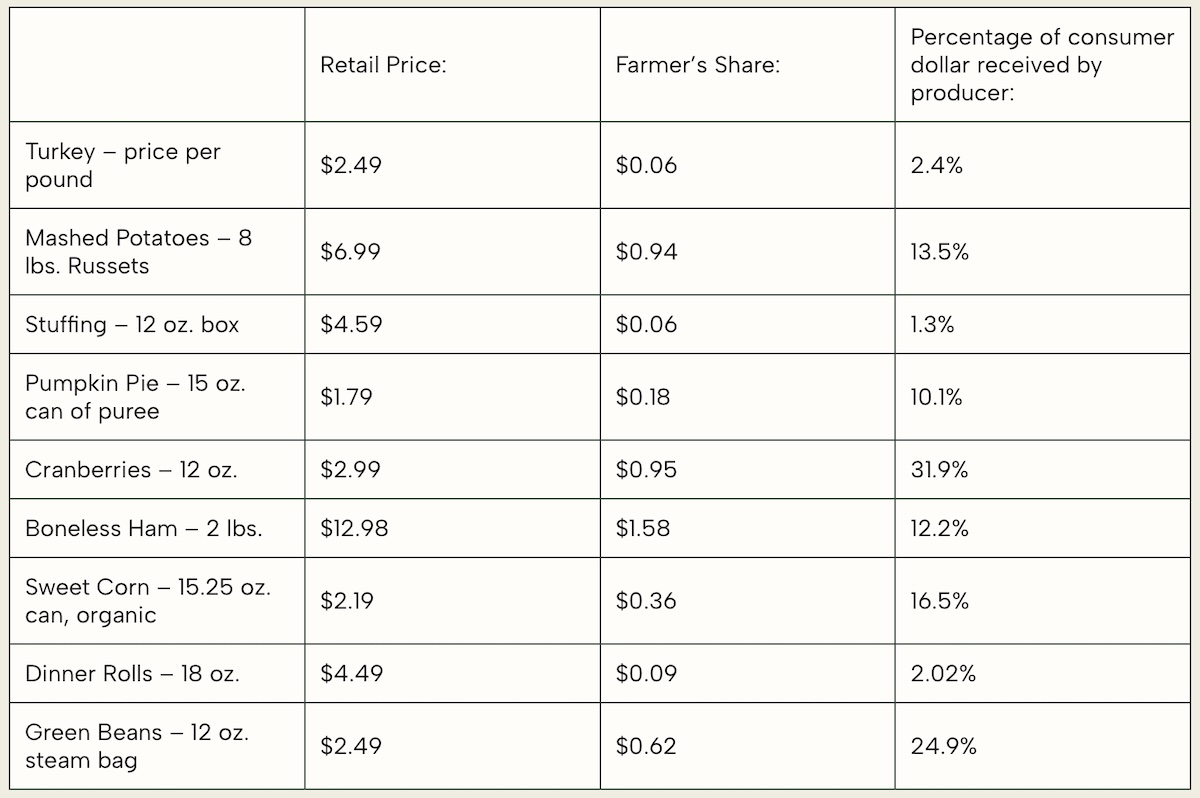
As you sit at your Thanksgiving table today and enjoy your turkey, consider how much the farmer who raised that bird earned for his efforts. It’s hard to believe, but on a turkey that sells for $2.49 a pound, the farmer makes a puny six cents per pound. You may wonder why these farmers even bother.
This week, the National Farmers Union (NFU) released its annual Thanksgiving Edition of the “Farmer’s Share of the Food Dollar” report. It reveals stark inequities in America’s food system. Farmers continue to receive only pennies on the dollar for foods typically consumed for Thanksgiving dinner despite high grocery prices.
According to the news release that announced the report findings, farmers earn small returns on staple Thanksgiving foods, not just the turkey. It noted that monopolies now dominate everything from food processing and distribution to the markets for seeds and farm equipment, leaving family farmers at a steep disadvantage while consumers face fewer choices and higher prices.
“Even in a season of gratitude, we must acknowledge the continuous inequality in our food system and agriculture industry,” said NFU President Rob Larew. “Family farmers and ranchers work year-round for historically low profits across all sectors of the industry, while consumers are still paying unsustainably high prices at grocery stores. Fairness for farmers is also fairness for consumers — when rural America does well, we all benefit.”
“Every Thanksgiving, the numbers tell the same story: farmers aren’t asking for a bigger slice of pie, just a fair one,” Larew said.
Data for the report came from the U.S. Department of Agriculture’s National Agricultural Statistics Service and other industry sources. Retail prices were based on the Safeway brand in the Washington, D.C., area.
SOURCE: NFU press release
RELATED
- The amazing, belching turkey I once met
- RV-turned-chicken-coop fire sparks holiday warning on turkey frying safety
- When it comes to cooking Thanksgiving turkey, don’t do this… or this… or this…
- How to cook Thanksgiving turkey in an RV oven
- RV Thanksgiving: How to cook a whole turkey over a campfire
RVDT2784


Although on a percentage basis, per turkey, it’s quite small, but the economy of scale plays a big part in farmers making a profit. The same could be said of many, many other products grown or manufactured.
Corporate greed.
Having raised poultry as a hobby years ago. I don’t believe farmers only make $0.06 a lb on a turkey.
I raised 500,000 broilers/year for Frank Perdue for 15 years. I bet that number might be pretty accurate.
That’s why I try to buy from local farmers not much difference in price but money goes to farmers not corporations.
As a 5th geneation former farmer I can testify to the low prices we receive. After 25 years, DW & I reached the conclusion that it could no longer work. It was a great lifestyle but a poor livelihood. How many other businesses can survive if they buy inputs at retail and sell their wares wholesale? Also, rather than setting our own price for our products, we have to take what the purchasers offer.
A farmer isn’t handing a processed, frozen, packaged, and delivered turkey to a retail grocer. As a teenager, I worked in a turkey processing facility. Crews take semis to the farms, sometimes 100+ miles from the farm and hand capture and load the birds. The birds are delivered alive, so an unloading crew takes birds, one by one, and hangs them on schackles to go into the plant to be killed and processed. Very strict gov’t processing controls are in place and frequently gov’t inspected. A certain % of the birds cannot be sold whole due to “defects”. Net, a huge investment/cost just to process. Wholesalers, retailers, temp controls, food safety: it all costs and all adds $.
How about the farmer that grew the grain that fed the turkey? I bet that’s a tinier % of the final price, but that doesn’t mean they aren’t making money. And no one beyond the farmer is getting gov’t farm subsidies to help.
A real analysis would be total required input costs of each step to each step’s selling price to see where the % markups are going. % revenue of each phase leading to final selling price means little.
Good point Mikal: My granddaughter bought a 14 lb bird this past Fri. at a local supermarket, with all it’s parts @ $.69/lb. (Typical annual price – except the 4 yrs. prior). I suspect that is the going price for other than the Tv advertised brand(s). They seem to be in $1.89 to $2.49 range – except yesterday when they dropped too!
Farmer should charge a suitable price to make margin.
If the market is not there, find another income source.
No different than any other business.
Hard facts of life. But facts anyway.
When people get hungry enough, people will pay the price.
BTW – Many farms are a corporate entity…Guess it’s “”corporate greed”” on their part?
BTDT…No “T” shirt..
Farmers do not set a price for their goods. They sell at what the Commodities Market offers, no matter the cost of production.
Let’s first acknowledge the NFUs built in bias. Advocacy groups selectively use data in misleading ways all the time to bolster their claims. So, to just take this report at face value is pretty naive and not scientific in any way. But, the bigger question is why is this being covered here? Seriously, this has zero to do with RVing. Please, please, please just cover what your website title would lead everyone to believe you’re all about.
Hi Larry: It is an item of general interest and it is a holiday article related to this day! Many Rver’s are preparing birds in their Rv’s as well – so it is relatively applicable to the season and Rver’s.