

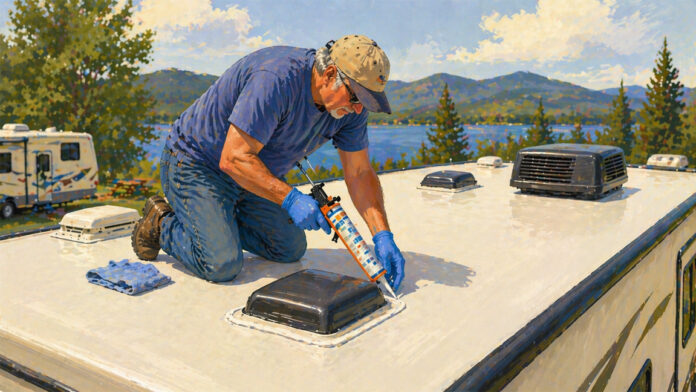
If you’ve owned an RV for any length of time, you already know the drill: Climb up the ladder, check the seams, touch up the sealant, and hope you caught things before water did. Roof maintenance isn’t glamorous, but it’s one of the most important—and most dreaded—parts of RV ownership.
Now, Grand Design RV says it has a better idea. The company is expanding what it calls a “worry-free” roof system to more of its lineup, including Momentum toy haulers. The pitch is simple: fewer seams, less sealant, and less routine upkeep.
That’s the promise. The real question is whether it actually changes anything for RVers.
What Grand Design is trying to fix
Traditional RV roofs haven’t changed much in decades. Whether you’re dealing with rubber (EPDM or TPO) or fiberglass, the construction usually involves multiple layers and, more importantly, a lot of seams and sealant.
Those seams are the weak point. They show up around vents, skylights, edges, and caps—anywhere the roof is interrupted. Over time, sealant dries out, cracks, or pulls away. Water finds its way in, often long before you see any sign inside.
That’s why routine inspections and resealing are simply part of the lifestyle.
RV roofs have always needed babysitting—this one is trying to change that.
So what’s different here?
Grand Design’s “worry-free” approach doesn’t reinvent the idea of a roof, but it does change the way it’s built.
Instead of a multi-piece surface with lots of joints, the company is using a single-piece, seamless composite roof—closer to what you’d see in marine construction. The idea is straightforward: Remove the seams, and you remove the most common failure points.
They’re also moving away from traditional lap sealant along the roof edges, replacing it with automotive-style gaskets. That’s a meaningful shift. In theory, it reduces the number of places where sealant can fail over time.
The roof itself uses layered composite materials designed to resist impact and flex without cracking, another nod to how boats are built rather than how most RVs are assembled.
Does this eliminate maintenance?
No—and this is where it’s worth slowing down.
Even with a seamless roof, you still have penetrations: air conditioners, vents, antennas, skylights. Every one of those openings still needs to be sealed and checked over time, and any one of them can become a failure point if something goes wrong.
What this system may do is reduce the number of vulnerable areas, especially along seams and edges, which have historically been the biggest trouble spots.
In other words, this isn’t “set it and forget it.” But it could mean less frequent attention and fewer long-term surprises.
Why this matters beyond one brand
RV roofs have been a pain point for years, and manufacturers know it. Water intrusion leads to warranty claims, unhappy owners, and expensive repairs.
If a company can genuinely reduce those issues, it’s a big deal—not just for buyers, but for the builders themselves.
So, if this system holds up in real-world use, don’t be surprised if other manufacturers start experimenting with similar approaches.
There are some tradeoffs, though. Systems like this can cost more to build, require changes on the factory floor, and may be more complicated to repair if they’re damaged. That combination could slow adoption, especially in lower-cost rigs.
What it means for RVers shopping today
If you’re in the market, this kind of roof is worth a closer look, but it pays to ask a few practical questions.
What’s actually covered under warranty? How are roof penetrations handled and sealed? And if something does go wrong, can the roof be repaired easily, or are you looking at a more involved fix?
Those answers will matter more than the marketing label. Because at the end of the day, “worry-free” is a goal—not a guarantee.
The bottom line
Grand Design isn’t inventing a brand-new concept, but it is bringing a seam-reducing approach into more mainstream RV production.
For RVers, the takeaway is simple: This could mean fewer leaks and less maintenance—but not the end of roof care altogether.
If it performs the way it’s advertised, it may push the rest of the industry to rethink how RV roofs are built. And that’s something just about every RV owner can get behind.
If it holds up in the real world, other RV builders may not have much choice but to follow.
Sources:
RVBusiness: Grand Design expands “worry-free” roofs to Momentum
Grand Design RV (official release): Seamless composite roof details
RELATED
- What should I look for when inspecting my RV roof?
- Look out for sagging slide-out roofs!
- Navigating RV roof replacement through insurance
- FlexArmor roofs—RV expert’s concerns
- Time to reseal your RV roof seams? Here are caulking tips
- A step-by-step guide to applying self-leveling sealant on your RV’s roof
RVT1258b


I have faulted Grand Design many times for sub-standard components but there seems to be a meaningful shift in the company’s decision making. This is one of several examples they’ve shown off lately.
We have had a large traditional TT parked in Texas Hill Country for 9 years, more or less as a park model. We have loved our winters, but the SW sun is tough on traditional RVs, roof seams particularly and I typically spend around 40 hours of our winter doing maintenance. As I arrived at 70 years old, ladder work has become less advisable. As a result, we are selling our TT and just installed a RV Tiny Home on our long-term site (this park allows a limited number – limited because most have 100A rather than 50A service). No more and maybe less room due to 2×4 wall construction, but far less, and effectively no roof, maintenance.
Inspecting and resealing a roof isn’t hard or expensive. Replacing sun-baked gaskets??? Would love to actually lay my eyes on their system to see what all it entails.
The links provided at the end of Russ and Tina DeMaris’s informative article provide a good visual on what this novel and innovative design looks like
When you think about it, the “typical RV roof” seems primitive considering the year is 2026
We got away with it so long because a lot of roofs are “outta sight, outta mind” until something bad happens
Thank you, Russ and Tina! Well, it is innovation and hopefully not one that leads to a dead-end. Less work usually beats more work, so, on the surface, this sounds promising. Potential downside is that roofs with more seams might take a complete tube of caulk while this one only takes part of one. I routinely fail in attempts to “save” a partial tube of caulk for later uses. Guess, my RV education is even more incomplete than I imagined before reading this. Have a great weekend and safe travels!
I guess I have to ask why Grand Design is getting this praise, when my 2022 Jayco has a one piece fiberglass roof sheet. There is one seam at the front, one at the rear, and one down each side (not on top). The fiberglass sheet is continued down the side of the RV by a few inches which puts the seams on the side of the RV instead of right on top or at the edge. Am I missing something? Is this the same concept the GD is now using? I purchased my Jayco in August of 2021, and there have been no leaks, soft spots, or any water intrusion, and the only maintenance I have performed is cleaning and checking the seams that are there.
Okay, I read this twice. Even after battling all the pop up advertising, it ended up being an article about nothing new. It sounds like Grand Design may be working on something, but what? Was this all AI or just mostly?