

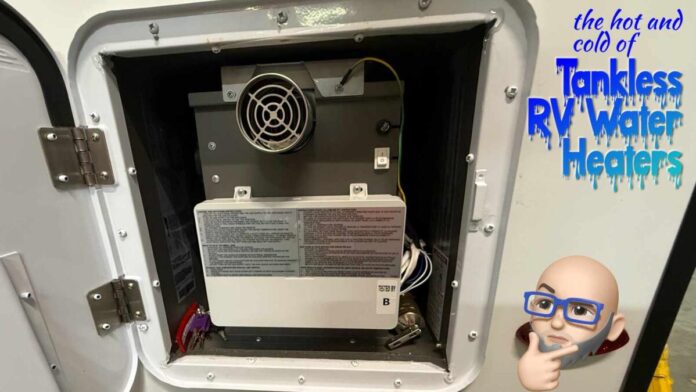
Why are you seeing tankless water heaters suddenly being included in so many RVs? A few years ago, these were luxury items, and now they’re everywhere. Is the RV industry becoming more generous with what they’re offering? Have you stopped laughing at that question yet?
The simple imported tankless water heaters are much less expensive than the traditional gas-electric tank-type water heaters. They are almost universally gas-fired appliances only, so the RV companies don’t have to run 120VAC power to the water heater if they have a tankless model. With copper being so expensive, this is another savings.
So what’s the appeal of tankless water heaters?
The idea behind these is that the water heater isn’t heating the water until you call for hot water. Another benefit is that, as long as you have water and propane, you have hot water. That sounds incredible—endless hot water—and they actually deliver on that.
Another big reason you’re seeing these more and more in RVs is that they’re inexpensive relative to the six-gallon tank-type water heater. There’s no doubt that, in bulk, these things are far less expensive than the traditional gas and electric tank-type water heater. Also, the RV companies share that you can have endless hot water with one, which is mostly true.
I am guessing that a lot of RVers are used to the large 40-plus-gallon water heaters in their homes and quickly run out of hot water in their RVs. Or, some RVers have multiple family members who camp with them, and six gallons just doesn’t cut it when there are multiple showers wanted.
Funny thing, when we replaced the water heater in our home, the plumber only stocked 40-gallon or more water heaters, and ordering something smaller was actually more expensive than just going with a 40-gallon water heater. Oh, well. Seems like a big waste of propane to me.
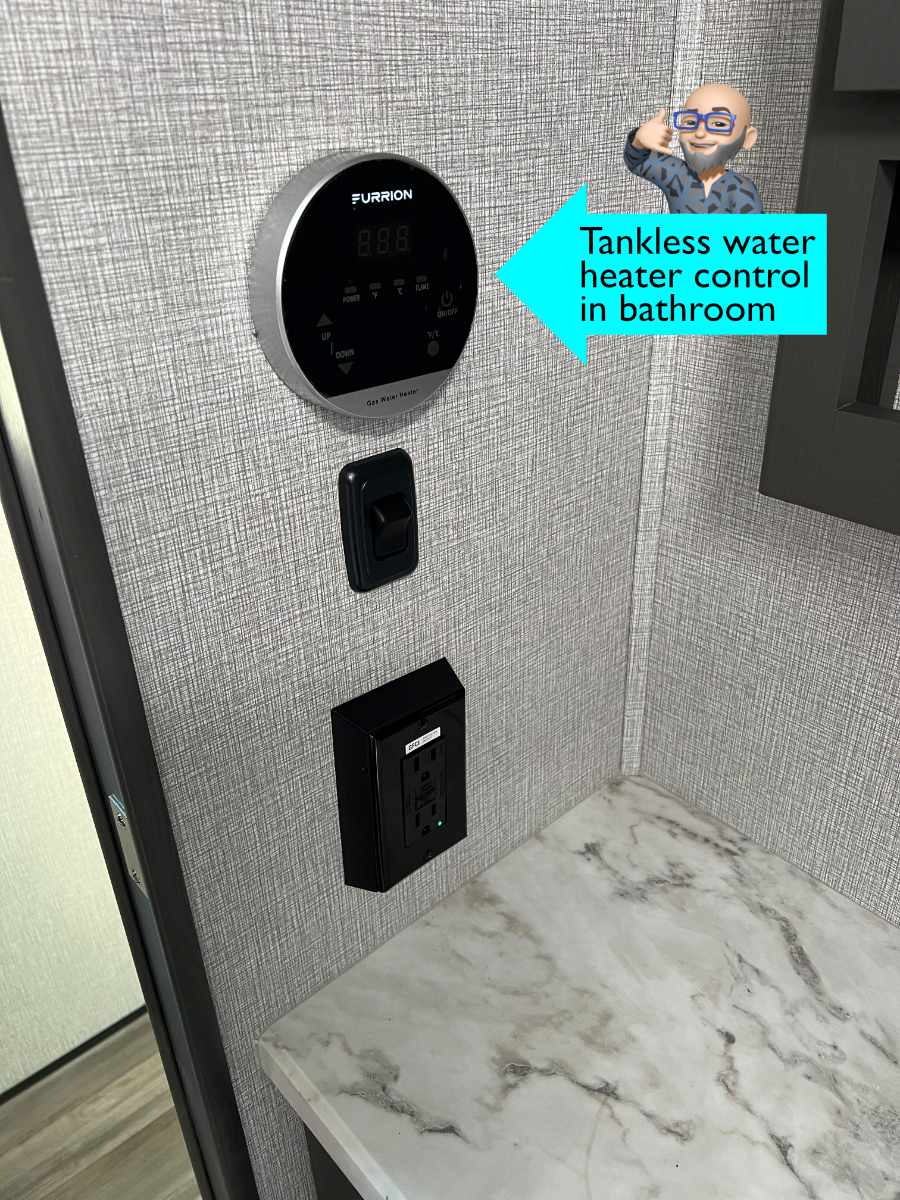
One of the best features of tankless water heaters is that there is typically a control panel that enables you to set the temperature that the water heater is intended to deliver. While traditional gas-electric water heaters basically deliver to 140°F, you can set most tankless water heaters to deliver water at a temperature that is much more comfortable.
 Hot water 101
A regular old tank-type water heater has a system that measures the water temperature inside the tank and turns on the heating system when it sees that water is below a specified temperature. In most cases, the temperature inside the tank is set to about 140°F, which is really hot. You wouldn’t want to only run the hot tap at that temperature.
And that’s a huge disadvantage if you have very young campers who may turn on a hot faucet and actually injure themselves with 140° water. This can make the hot tap actually dangerous, and I remember warning people about this when I was selling RVs.
The whole idea with that high of a temperature is that you’re intended to mix in cold water, which makes the hot water last longer. You wouldn’t take a 140° shower, so if you mix in about half cold water, then that hot water will go further.
These tank-type heaters also recover relatively quickly because they only have to heat six gallons of water, although some RVs have ten- and even 12-gallon tank-type water heaters.
How a tankless water heater works
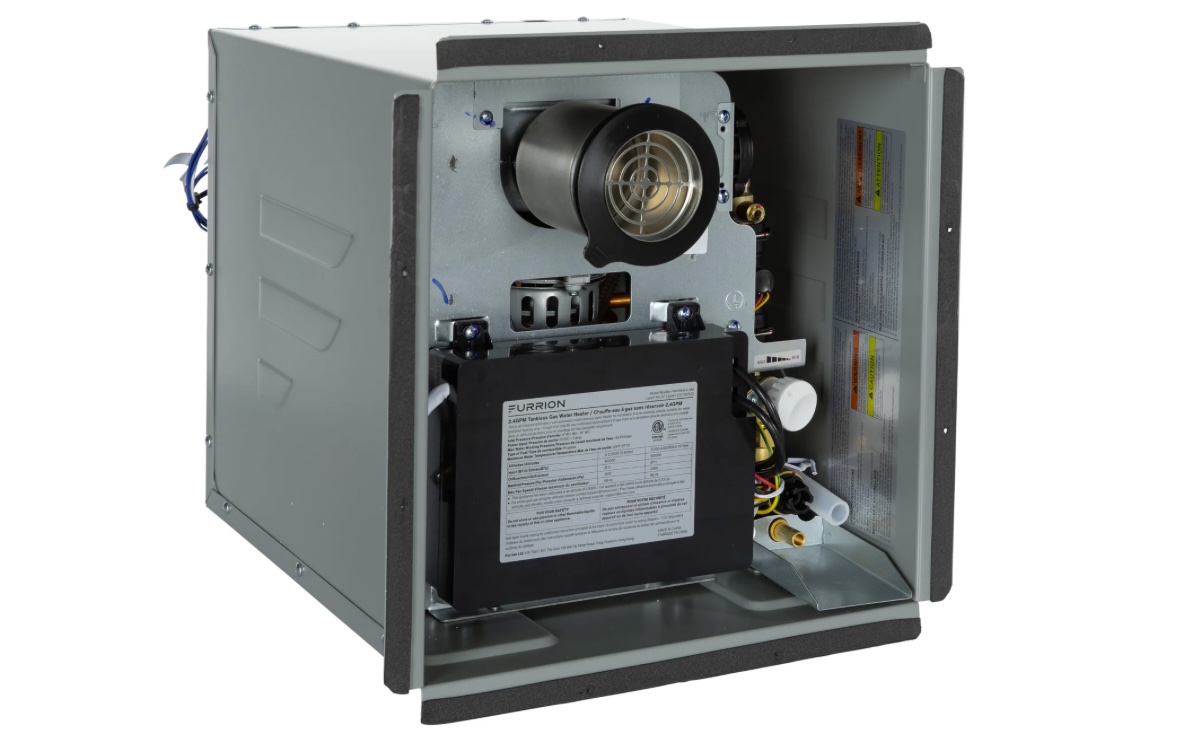
A tankless heater has a built-in flow meter that lets the water heater know that hot water is being demanded. When you open a hot tap, let’s say at the kitchen sink, the water heater sees that demand and fires up the propane burner to heat the water as it’s coming through.
Heating water this quickly takes quite a bit of energy, so while it’s actually functioning to heat the water, it’s going through a fair amount of propane. But the idea is that it’s only using said propane when it’s heating the water, which isn’t all that frequent in the grander scheme of things.
For example, a tankless water heater can easily consume the propane needed to generate a rating of 60,000 BTU. A typical propane/electric water heater is only rated for 10,000 BTU.
This is why you won’t likely see an electric tankless water heater in an RV any time soon. It takes a lot of energy to change water temperature on demand—typically more than even a 50-amp connection can deliver. A typical bottle of propane has about 431,800 BTUs of energy in it. That’s also very roughly the equivalent of 1,000 100-amp-hour batteries. Liquid propane is very energy-dense.
Thinking about that flow meter, it also has to see enough demand that it recognizes that you’re after some hot water, so that it kicks on the propane burner to accommodate your wishes. That brings us to the next section: tips.
Tankless water heater tips
If you have a traditional water heater in your RV or one at home, the common practice is to mix some cold water with the hot to achieve the desired temperature. Makes sense, right? It’s what we’ve been doing for a long time.
But tankless water heaters are different. One of the many advantages of these is that you can set the temperature that the water heater delivers. Since a tankless water heater needs a certain amount of demand and can deliver water at the temperature you want, the idea is that you set the temperature of the water to what you want to use without ever touching the cold tap.
Another thing to note is that, like so many things in the RV space, there are vast differences in the quality from one brand to the next. One of the best tankless water heaters is the Truma AquaGo, but there are plenty of import-sourced water heaters showing up in RVs that are of lesser quality.
One of the things the Truma has is a small tank of hot water, so you’re not waiting for the water heater to cycle on. That is especially annoying if you’re just using hot water in short bursts, such as when washing your hands.
And, as with so many things, if there is demand, someone out there is going to start making better tankless solutions, which is happening already. I’ve often said that the RV industry is very open to making changes to make customers happy, so shop around—there are choices.
Downsides of tankless water heaters
Like anything that’s cheaper, it may seem like a great idea at first, and will work out for some RVers. But you may also find that the lower cost means a less outstanding experience.
One of the bigger drawbacks of tankless water heaters is that they only operate on propane, and they draw a lot of propane when operating. But if you’re at a seasonal site with electrical power, you’re not using that power to heat water, so you’ll have to have propane available.
That also means that, when the temperatures drop, your RV is also going to demand propane for the furnace, another high-draw appliance, and possibly a stove, as well. The combination of appliances looking to draw propane at a time when less is available due to colder temperatures can mean the appliances just shut down. You can absolutely overdraw your propane system.
Some tankless water heaters don’t work at higher elevations
Also know that anything with an ignition system uses a balance of fuel and oxygen to achieve a flame. The higher you go in elevation, such as up into the mountains, the less available oxygen you have in the atmosphere. So, some tankless water heaters simply don’t work at elevations of 4,500′ or greater. Propane water heaters can be troublesome here in Albuquerque, where I call home, since we’re at 5,300 feet of elevation.
Yep, you could say I’ve got my head in the clouds, and the air is thin up here, which may explain some of what I write about… Lack of oxygen to the brain.
Yes, you can re-jet them to operate at that elevation. But if you’re only visiting, this is a lot of work when a simple propane/electric water heater would have operated just fine on electric power.
Oh, and speaking of simple. A tankless water heater has a bunch of components in it that are more complicated, including that aforementioned flow-measuring system. The more complicated things are, the more there is to go wrong.
Tankless water heaters are also not so great with short bursts of demand, such as Navy showers or hand washing or even dish washing. They have to cycle up every time you turn on the hot tap and then cycle back off.
This also means that you’re likely using more water to just get the darned water heater to cooperate. So, tankless water heaters are less than ideal if you enjoy boondocking.
What can you do
There are still RV companies using tank-style water heaters, although there are fewer doing so just because of the cost. If your RV did not come with a tank-style water heater, it’s not that simple to replace the water heater because you’ll need to run a 120VAC line to the water heater to operate the electric side.
But you can also let your voice be heard. If you did buy an RV with a tankless water heater and you don’t like it, let the RV manufacturer know. But, if you do like it, also let them know. The RV industry is very responsive to well-voiced customer feedback, so they may change if customers demand that change.
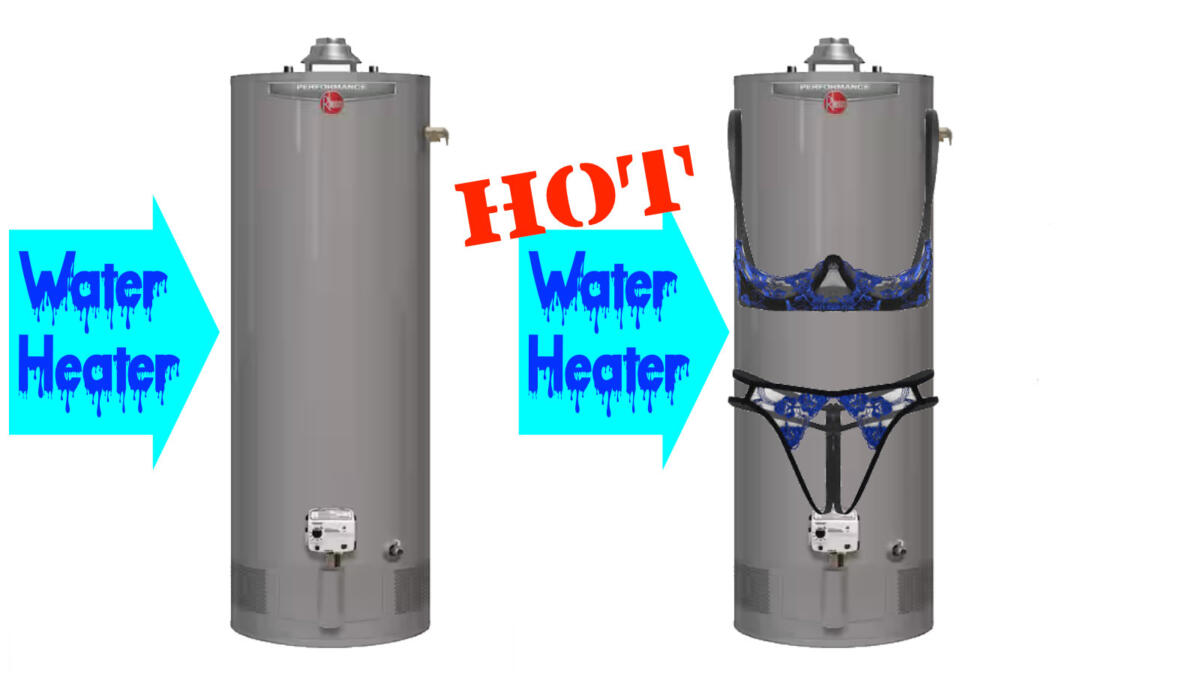
Lastly, know that the device I’ve been going on about is a water heater, not a hot water heater. If you already had hot water, you wouldn’t need a water heater.
RELATED
- How to maintain your RV’s water heater valves
- On-demand water heater do’s and don’ts
- How to troubleshoot your RV water heater
- Finding and identifying your RV’s water heater information
- Tankless RV water heaters aren’t what you think. Here’s why
RVT1256

If you install a tankless it is important to also insulate water line from the tankless to the fixtures. I installed an electric tankless in our Masonic lodge kitchen and was surprised at the amount of water that had to flow to turn the unit on. One last thing if you boondock the tank type provides and extra 6 gal of water the tankless does not.
I’ve witnessed tankless WHs not functioning when water pressure to the RV drops. Is there a min operating pressure requirement? The article doesn’t discuss that.
It’s not the pressure of the water. It’s the volume of water passing through the heater.
We have a tankless in our house and it requires at least a 1/2 gallon/minute flow to turn on the flame. So if you just open the faucet part way, you may not get hot water.
They also ‘waste’ a certain amount of water before the water temperature stabilizes.
That makes sense. Thank you
I have a tankless in my Brinkley. I don’t like it. It takes a lot of time to bring up hot water every time you open a faucet. Letting it run fills the grey tank twice as fast as my former RV 10 gal tank heater. Big downer. I live at 5400’…and camp at altitude. No issues with altitude. I would choose tank vs tankless in a heartbeat.
I am with you. I do not like the tankless. Huge waste of water.
EXCELLENT ARTICLE, Tony. I’m sticking with my electric/propane 6 gallon multi-fuel tank-type water heater. This is likely our last RV at age 79 so I think we’re set for life!
It’s nice to have the campground paying for my hot water.
All of these are a PIA! And, if someone says they love theirs- they are not telling the whole story. Even if they work well there are compromises and a big learning curve. I don’t even have one but I spend a lot of time troubleshooting for fellow campers. Aside from all else, not everyone knows how to fix them. Stay with the tank- tried and true.
I have a tankless hot water heater and love it. It came in our Holiday Rambler Nautica and it runs on electric or diesel. It also will heat the floor in our RV when needed. So far no problems with it and I always have my mechanic check the system and everything else in the Spring before our first trip of the season.
Yep, when Tony says “This is why you won’t likely see an electric tankless water heater in an RV any time soon.” he’s not considering the many motorized (mostly Class A diesels) that have a HydroHot, AquaHot, or Oasis boiler system that is fueled from the main diesel tank or electric and runs both coach heating systems and continuous hot water. We love the Oasis in our last two DPs and it would be very hard to go back to any completely inefficient propane furnace and separate water heating system. “RV” should be “towables” in that statement to be more accurate. Many DPs have these systems and have for a long time.
Side note: The above are NOT cheap or light weight!
We have a Truma Aqua Go in our motorhome and love it. We had two trailers with propane-electric, 6-gallon tank heaters and maintenance was constant. In the arid SW where we live, anode rods might not last a season due to hard water. On one trailer, the electric heater burned out, so it became a propane-only heater, not worth the cost to repair.
Incidentally, we have camped in a dry USFS campground at 10,600′ near Leadville, CO. The Truma performed flawlessly, providing all the hot water we needed, with no adjustments or bigger jets!
Great article Tony.
I often wondered about tankless WH’s.
I have a 6 gal. electric/propane WH in my trailer that l’m sticking with.
BTW it works well when we camp up in the Jemez mountains each summer (7,800ft)
Thanks fellow 505!!