

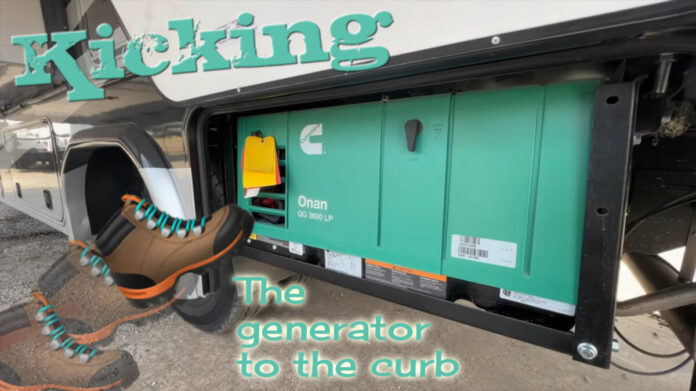
Today’s RV review is more of a look at a new system from a company called Volta, but we’ll also look at the RV that’s wrapped around it.
I received a press release from Volta touting their system that uses a very high-capacity alternator on a motorhome’s existing engine to replace the generator. This system is tied to a rather substantial battery storage system, thereby completely eliminating the standalone generator.
The release said this will be available for now in Forest River’s Sunseeker, Forester and Solera Class C RVs based on the Mercedes-Benz Sprinter cutaway chassis. But they also mentioned expanding this system to be fitted into Ram ProMaster– and Ford Transit–based RVs as well.
Further, this system has already been shown in a number of Class B RVs, and it really does make sense.

Who is Volta?
Founded in 2014, Volta Power Systems provides energy storage solutions for small to midsize businesses, RV, marine and specialty vehicles. The company’s power systems have started to appear in a number of RVs thus far, and I’m seeing more and more of them particularly in Class B RVs.
Essentially, these systems use a Volta-specific high-capacity alternator to provide power to a battery storage and energy management system. Essentially this lets the engine in the RV operate as a large generator, meaning that you don’t have a second engine to maintain in the form of a generator.
Volta’s alternators operate at 52 volts and, in this case, provide 6,900 watts of power. That’s the system that’s going to be offered in several Forest River RVs, including the Sunseeker, Forester and Solera brands based on the Mercedes-Benz Sprinter cutaway platform. That’s a tremendous amount of power from the alternator. Keep in mind that this is a second alternator—it’s not the primary one installed by Mercedes-Benz.
As such, it’s designed to charge these high-performance lithium battery systems, also designed by Volta.




Forest River Sunseeker 2400B
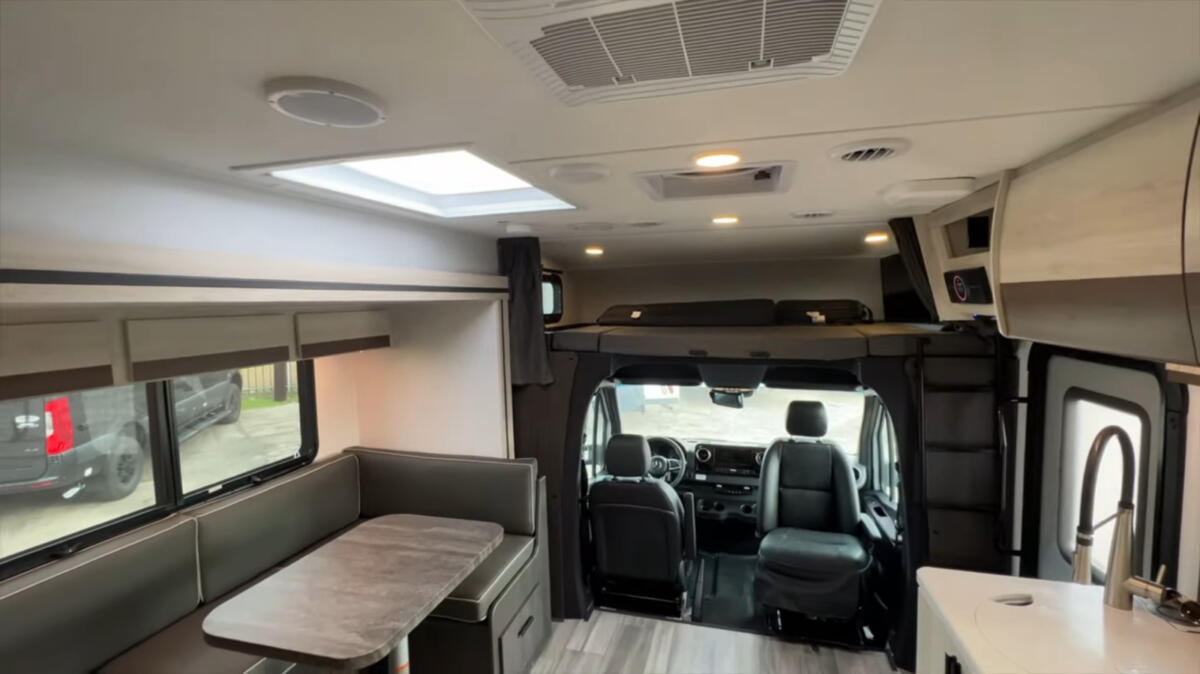
When I got the press release from Volta about these systems, I wanted to see just what the RV was like that’s wrapped around the system. I delved deeper into the Sunseeker 2400B, which is a Class C motorhome that’s built on the Mercedes-Benz Sprinter cutaway chassis. Know that this power system is available on a variety of models, but this one just happened to strike my fancy.
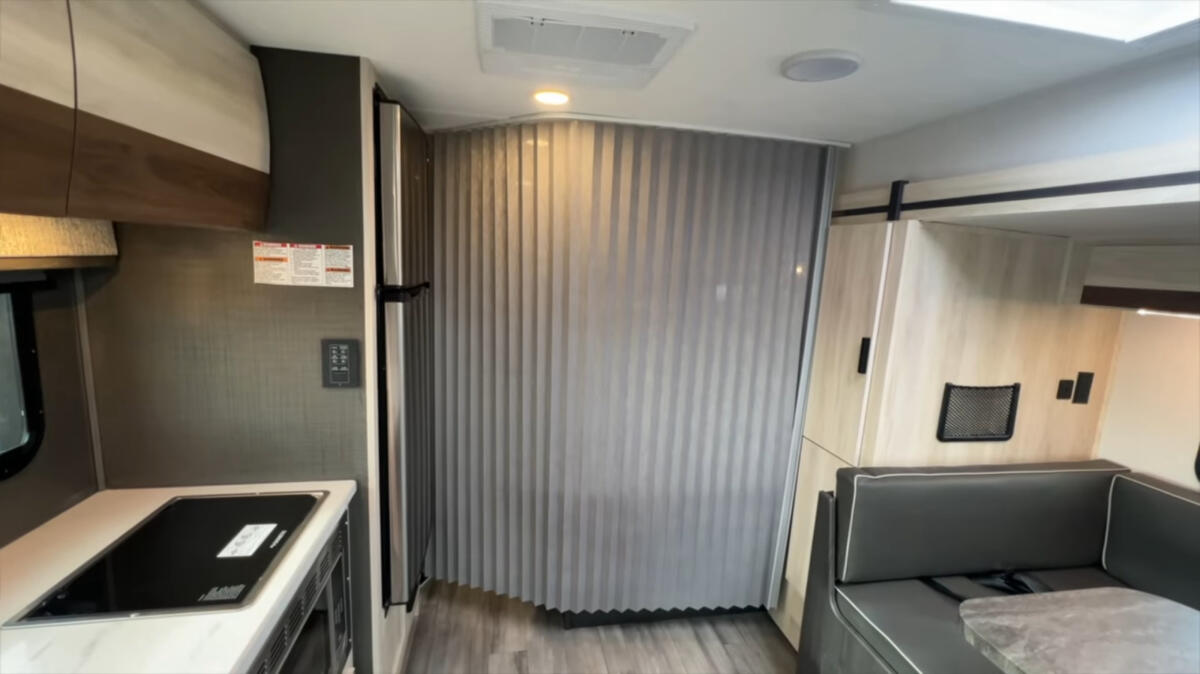
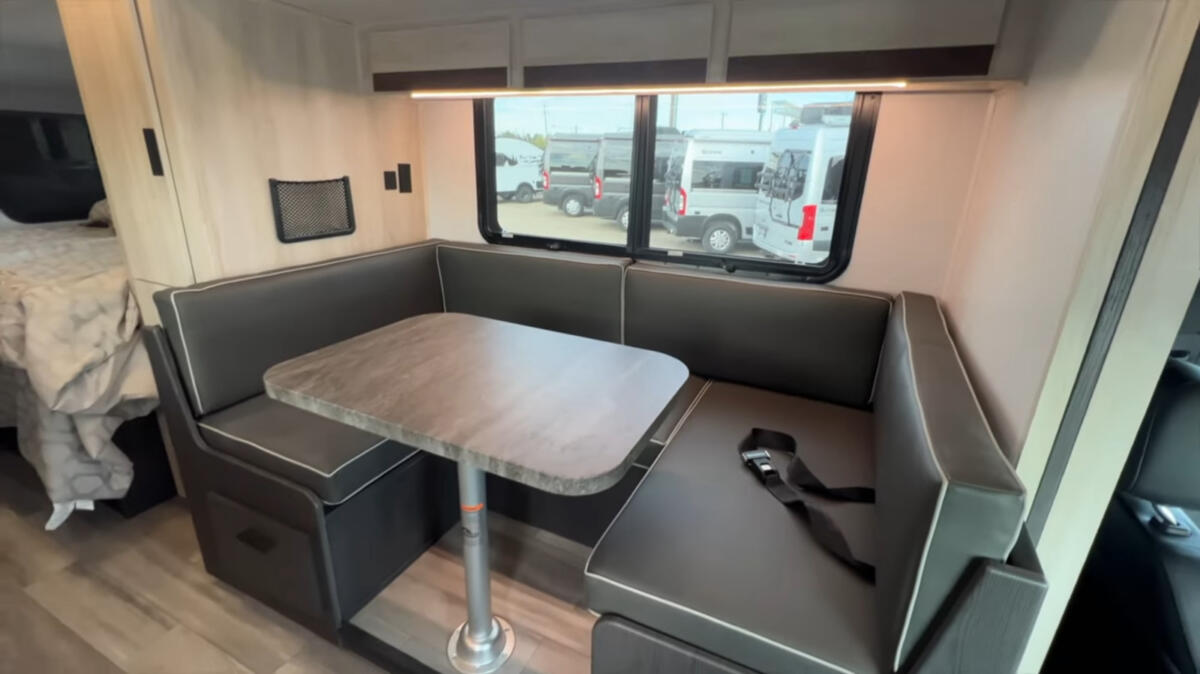
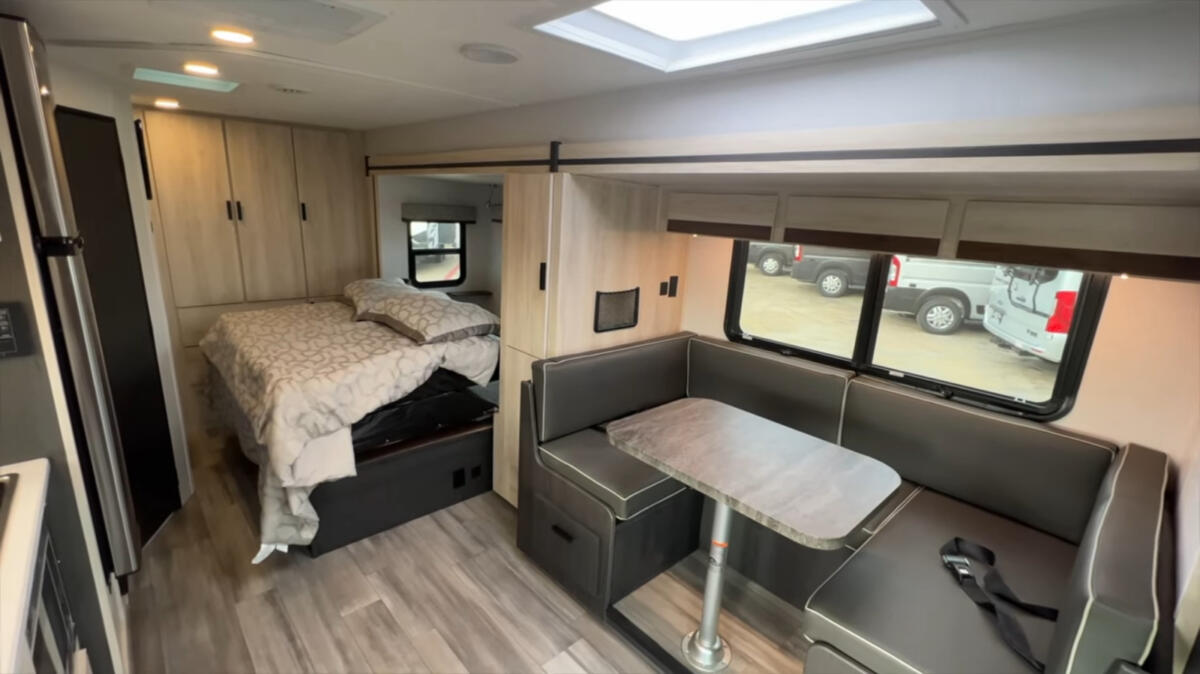
On the road side is an almost full-wall slide that encompasses a large U-shaped dinette. The slide also opens up a bed in the back, giving this smaller Class C a rather open feeling. There is also an over-cab bunk that can accommodate two adults (not two adults built like me, though). So, with the bed, the U-shaped dinette and the over-cab bunk, you could sleep six in here.
One thing I noticed—This is a big slide but is powered by a Lippert Thin Rail slide system. This wouldn’t be my first choice on a slide this large.
There is a divide between a lot of the thinking of towable RVs, which are what I tend to focus on, and motorized RVs. Obviously.
Things to like
But what I like about many of the towables is that you’ll find things like 12-volt refrigerators so you don’t have to run your generator or be hooked to shore power to operate them. I saw that here, too. This also incorporates Azdel substrates in the wall builds, and there’s a full fiberglass cap on the front. I also like that it incorporates 12-volt TVs so, again, you can leave the inverter off if you choose to and still watch TV.
One thing to note, though: You can configure this rig without the bunk over the cab, which makes it more of a B+ than a C. That’s pretty cool.
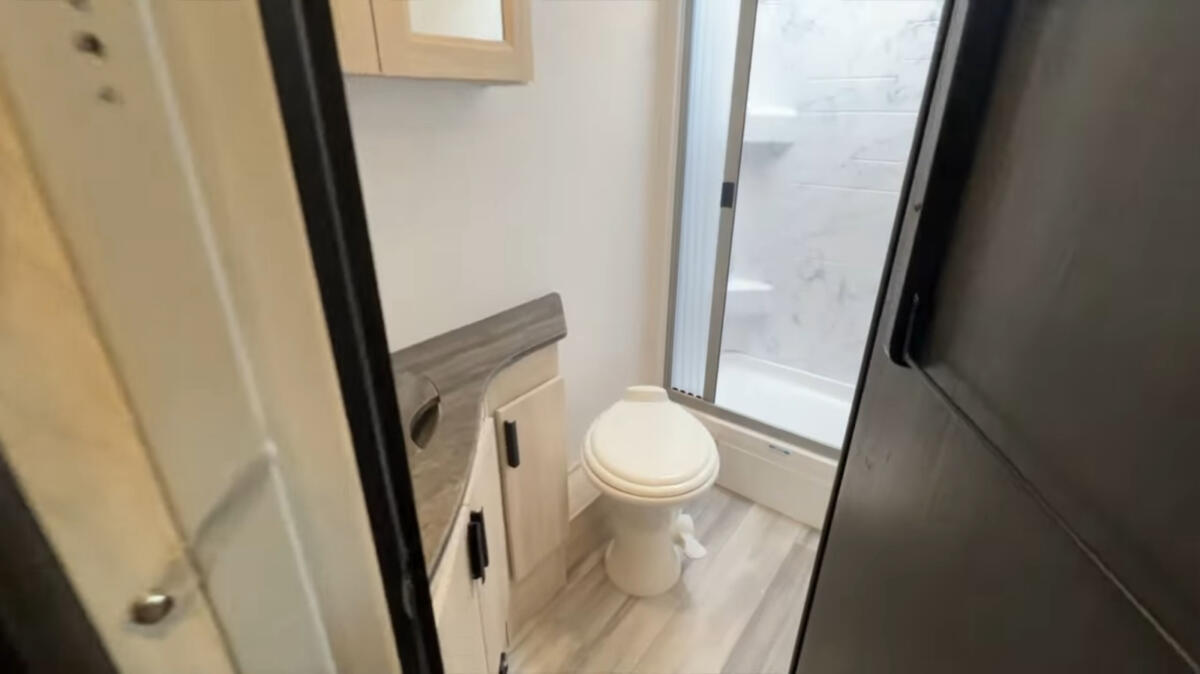
Something that Class C RVs have over towables is that you can utilize the rig with the slide room in. In fact, there are two belted seating positions in the slide room along with the front captains’ chairs, which rotate around to face the main living space. The bathroom is fully accessible, as are the kitchen and all the storage compartments for the kitchen.
The kitchen in this example features a two-burner propane cooktop along with a convection microwave in the cabinet below the cooktop—sort of at knee level. There is also a respectable amount of interior storage for a rig of this size. The drawers and many of the cabinets feature soft-closing mechanisms, so it feels ooh-so-fancy.
More to know
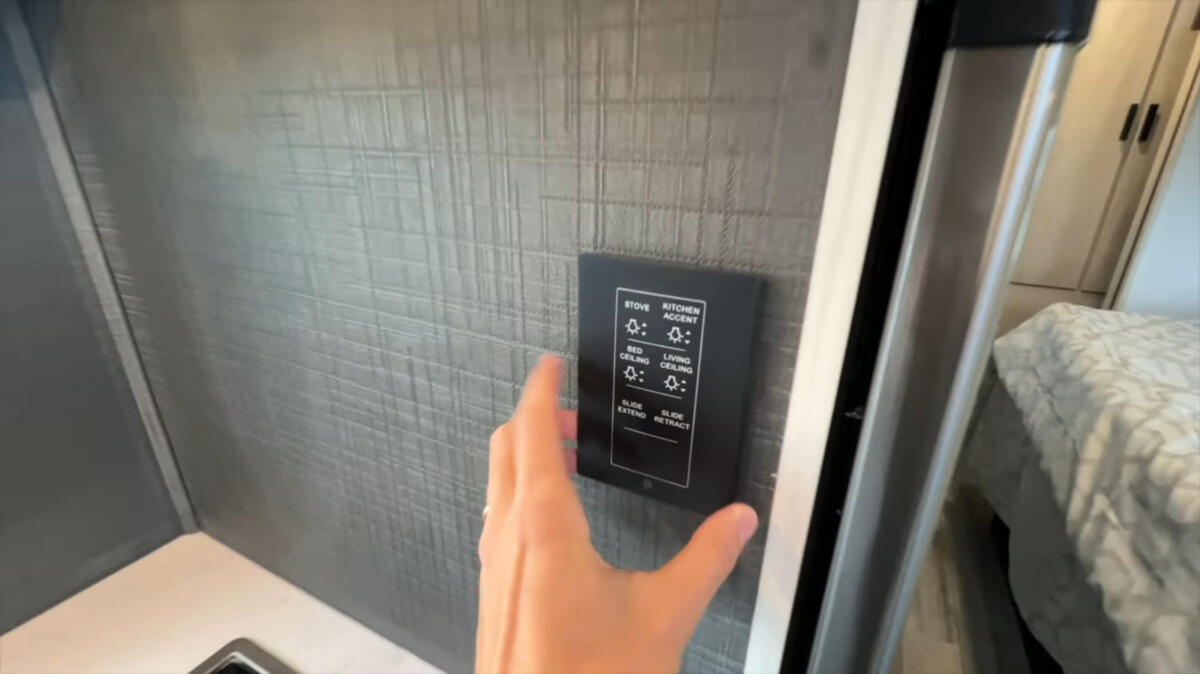
The control system in this motorhome offers a combination of a touchscreen control surface as well as more traditional buttons. The touchscreen can do it all and is actually pretty well designed. But, for those who don’t like this, there are traditional buttons for many functions. There’s also a set of buttons in the stairwell so you can operate some of the functions without even stepping into the coach. Neat.
If you’re like me and are a true geek, you’ll want to run all the functions on your smartphone, and that is available to you, as well. Nerds unite, baby. I’m opening the awning while standing under the awning.
Interestingly, I’m seeing a trend in RVs where they’re going away from the traditional puck lights that have been so common in the past few years. This one still has puck-style lighting but controlled centrally. In my own RV, I like that I can enable/disable each puck, although I can’t dim anything. This RV does have a dimming provision for the lighting but the lights are mostly all on, or all off.
Power to the people
What this Volta system delivers is that you can use this powerful alternator along with 13,500 watt-hours of lithium storage to operate the entire rig. With that much battery capacity, you really can operate the air conditioner overnight without worrying. And, if you completely deplete the battery, you just fire up the vehicle’s engine in the morning and it’ll fill it right back up.
My RV has only 4,000 watt-hours of storage and I can go for days without worrying, if I don’t use the air conditioner. I can go for about 4-6 hours with the air conditioner running, but then I have to figure out how to refill the battery system. I generally favor camping where the weather suits my clothes, so I avoid places where I have to even use the A/C, In my case, the 1,000 watts of solar on the roof are more than sufficient. The two most power-hungry things I tend to operate in my RV are the 12-volt fridge and Starlink so I can stay in touch with you.
The 13,500-watt hours of battery reserves should be more than sufficient to run the A/C overnight along with all the other systems in this RV.
The future of these systems
One of the questions some might ask is whether this system bypasses generator bans that are forthcoming in places like California. That remains to be seen. However, know that a number of states just have it out for diesel engines in general, and it’s a popular target for some lawmakers.
Fortunately, Volta knows this, too. There is work being done for both the Ram ProMaster and Ford Transit platforms, both of which are gasoline-powered.
I wonder if a place with “generator hours” is going to raise an eyebrow if you are idling the engine in this RV during the quiet hours. I would suspect so, but there is so much battery power that you shouldn’t even have to do that.
My own editorializing
Given the choice, I would much rather have a system like this than a rig with a generator. If you’re looking at this strictly from the standpoint of air quality, the main engine in an RV is fairly regulated for emissions. So running that engine for periods to recharge the battery bank likely produces fewer emissions than a stinky, clattery, built-in generator. Not that I intensely dislike them or anything.
Further, at night with a full battery, you’ll have a quiet experience rather than having some rumbling hooligan under the floor vibrating the whole RV. I honestly couldn’t sleep with something of that sort, so I like the quiet of running systems on battery power. And there’s plenty of battery reserves in this system so you should be good to go for a whole night, even if you are running the A/C.
More editorializing
If you follow how I do things, you’ll likely notice that I do more towable reviews than anything. Aside from Class B RVs, I’m not a big fan of motorized RVs only because the cost of maintenance is so high and the number of places that will service an RV is limited. Further, there have been numerous stories here on RVtravel.com about the issues with modern diesel engines.
Perhaps this came from my time at the dealership where we had a Class C RV that none of the local Ford dealers would touch. I had to drive the damned thing all the way to Sacramento to get a recall solved and an oil change done, which was three hours out of my day just to get there.
On the flip side, just about any small town in the U.S. has a place that can do routine maintenance on a pickup truck. There is no special vehicle needed by roadside assistance to accommodate a pickup truck. Also, you don’t have some elaborate system of hooking a pickup to a trailer.
Further, many of these Sprinter-based RVs are so heavy that they come close to the GVW of the chassis before you even put your first pair of underwear in a drawer. So, with any RV, look at the cargo-carrying capacity before you even step inside.
Conclusions
I do like the layout of this RV quite a bit. The idea of using an existing engine with a second alternator on it to charge a substantial battery pack also appeals to me over having a separate generator, as you might have gathered.
The press release I got was funny, to me, because it touted words like “sustainable” and the feeling of “home away from home.” Oh, brother. We RVers have to be honest with ourselves. Our lifestyle is wonderful but it’s certainly not “green” when you remember we’re shoving huge boxes through the air to get to where we’re going.
Unfortunately, I don’t know what the upcharge on this system will be. I know the MSRP for the option in my own trailer with 1,000 watts of solar and 400 watt-hours of lithium along with a 3,000-watt inverter is close to $12,000. I wouldn’t be surprised with an MSRP (Manufacturer Suggested Retail Price—dealer discounts vary) of around $20,000. That’s nothing to sneeze at. But I’ve seen base models of this RV with an MSRP of around $140,000, with typical options stretching that to over $165,000.
Honestly, one of the options I saw was full-body paint for almost $10K. Shoot, this power system would be more useful, to me, than a swishy swirl paint job. But life’s all about decisions.
More about these RV reviews
These RV reviews are written based on information provided by the manufacturers along with our writer’s own research. They are based on information from a single unit and may not reflect your actual experience. Shop your RV and dealership carefully before making a buying decision. We receive no money or other financial benefits from these reviews. They are intended only as a brief overview of the vehicle, not a comprehensive critique, which would require a thorough inspection and/or test drive.
Tony comes to RVtravel.com having worked at an RV dealership and been a life long RV enthusiast. He also has written the syndicated Curbside column about cars. He also works closely with a number of RV manufacturers to get an inside look at how things are done and is a brand ambassador for Rockwood Mini Lite with his wife, Peggy.
You can also check out his RV podcast with his wife, Peggy.
Got an RV we need to look at? Contact us today and let us know in the form below. Thank you!
-form broken-
##RVDT2321


Thanks for commenting on load capacity. We turned down a beautiful Tiffen Wayfarer because of it’s limited load capacity. I wonder how many of the Sprinter Class B’s are operating above their load capacity. Or, if their owners are even aware of their OCCC.
One of the reasons I don’t write many articles about motorized RVs is that the cargo carrying capacity seems very difficult to find (unless you’re looking at the yellow data plate, of course). But that may change in the near future as I’m working on relationships with some local dealers to actually TOUCH the RVs and this would be something I could then take into account.
I’d still prefer a generator, just not the typical Belch Fire Onan that we have. We also have a Honda invertor generator for back up at home. The cost of a repair on our loud vibrating Onan was well over the cost of our brand new quiet and smooth Honda. If there was room in our RV I would replace the Onan with an invertor generator and trash the Onan.
Onan’s new relatively quiet inverter, fuel injected RV generators might also work for you.
So you’re saying you don’t like the Onan? 😂
Great review and an intriguing concept. Having had issues in the past with an Onan (brand not really the issue) I can appreciate this new approach. Seems an additional option (and where I sort of thought this was going) might be a solar system to recharge it versus a large, low fuel mileage ICE. Still, IMHO it would be much better than current setups except perhaps if the coach battery dies and then ooops….Guess one has to pay attention to that as well. Thanks for the super information!
With regards to your article about the Forest River Sunseeker on the MB chasis. I am wondering how having a second alternator will effect mileage and is this a MB install under MB Warranty. Secondly, alternators charge best at road RPM’s not at idle. How many hours do you think you will have to idle your engine to charge that battery bank.
The Volta system was part of the build of my 2019 Tiger on an F350 diesel. On average, the batteries get recharged at 1 to 1.5 percent of capacity per minute.
There was nothing that compared with the Volta in 2019. Still a great system in 2024.
I mostly boondock and have never had to recharge by idling. Then again, I’ve never had to run the A/C for 6 hours and not drive anywhere afterwards.
Winnebago did Volta full coach power almost 5 years ago with their Class B Travato KL and GL models on the gas powered RAM Promaster, and then shortly afterwards with the Winnebago Boldt (Sprinter chassis). For the past 2 years, the Winnebago Ekko has a similar full coach power capacity with large Lithionics batteries and a second alternator on the Ford Transit. In addition, Winnebago is now selling an Ekko model on the Sprinter chassis with even more capacity. The products in this article are interesting, but they’re very late to the party.
What about regen issues if you long time idle your Class B diesel
Thank you, Tony! Interesting idea of using the vehicle’s engine as a proxy for a generator. If one had such a rig and moved every two or three days, then running the engine to charge the batteries likely would never be necessary. I always thought that your reviews were based on the distribution of owned RVs. That is, overwhelmingly towables (80%?) with travel trailers accounting for possibly 60% of them (48% of all RVs?), and that class Cs account for about 60% of the driveables (12%? of all RVs). Safe travels! 🙂
With modern diesel engines equipped with all the emissions systems, it’s generally not recommended to have extensive idle times as it can hasten clogging of the diesel particulate filter which cannot do a regen at idle. Will be interesting to see if the incidences of emissions system failures climbs for those using their vehicle’s diesel power plant as a generator while parked.
In my readings it sounds like there may be some progress on this issue, but one should read their specific owner’s manual for warnings or instructions on appropriate idle times.
In my perfect world Forest River/Volta would have considered this and talked to Mercedes-Benz as well. But we all know that it’s the RV industry and sometimes real-world use case variables like the one you brought up are a shock to them.
We eliminated our Honda generator (after it was stolen!) and installed a RedArc 50 amp DC/DC charger. Our truck now charges the battery bank if we are dry camping or by daily driving from one spot to another on long trips. Weighs about 3 lbs. Brilliant Australian design and quality.
How long per day avg. do you run the engine in your truck to charge up the battery bank? You seems real happy with the RedArc system.
The time it takes varies on my state of battery charge and how much juice I am using. I have four Trojan 6V AGM batteries with 436 amp hours capacity.
When the batteries are at 50% charge, my truck runs for 2-3 hours to bring them near full charge. Our Redarc 50 amp model puts in 45-50 amps into the batteries until it ratchets down automatically as the batteries reach near full charge. It also has a built in solar charge controller which I haven’t used yet, but will be a bonus when I install a few panels. And yes, I could not be happier with this RedArc product. As vehicles are regulated for pollutants and generators are not, IMHO this is also better for pollution control.
Seems like a real good and well thought out option, thoroughly researched by you pre-purchase. Very Efficient and comparatively very clean. Thanks Leonard.
We are “travelers”, not “campers”, so we can easily run our 12v fridge, 12v TV, and other 12v appliances from our 210Ah Li batteries, charging off 450w of solar and the M-B alternator in our Sprinter Class C. We even run the conv-micro, induction cooktop, and Keurig coffee maker for normal cooking times off the 2000w inverter. So, we have only had to run our propane, not diesel, generator twice while camping in the 3 years we have had the MH. We have run the AC on just two trips since buying the MH because, like Tony, we seldom camp in hot weather. We RV in the off-season or camp above 7,500′ in summer.
I didn’t think you’d print my comment since it wasn’t complimentary, oh well!
I have not tired to purchase a new model year 2024 RV in California with a generator. It is my understanding new gas, diesel, propane electric generators 25 horsepower and less are now prohibited for sale in California. California business with gas generators on the shelf can sell their existing stock, but once they are gone, no more can be sold. I always considered main engine alternates and generators would skirt California’s rules and so it appears to be in the works for RV’s.