

If it’s true that “there’s a sucker born every minute,” then there must be at least 10 idiots born in the same time span. One could easily infer this from the number of yo-yos who do idiotic things in national parks like deface ancient petroglyphs or trash trails. Now add to the list: Drive a vehicle over threatened plant species. There’s always a new twist in national park vandalism. But maybe you saw something and can help.
National park vandalism – “a few minutes of joyriding”
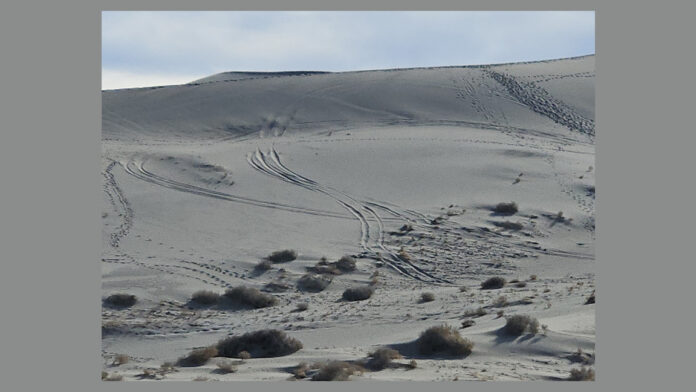
The National Park Service (NPS) seeks help identifying the person or people who illegally drove on Eureka Dunes in Death Valley National Park. The vandal performed the stupidity in late December or early January. The vehicles caused significant damage to rare plants listed as threatened under the Endangered Species Act.
“I urge the public to come forward with any information that could help identify those responsible for driving on Eureka Dunes,” said Superintendent Mike Reynolds in a press release. “I’m saddened that someone would disregard the survival of a rare species for a few minutes of joyriding. There are multiple areas on BLM land nearby, such as Dumont Dunes, which are set aside for this type of recreation but the sensitive dune systems in the National Park are set aside to be protected.”
Miles of tracks do their damage
In this latest national park vandalism incident, an NPS biologist documented damage to Eureka dunegrass (Swallenia alexandrae). It’s a plant species that only grows on sand dunes in Eureka Valley. Eureka dunegrass is classified as a threatened species by the U.S. Fish and Wildlife Service.
One Eureka dunegrass plant was directly damaged by vehicle tracks, while eight additional plants were likely affected by root damage due to their proximity to the tracks. More than two miles of vehicle tracks were left on the dunes, suggesting that further damage to seeds and other rare plants is likely.
In addition to the documented damage to Eureka dunegrass, in this case of national park vandalism the vehicle tracks may have harmed five other rare plant species:
- Eureka Dunes evening-primrose (Oenothera californica ssp. eurekensis)
- Shining milk vetch (Astragalus lentiginosus var. micans)
- Gravel milk vetch (Astragalus sabulonum)
- Hillman’s silverscale (Atriplex argentea var. hillmanii)
- Wheeler’s chaetadelpha (Chaetadelpha wheeleri)
Eureka Dunes evening-primrose only lives on dunes in Eureka Valley. It was removed from the endangered species list in 2018 due to reduced threat of damage from offroad driving. Shining milkvetch only lives on dunes in Eureka and Panamint Valleys.
Can you help?
Eureka Dunes are 680 feet tall, making them the tallest dunes in California. The dune field is about three miles long by one mile wide. Eureka Dunes is designated as a National Natural Landmark.
Information from visitors is often very helpful to investigators. You don’t have to tell them who you are, but please tell them what you know:
- Call the NPS Tip Line 888-653-0009
- Email nps_isb@nps.gov
- Online form go.nps.gov/SubmitATip
You can use these contact points to report any national park vandalism incidents.
More articles you might really like
• RVers, if you see purple paint on trees, stay away
• Has ‘greedflation’ taken over RV campgrounds?
• $245 a night at a KOA—Where will it end??
• Why Moose and Elks lodges are the way to go for RVers
• RV inspector’s picks: 3 best RV brands for travel trailers
##RVT1192b


We know people suck, so campers it’s up to us to help the rangers! Clean up a mess that we didn’t make, get involved where we can, report what doesn’t look right! Come on! It’s up to us to show them what REAL campers are like not what these “camper want-a be’s” make us look like
Not only in the dunes, but anywhere someone is destroying or defacing NP properties.
Call the park rangers immediately. Take pictures and get license numbers of the perpetrators.
Thank you, Russ and Tina! Have a great day and safe travels! 🙂
We have visited Death Valley numerous times over the years and have only seen a Park Ranger out on actual patrol perhaps once or twice. Too bad that they don’t have more Rangers actually out in the field to provide a deterrent to this type of illegal activity.
Let’s help them. They are spread thin and can’t be everywhere all the time.
If you see a problem report it with all the information.