

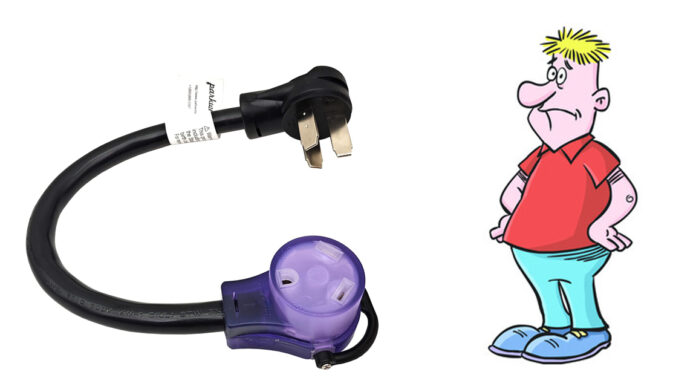
An RVer who posted on a social media site wants to know: “Can I use an adapter to plug my 30-amp RV into an electric stove outlet?” The RVer included a photo showing an adapter with the right configuration of pins on the plug, and a 30-amp RV “outlet” on the other end of the dog bone. Is a range outlet to RV adapter a wise idea?
Range outlet to RV adapter—sometimes used in a welder outlet, too
It’s not an uncommon issue. The old-style electric range outlet is designated a NEMA 10-50R. You’ll sometimes find the same outlet in use to fire up portable electric welders. Your 30-amp RV would certainly find enough power to operate, but that’s not the issue.
It boils down to the actual connectors in the range outlet. An electric range needs to “see” 240 volts to operate. Three wires feed these birds. Two hot wires, each with 120 volts, and one neutral wire. The neutral wire in house wiring serves one main purpose: it completes the electrical circuit by carrying current back to the electrical panel and ultimately to the power source (like your utility transformer) for the “return” of the electricity.
Groundless—to a fault!
An RV power plug contains three wires, as well: one hot wire, providing 120 volts to the system, and one neutral to complete the circuit. The third wire here is a ground wire. The ground wire is a safety feature designed to protect people and property if something goes wrong with the electrical system. Say a hot wire comes loose or touches metal (like an appliance casing or electrical box), the ground wire provides a low-resistance path for the electricity to safely travel to the earth.

In the wiring of the dog bone adapter that “allows” you to plug your RV into a range outlet, there is NO GROUND wire between the house wiring and the RV. While it’s true that the neutral wire in home wiring is tied to the house ground system, that doesn’t mean the neutral is a suitable safety feature. Additionally, the neutral wire is a current-carrying conductor. If something were to go wrong, metal parts of your RV could become a current conductor, putting you at risk of electrocution.
Another safety problem here, too
Additionally, your 30-amp RV, when plugged into the appropriate 30-amp circuit breaker-protected circuit, will trip a breaker if power exceeds 30 amps. Not so with this range outlet to RV adapter lash-up. If your rig’s demand exceeded 30 amps, that range breaker won’t trip and keep you safe until 50 amps of demand is exceeded.
One electrician who responded to the poster who asked about these adapters didn’t mince words. “This abomination should not exist. It is creating an ungrounded circuit or at least an improperly bonded one,” they wrote. “It doesn’t have any overcurrent protection built in either so it is relying on the load to protect the cord and adapter.”
Amazon’s “Rufus” says they’re safe!

Just how common are these unsafe-but-still-sold adapters? We found four of them on sale on Amazon. We picked one of them out and asked “Rufus,” Amazon’s artificial intelligence customer service feature, “Is it safe? Does it have a ground?” Rufus assured us that the adapter was safe—after all, it was built with copper wire, and “includes a ground connection.” It would have been pointless to ask a ground connection to what? We didn’t buy one and test it to see how it was wired, but it’s possible the manufacturer simply connected the range outlet side neutral to both the RV neutral and its ground. Illegal and unsafe.
Don’t risk your RV—and, more importantly, your life—on a cheap hack with a range outlet to RV adapter.
RELATED:
- Can I plug my RV fridge into a garage outlet to cool it before a trip?
- RV Electricity: Important 30-amp outlet voltage reminder
- RV Electricity: How to check 30-amp outlet polarity
- How to install a 30-amp RV outlet at home
RVT1207


Over the decades I’ve seen multiple slap-dash electric configurations. This is certainly one of them. The most common is using under capacity copper wires (especially through walls) with a too large amperage breaker or fuse because A-it was what was on-hand at the time and B- “we’ll never use that much power”.
As far as the 50 amp house breaker not tripping, you still have the 30 amp RV breaker.
Also, some older homes receptacles were wired with 2 hots and a ground instead of a neutral. Technically it is not a problem since the neutral and ground are bonded together in the panel.
Thank you, Russ and Tina, for the discussion and admonitions. Have a great week and safe travels!