

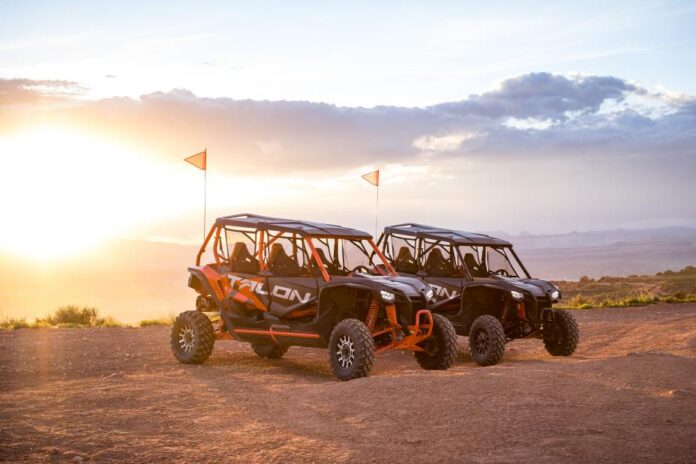
If you’ve noticed more golf carts, UTVs, or ATVs zipping around campground roads lately, you’re not imagining it.
Small vehicles are popular and gaining in popularity by the day. They offer cheap, fun ways to get around neighborhoods and vacation spots. That popularity has sparked a lot of pushback from campground neighbors and officials who worry about safety and liability.
But first…
Just to make sure we are all on the same page, here are brief descriptions of the most popular vehicles you may encounter in RV campgrounds:
ATV (all-terrain vehicle)
A small, single-rider off-road vehicle with a straddle seat and handlebars. An ATV is built for trails, mud, and rough terrain. They are typically used for recreation and light utility work.
UTV (utility task vehicle or side-by-side)
A larger off-road vehicle with side-by-side seating, steering wheel, seat belts, roll cage, and a cargo bed. A UTV is designed for work and recreation, carrying passengers or gear across rough ground.
Golf cart
A low-speed, electric or gas neighborhood utility vehicle originally made for carrying golfers and equipment on golf courses. Golf carts usually seat 2–6 and have simple controls. They are intended for short, low-speed trips on private roads or permitted public streets.
OTV (off-track or off-highway vehicle)
A loosely used term for off-road recreational or work vehicles (side-by-sides, dune buggies, tracked machines, and other off-highway vehicles). In practice, OTV is often treated like an umbrella label similar to OHV/ORV/ROV. The exact meaning and legal treatment vary by state and agency.
Shared spaces
Campgrounds are shared spaces. At any given time, you can expect to see people walking dogs, kids playing, people backing big rigs into sites, and RVers relaxing.
Enter the OTVs. (I’ll use this abbreviation for ATVs, UTVs, and other off-highway vehicles for clarity’s sake.) Almost every campground we’ve visited in the past six months has allowed OTVs throughout the camp.
I don’t mind. However, I do worry about young kids driving these vehicles. I’m concerned about teens racing their OTVs around camp loops and up on sidewalks. My concern isn’t limited to the young. Older, over-served campers driving haphazardly can also pose problems, especially at night.
A golf cart or ATV going too fast or driven by an inexperienced or inebriated person can cause collisions, serious injuries, or damage to rigs and gear. We’ve witnessed an OTV running over a sewer hose, a dog narrowly escaping an OTV collision, and two very young children driving an OTV early on a Saturday morning. (We suspected the parents were still asleep.)
My confession
While my concerns about OTVs are real, I must admit I enjoy riding in these off-road vehicles. We’ve frequently used OTVs while work camping to carry tools and building materials. They save a lot of time and effort!
We’ve also used OTVs to explore wooded trails that I wouldn’t try on foot or bicycle. The OTVs allowed us to see majestic scenery, along with animals and their habitats. Riding is thrilling and really fun!
So how dangerous, really?
There are real statistics behind OTV concerns. Federal safety reports and medical papers document thousands of injuries and dozens of deaths each year from off-highway vehicles and golf-cart crashes, with children and teens disproportionately affected.
Pediatric trauma studies show that golf-cart incidents can cause serious head and spinal injuries. Federal injury reports on ATVs and similar recreational vehicles make it clear these aren’t harmless toys. Those numbers are why campground managers and public-land agencies worry when kids drive unsupervised.
Legal facts
Golf carts and many UTVs often live in a legal gray zone. At the federal level, they aren’t always classed as “motor vehicles.” Whether they’re allowed on public streets, what safety equipment they need, and who can drive them is decided at the state or local level. Sometimes a campground determines its own rules.
This patchwork of classifications and rules affects liability, insurance, and what a campground can or will enforce. Some states are starting to add cart-specific rules. For example, there are new seat-belt requirements for children in some places.
Practical steps for RVers
• If carts or ATVs are making you uneasy, report it to the campground management quickly and politely rather than confronting drivers. You might say, for example: “Can you remind guests about speed limits and age requirements? We had a near-miss at our site and I’m worried.” Asking management to remind guests about the regulations usually works better than a camper-to-camper confrontation.
• Ask whether the campground has a written policy and if staff will enforce speed limits, age restrictions, or require helmets and lights after dark. Many campgrounds already require insurance riders and driver age minimums for private carts.
• Keep people and pets safe around your site. Keep dogs on short leashes when near roads. Move chairs and breakables back from the edge of the road. Choose pull-throughs or sites with a buffer if you can.
• Teach children in your group to treat campground roads like real roads: No playing near them, step back when an OTV approaches, and always make eye contact with the driver before crossing.
These small adjustments reduce risk and may give you more peace of mind.
If you use OTVs when camping
Bringing your off-trail vehicle on a camping trip adds freedom and fun, but it also adds responsibility. Here’s a guide of practical suggestions.
• Check the land manager and campground rules first. Confirm whether the land you plan to ride allows OTVs. Before you show up, read the park/forest/BLM ORV rules or call the campground host.
• Have the right paperwork and permits with you. Requirements vary widely by state and by land manager. Some public OHV areas require trail passes, day permits, or state OHV registration. Some private or commercial campgrounds require proof of insurance. If you tow a trailer or plan to ride on public roads, you may need registration, license plates, a driver’s license, and proof of insurance. Keep originals or photos on your phone so you can show them at check-in or if asked.
• Insurance. Insurance is not always legally required, but often strongly recommended or requested. Many states don’t legally require insurance for ATVs/UTVs, but private trails, parks, campgrounds, or lenders often do require liability, comprehensive, or collision coverage. Having an OTV policy protects you if you damage someone’s property, get into a collision, or need vehicle recovery. If you finance the vehicle, your lender may also require coverage. Check with your insurer about temporary or supplemental coverage if you only ride occasionally.
• Street-legal OTV. If you plan to use campground roads or public streets, confirm whether your machine must be made street-legal where you’re traveling. That can mean lights, mirrors, turn signals, DOT tires, license plate, and proof of insurance. Even in places that allow street use, access may be limited, so check ahead.
• Follow campground etiquette and noise rules. Keep noise down (especially early morning and after dark), avoid driving through other campers’ sites, and don’t treat campground lanes like trails. Some campgrounds ban riding inside the developed area entirely. Others allow only traveling to and from trailheads. Assume neighbors value quiet and privacy.
• Ride responsibly. Stick to designated trails and hardened surfaces, and don’t create new tracks. Avoid wet or soft ground and respect seasonal closures and fire restrictions. Respectfully yield to other trail users (especially horses and hikers) and pack out all trash. Always wear required protective gear (helmets, seat belts, eye protection), carry a first-aid kit, and make sure someone knows your route and ETA.
• Bring recovery and maintenance gear. A basic recovery kit (tow straps, D-shackles, gloves), a small toolkit, spare tire/patch kit, tire pump, and a shovel can turn a long day into a manageable delay. Consider a portable power bank/charger, a satellite communicator for remote areas, and a vehicle maintenance checklist before each trip (fluids, battery, brakes, lights). Travel with a buddy when possible. It’s safer and makes recovery easier.
• Storage, theft prevention and transport. Store your OTV securely when traveling. Lock it to a trailer, remove keys from the vehicle, and use wheel locks or a hitch pin lock. When towing, check trailer tie-downs and lights every time you stop. Be mindful of weight distribution in your RV payload plan. (OTVs and trailers are heavy and affect towing, braking, and fuel economy.)
Your thoughts?
Do you bring an OTV with you when RVing? Do you think OTVs should be allowed in campgrounds? If so, should they be regulated in campgrounds? Share your thoughts in the comments below, please.
RELATED
- Read the fine print before bringing your golf cart to the campground
- Reader poll: Do you own a golf cart?
- Golf carts? You’re kidding me, right? Really?
RVT1230


As a campground resident and summer campground worker, I have no objection to the use of golf carts or OTV vehicles, except that most of them drive too fast with no attention to posted speed limits. Golf carts, especially, are a danger because they are usually quiet so you can’t hear them approach. Children driving these items should never be allowed.
OTVs have their place. Although I’m not a fan of their use in campgrounds (maybe large RV resorts). As a manager of a small private CG, we do not allow OTV use at all. There are 2 golf carts in the CG, reserved for staff only. We are a small CG, easily walkable. Having said that, I’m noticing a lot more vehicle traffic – driving to the dumpster and bathhouse, driving around the CG (which again can be walked in 10 minutes). I’m glad we don’t allow OTV use.
I don’t mind golf carts, scooters, e-bikes or off highway vehicles if used responsibly. Ditto with kids, dogs, dune buggies, lights and outdoor parties.
Keep it considerate and everyone can enjoy their time outdoors.
Mosquitoes. I despise mosquitoes.
Yeah, mosquitoes need to be banned!!
One mosquito to another: “I saw you on a golf cart the other day, did you injure a wing?” “No, but when you have 4 people corralled to where they can’t quickly run away, you have a 4 course meal.”
Between physical limitations and the crushed rock road in the campground, we drive to the park’s laundry. Due to night vision issues, we drive to the community room when attending evening gatherings. I am thinking of looking for a used electric cart (don’t want to store gas and we pay for our electric) just for these short in-park trips. In-park speed limit is 10mph so we don’t need a speed demon and nobody wants the extra noise from a gas-powered UTV.
People who use these for necessity and convenience, sure. However for the stupid, they attach boom boxes and bright lights so they can spread their inconsiderate behavior throughout the campground. No thank you, go home!
My concerned I not only Are these vehicles when traveling fast with no respect or others in area. Another one is yesterday I saw a 10 YO with electric bike motorcycle not peddle bike.with others kids in awe.why are these sold for anyone under 15 made for their size and allowed on public, or open space. On ther own property but driving in streets without proof of ability to do so or know about any rules or safety.not even a licensed vehicle or motor vehicle
Those small electric things are NOT being sold to the youngsters. They are bought by their parents.
Now the big problem. It is up to the parents to control how their kids use them.
But few do. These parents have no regard for the rest of the campers and the kids follow suit.
The State of Alabama NOW requires ALL people operating a vessel (boat, jet or any powered vessel) to have taken and passed the Alabama Boaters Safety Course OR a similar course in your state of residence to operate a vessel anywhere in the State of Alabama. Operating a vessel without this safety course completion will get you an expensive ticket and your boat potentially towed IF nobody on the boat has a certificate.
It’s time for a similar course to be required for the safe operation of all the vehicles listed above to know the laws, restrictions and requirements for the safe operation of these vehicles.
Time will tell IF this eventually becomes a state requirement across the USA
Most of these vehicles are dangerous in my small town they drive them on the street and cops don’t do anything. If you have property have no trespassing signs. Had one incident where a family was on private property and they taught they were driving thru a puddle. Instead it was a small pond and the wife drowned, but kids were saved. The husband sued. Seen many on the news in my area hurt and killed. One guy hit a deer with his girlfriend on back. She got killed and he’s facing murder charges.
They destroy the peace of any campground. One otherwise blissfully remote and peaceful county park has its peace ruined by workers zooming around blasting noise and exhaust at least every 15 minutes. All of those loops cannot possibly be necessary. They just don’t give a flip about the campers’ experience.
If they are needed to maintain a park, they should be electric and quiet.
As far as campers, if ORVs are allowed, I will avoid staying there. BLM has ORV camping areas, offroaders can use those, or private parks that cater to motorsports.
I don’t like them. Kids are racing around in them creating hazards when walking in the park. I also don’t like kids racing around on electric bikes, scooters, etc. I think these things ought to have age requirements or somehow be regulated.
My only experience with carts has been at large Yogi Bear Parks – and it was awful! People were out of control, driving crazy (drunk?), not paying any attention to speed, people, dogs, etc all day and night. That cured me from ever going to one again. We have run into ATVs/UTVs at other cg and they were very respectful, unloading/loading them to go out for their rides – not for the cg. That’s what they are for.
Just another vehicle to look out for whether in a campground or in your hometown.
In Utah they are typically treated as a Jeep or any other 4WD vehicle. They a fully licensed and insured, and meet all highway requirements. Yes, they are high clearance and well sprung and shocked, but otherwise they are just like your Jeep or other 4×4.
As a former firefighter/EMT I’ve had my share of calls to people being hit or run over by off road vehicles. Results ranged from bumps and bruises to death. This is a serious problem, especially in campgrounds with kids and pets. Many off road vehicle drivers love the thrill of going fast and performing crazy maneuvers. This is fine when you are out in the wild. There is NO place for this in campgrounds. On top of that, some of these machines are quite loud. My vote is to NOT allow off road vehicle operation in campgrounds. Trailer them someplace where it’s safe and free of children.
We take our UTV to our snowbird park in Arizona. The park has a 10mph limit and I would say that 95% of the riders don’t race around and adhere to that speed limit. As with everything, there are always a few that don’t think they have to abide by the rules.
I am physically disabled and use a Cricket SX-3 mini golf cart as my mobility aid. We carry it on a rack on the back of our Cherokee and have had no issues. Some parks have said it was not allowed, but when shown the ADA regulations, they have no further issues.
This should be the only reason to use a golf cart in a campground. No atv or utv
Same problem with E-Bikes. They are by definition “motorized vehicles.”
And capable of doing 30mph. Most people and kids do just that.
I absolutely hate them. I’ve been in situations where these vehicles zoom past my van until late in the night (10:30pm) stirring up so much dust and creating so much noise. If they were responsible and respectful, I would have no problem. But I haven’t found that to be the case. And they’re destroying the environment.
I don’t mind golf carts driven by people with state issued drivers licenses. No OTV’s.
On the part of utv and golf carts in campgrounds you said to keep kids off the streets. Campgrounds are not streets. Most have a 5 mph limit. This is a campground so kids can run around and have fun. Not lock them up in their site. Most campgrounds you can’t just drive them around you can go from your site to the street or trail. Some you have to trailer out of the campground. Don’t make campgrounds like my house and street at home. By the way I am retired and have no kids. I grew up in a campground as a kid and ran around having fun like a kid should.