

By Chuck Woodbury
ROADSIDE JOURNAL
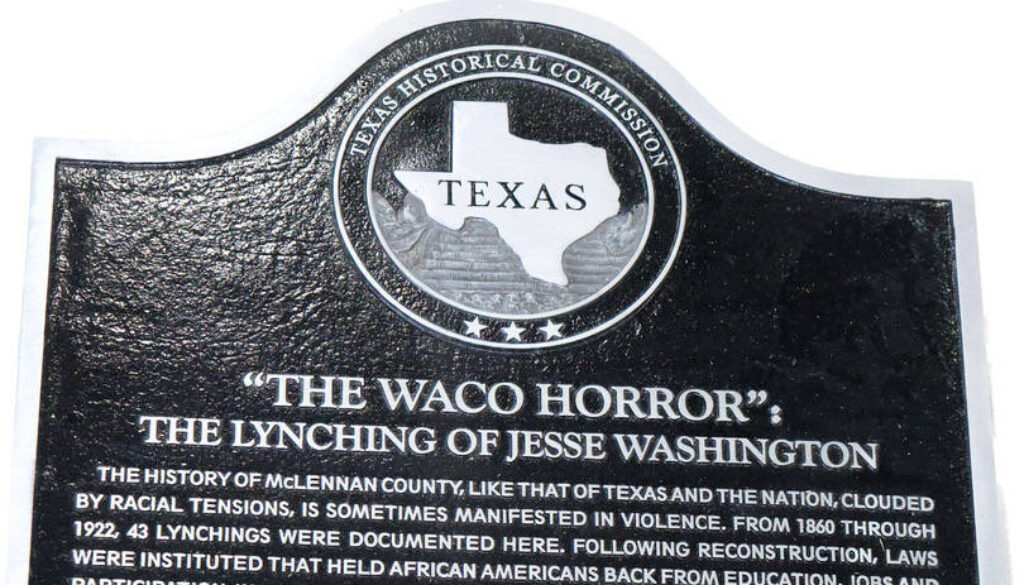
The history of McLennan County, Texas, like the rest of the state and the nation, is marred by institutional racism sometimes manifested in violence. From 1860 through 1922, 43 lynchings were documented in this county.
Following reconstruction, most victims were Black. Jim Crow Laws and acts of violence were used to disenfranchise, segregate and impede the advancement of African Americans. The most notorious local act of racial violence occurred in 1916.
On May 8th, in the farming community of Robinson, Mrs. Lucy Fryer was killed near her house. Jesse Washington, an 18-year-old African American farmhand, was arrested for her murder. Known to be illiterate and possibly having an intellectual disability, Washington changed his story from denial to admission of guilt after being questioned for days.
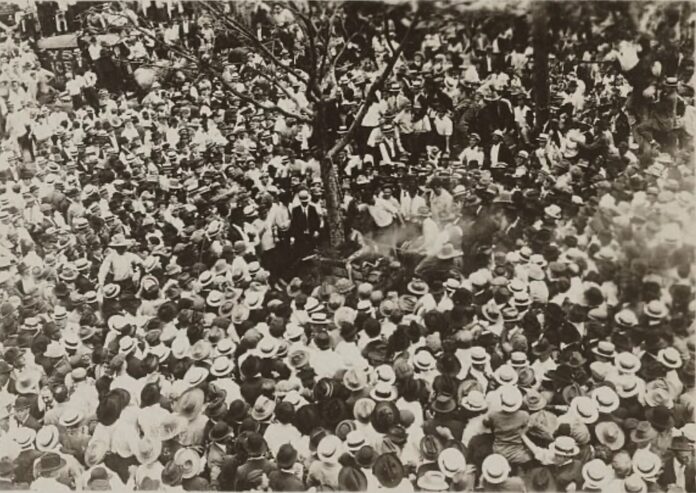
One week later, as large crowds gathered, he was brought to Waco for trial. Following brief proceedings with novice lawyers, Washington was convicted of murder and sentenced to death after four minutes of jury deliberation. Immediately, he was seized by a horde of onlookers and dragged several blocks to city hall where he was beaten, stabbed, hanged, mutilated and burned to death as thousands cheered.
Jesse Washington’s horrific death received unparalleled nationwide public attention. Several reports, particularly from outside Texas, denounced the act as a breakdown of law and morality. The newly formed National Association for the Advancement of Colored People (NAACP) — today the nation’s oldest Civil Rights organization — hired Elisabeth Freeman to investigate.
Famed editor W.E.B. Du Bois used her findings and commemorative photographs taken at the scene as the basis for the NAACP’s July 1916 issue of The Crisis, a widely distributed publication, referring to the event as “The Waco Horror.” Du Bois and the NAACP made the atrocity a turning point in the National Anti-Lynching Movement and a step in the long march toward the promise of Civil Rights for all.
A state monument to the site of the lynching is located in Waco, Texas, on the City Hall grounds, N. 3rd St., on the north side between Washington and Austin avenues.
Much of this information comes directly from the memorial at the site of the lynching.


Institutional racism is pretty much dead. Why bring up something that happened over a century ago? Let’s move forward. RV newsletter needs to stick to RV stuff. Everyone should practice what Martin Luther King, Jr. said. “Judge a man on the content of his character and not the color of his skin.” If we all did that the world would be better.
Nowadays the racism against the Jews is the worst racism in America today. And it needs to stop. Let’s keep the best newsletter about RVing about RVing.
“Institutional racism is . . . . dead”? We may not see lynchings of black men on public streets or police using attack dogs on civil rights marchers in Alabama, but does that mean institutional racism is dead? Ever heard of George Floyd or Ferguson, Missouri or protests, not just nationwide, but worldwide, over “Black Lives Matter”? Those are recent, not “century-old”, examples of institutuonal racism in our society. The 1964 Civil Rights Act did not instantaneously end all racism!
Whether this is an appropriate topic for RVtravel is for Chuck to decide. He is, after all, the owner-publisher!
100 %. Agree
Disagree with you Steve, Floyd wasn’t killed because he was black, he was out of his mind on drugs and resisting arrest. Michael Brown wasn’t killed because he was black, he was attacking a police officer after he just looted a convenience store. We have come a long way to overcome racism, even to the point our country had a very popular President that is black. Time to move on.
Chuck, thank you for your article on Jesse Washington. I never heard that story. I grew up in South Carolina. The type of racism that openly lynched Jesse Washington may be dormant, but it is NOT dead. This is our history, and we all need to know it so that we don’t repeat it.
Wishful thinking…that’s all we humans do is repeat history because our memories are short. When and IF we read about these atrocities in history, we for the most part, want to ignore it because it’s so painful and shameful. Vicious cycle…
Way outside the norm for RVtravel to publish this. What was the purpose for doing so?
Ray,
The story is from his “Roadside Journal” which is a collection of things Chuck experienced and wrote about in his rv’ing travel days. The stories don’t necessarily connect with rv life all the time. I’m a big fan of Chuck’s writing and can also recommend a book called “Out West” that he wrote years ago.
It’s a “Roadside History” stop, for those who are traveling and are interested in history. Have a good afternoon, Ray. 🙂 –Diane at RVtravel.com
I see the connection. As we travel, we visit sites of historical significance all over the country. Like Gene said below, it is part of our history. What interests us and what we disregard is our choice.
RV Travel- thank you for printing this story. It’s really shocking to learn. I’m surprised I’d never heard of this event.
Thank you, Chuck! 🙂 Such an outrageously tragic event. 😯🙁😟😥😢😡 Safe travels! 🙂