

In a recent RVtravel.com writers’ Zoom meeting, we discussed a 5th wheel frame flex issue. I was asked if it was the biggest RV catastrophe I’d seen in my 41 years in the RV industry. (Read about that in part one of this series.) Even though the frame flex issue is a big, current concern, it pales in comparison to others I have witnessed. Like the Chevrolet P30 chassis I wrote about last week.
Now, on to this week. Three more big-time RV industry failures…
The Winnebago Spectrum 2000
One of the biggest disasters in my opinion was the Spectrum 2000 built by Winnebago in 1989. It started as a rear-engine gas model that would mimic the iconic GMC models. Originally, it was only going to be 28’ in length, but once marketing got involved, it shot to more than 32’ with Corian countertops, plush carpeting and furniture, and a central air conditioning unit.

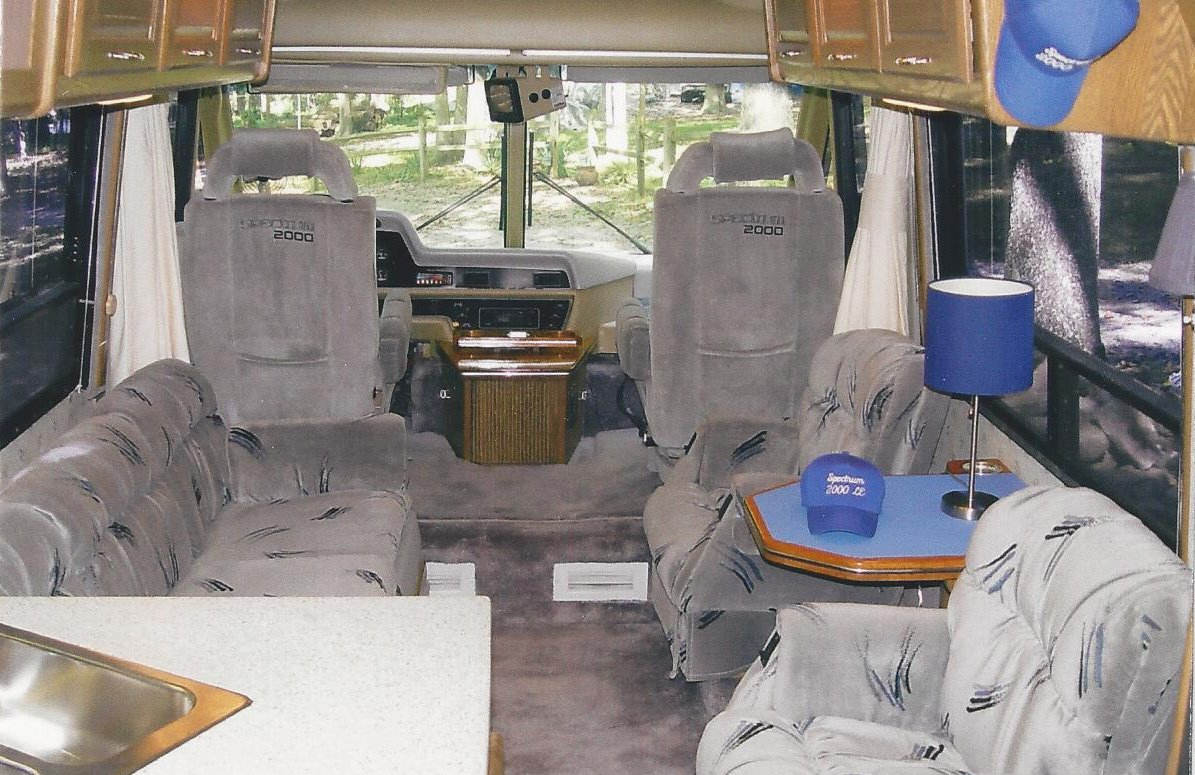
Only 86 of these units were made and sold through top Winnebago and Itasca dealers. And for good reason. The overweight units started a fire in the engine compartment and the brakes were not adequate to stop it, so all units were recalled and brought back to the factory and sat in a field at the North Plant.
I drove one back from Bangor, Maine, and it caught fire as I pulled into the Winnebago parking lot.
The units were then reconditioned with larger brakes, vents were added to the sidewall in the engine compartment, and they were resold to Lazydays in Seffner, Florida, only to have them recalled once again. The engines were removed, and the units were resold as salvage to be used only as trailers, but several slipped back into the motorized world. There is even a Winnebago Spectrum 2000 Facebook group today.
The Winnebago LeSharo and Itasca Phasar
Next was the catastrophe of the Winnebago LeSharo and Itasca Phasar built on a Renault chassis classified as the “H” body. The design was state of the art with a full unibody chassis similar to the van and automobile manufacturing, all in a compact design years before the small Class C and B vans that are so popular today.
The first design was on a naturally aspirated engine that failed miserably. They immediately switched to a diesel engine with a turbo that nobody knew had to be idled for 15 minutes during initial start and shut down to cool the ceramic gasket, and they cracked left and right.

I was working in Vendor Conformance at Winnebago and the warehouse was filled with engines and drive trains that later were purchased by Mobility RV, which is an H body specialty parts center as well as other Winnebago parts. While I was in Owner Relations, we got calls every day from owners needing a $10,000 engine, $8,000 transaxle, and even $1,000 alternators for units that were less than two years old and had less than 10,000 miles on them. We were told the response we were to give was: “The warranty is one year or 15,000 miles, whichever occurs first,” and to deny it and see how hard they fought it! It was a very long two years with what I believe had to be a 50% or greater fail rate.
A new sidewall design: Mende Board
In 1989, a company from Germany introduced a sidewall composite that was fiberglass outer skin and a particle board substructure that they called “Mende Board”. Typical sidewall construction was fiberglass with a thin lauan panel that added structure but was prone to separating when a leak occurred, which is called delamination. The Mende Board was designed to be moisture-resistant, and samples had been sitting in huge water pools for more than two years with no delamination.
The problem was, when the panel was sandwiched to the block foam insulation and set horizontally on the outriggers, the flex and movement that naturally occurred would pull apart the particle board, exposing the inside to moisture. We all know what happens to particle board when it gets wet! Yup, huge bulging and delamination. Everyone that used Mende Board had massive warranty issues. It lasted only a year or two.
Some manufacturers are slow learners
Fleetwood had a different issue, as they decided to use a composite material similar to countertop laminate that was impervious to moisture, which it was. However, it was not impervious to cracking and actually shattered in some cases.
Next week we’ll look at RV tires because it’s not IF they blow out, but when! And that’s a catastrophe!
Dave Solberg is a leading expert in the RV industry and author of the “RV Handbook” as well as the Managing Editor of the RV Repair Club.
Read more from Dave here.
##RVT1167

Thank u Dave- never could even imagine such horrors……
And Dave, you still have continued in the RV business? Is there a tougher job than Owner Relations?
Thank you, Dave! 🙂 Wow! The rig you are driving catching fire as you reach the end of your trip sounds ike the ending of a Who concert in the 1970s!?!?! No, it sounds much worse. 🙁 I am thankful that you survived! Thank you for the history lessons! Have a great week, safe travels, and safe stays! 🙂