


Dear Readers,
 The amount of misinformation posted on Facebook is legendary, so please don’t take advice from any FB “electrical expert.” It seems a bit like the original Firesign Theatre album, “Everything You Know Is Wrong”!
You should be aware that all of my RVelectricity articles on RVtravel.com and my own RVelectricity Facebook group are fully peer-reviewed by my own administrators and moderators—who are all highly skilled in electricity and code. Nope, I can’t get away with publishing any incorrect information, so you can trust what we post.
Here’s what started this thread on a Facebook Group (not mine)…
I want to convert my 30-amp motorhome to 50-amp. Can I just put in a larger circuit breaker, as someone said to do?
One of the answers (that’s wrong)
A good 30-amp circuit breaker takes 6.5 hours at 50-amp flow to trip. And yes, the larger breaker can source even more. If he is tripping the breaker and wants it fixed, that would be a different issue. (WRONG)
Another answer (that’s also wrong)
A 30-amp circuit breaker will trip instantly as soon as it goes over exactly 30 amperes (WRONG)
So, what’s right?
 First of all, NEVER put in a higher-amperage circuit breaker than the original one that the wiring will support. So no swapping in a 50-amp breaker for a 30-amp one. That’s a recipe for disaster!
Circuit breakers that you would find in your residential, campground or RV travel are all thermal/magnetic overcurrent protection devices. That is, the breakers are really two protection devices in one.
Divide and conquer
Inside these breakers are two different ways that they can “trip” or “clear the fault” – as it’s called in the trade.
First, there’s a bimetal strip that gets hot if you draw more current than the breaker is rated for (up to 5x the breaker rating). When it gets hot enough from a sustained overload, it causes the spring to trip a lever and open up the contact.

This is what allows the circuit breaker to provide you with enough power for momentary current surges like what’s required by an air conditioner compressor starting up. For example, above is one of my High Rate Data Logger (HRDL, like in “turtle”) curves for reference that shows just how much extra surge current is needed to start an air conditioner with the stock starting capacitor as well as the SoftStartRV controller. Without a thermal delay, any normal air conditioner would trip a 30-amp circuit breaker every time the compressor started up.
How long does a breaker take to trip with a moderate overload?
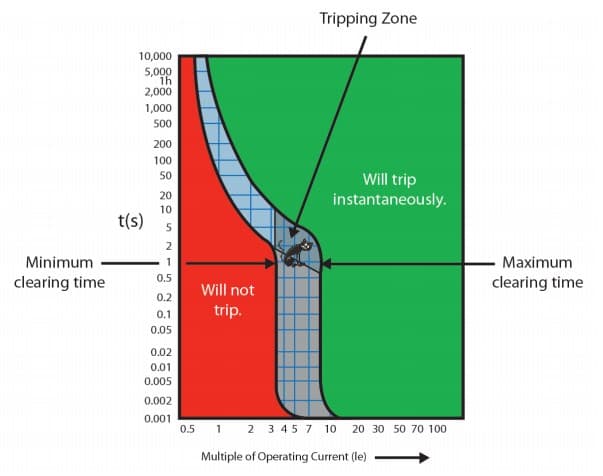 Actually, it takes a lot longer to trip than one might think. Let’s look at a standard Class B OCPD (overcurrent protection device) Trip Curve, for example.
The bottom axis shows you the amount of current in multiples of the rated amperage. So, for a 30-amp breaker, 1 would show you the trip time at 30 amps, 2 would show you the time at 60 amps, and 3 would show you the time at 90 amps.
The vertical axis shows you how long the time window is in seconds. So 60 amps of current through a 30-amp breaker should trip in between 5 and 20 seconds. At 1.5 times the rated 30 amps of current (45 amp overload), that same breaker could take anywhere from 30 to 200 seconds to trip.
But wait, there’s more!

Take a look at my chart showing how quickly a circuit breaker will clear a short circuit. I gathered this data myself using HRDL running at 48,000 times per second and 24-bit resolution. I use my own diagrams from my own lab data whenever possible.
Once you get above 4 times the rated current (in this case, 120 amps from a dead short-circuit), the magnetic tripping part of the circuit breaker kicks in (literally). There’s an electromagnet that slaps a little hammer against the latch, causing it to open very rapidly. So, if you look at the curve above the number 4, you’ll see that this circuit breaker could “clear the fault” in anywhere from 0.002 seconds (2 milliseconds) to around 1 second. This is the big spark you see when you accidentally short out a wire with a screwdriver.
 Here’s what this looks like when you short out a 100-foot length of 10-gauge copper fed by a standard 30-amp circuit breaker. Yes, that’s me in my lab doing an experiment to demonstrate just how fast circuit breakers trip on a bolted short circuit. And, yes, it should be faster than the blink of an eye at maybe 15 milliseconds (0.015 seconds) or so.
What does this all mean?
Well, circuit breakers are there to protect your wiring, not your heart. Their job is to prevent either a moderate overcurrent from heating up the wiring enough to start a fire, or clear a short circuit, which could dump hundreds of amps through a wire and cause it to melt or even vaporize. GFCIs (ground-fault circuit interrupters) are there to protect you (and your heart) from more than the 5mA of current that’s needed to trip them. But that’s a different story altogether.
And, kids, DON’T try this at home…
I’m doing these short-circuit demonstrations in the safest way possible, and I have 5 decades of experience to help keep me safe. So please, DO NOT try to replicate any of my experiments on your own. Yes, these are very dangerous.
If you want to take a really deep dive into how to interpret trip curves for Overcurrent Protection Devices, here’s a great resource: StudyElectrical.com.
Let’s play safe out there….

Mike Sokol is an electrical and professional sound expert with 50+ years in the industry. His excellent book RV Electrical Safety is available at Amazon.com.
RELATED
- Don’t trip the breaker. Colored sticker dots save the day
- RV outlet issues, wiring and replacement
- The RV electrical adapters all RVers need
- Simple but essential gadget protects your RV electrical system
- Powering your RV: Essential 120-volt electricity tips and gadgets for every RVer
- Burned by the plug: A wake-up call on shore power safety
RVT1237
Thanks for this article!
Excellent information and cautions! Believe it and beware of up coming Ai stuff – especially on this subject!
Thanks Mike!
Thank you for reprinting the article, Emily, and thank you, Mike, for allowing it! Have a great week and safe travels!
This is great stuff, Mike! It really clears up a lot of questions and misconceptions.