


Today’s RV review is an update on what’s coming from Pebble, a new RV company that promises a new level of experience in the RV space through the use of innovative technology. The idea is to dramatically simplify the RV experience by using technology to accomplish this.
Pebble Flow
The company has been teasing us with the promise of a new RV, and now it promises actual deliveries in spring. As with any prototype, there was an initial design study. However, through the feedback of campers and testing, changes were made so that the models that will be delivered are different from what was originally shown. But the core ideas haven’t changed.
Instead of repackaging a lot of the technology and thinking that have built RVs for the past few decades, the Pebble Flow is new in a lot of ways.
A lot of the press it’s already gotten centers around a high-capacity battery system and the option to have a powered drive system. But there’s significantly more to the Pebble Flow than just that. The interior configuration, the styling, and the engineering behind the trailer all represent a fresh way of looking at RVs, and for good reason.
Pebble, the company
Like so many of us, Pebble’s founder, Bingrui Yang, had his first RVing experience during the pandemic. The former Apple systems engineer wanted to get out of the house and thought renting an RV would be the way to go.
What he found was all the pain points and frustrations that are inherent with the RV life. These include the complexity of hitching, the challenges of learning the systems, and the poor quality of many of the components and overall build. Rather than complaining on Facebook like so many of us do, he decided to take a leap and start a company that addresses these pain points.
What’s happening at Pebble
Since the company initially announced its trailer, it listened to a lot of input from both inside and outside the company. In typical modern fashion, this includes actually paying for things like RV reviews and social media. The company’s initial announcements received a lot of attention just due to the pain points they addressed.
The company said that more than 3,000 members of a relatively diverse community participated in feedback, which created the changes the production-intent models have implemented.




Pain points
So many of the experiences that we RVers share are common experiences because so many of the decision-makers at RV companies never go RVing. If they do, they aren’t typically enthusiasts—just occasional users. Clearly, this isn’t everybody—but it’s not uncommon.
One of the principal pain points of towing an RV is hitching that RV. Anyone who’s ever watched two people yelling at each other while one tries to back a tow vehicle and align it with a hitch ball knows this all too well. So the first place where Pebble differs is called Magic Hitch.
Magic Hitch in the Pebble Flow
Magic Hitch is a system where the Pebble Flow uses its own technological smarts to solve the pain of hitching an RV. Essentially you get the Pebble and whatever will be towing it close together and set off a command via the Pebble app on a smartphone or tablet. From there the trailer approaches the tow vehicle and lowers itself onto the tow ball. It then latches the hitch. Just like that.
You do have to hook up the safety chains and the seven-pin connector, but that’s easy.
Another thing you don’t have to do is fiddle with weight distribution or sway bars.
The Pebble Flow has technology built into it much like the technology likely built into your vehicle such that it can handle things like sway by adapting the drive and braking of the trailer to accommodate that. Your vehicle is doing this, too, and it’s seamless. Honestly, it’s so game-changing that you probably wouldn’t buy a vehicle without it anymore.
But this is the first towable RV announced that has these features. The RV industry is still stuck somewhere in 1967.
Just as the Pebble Flow can hitch itself, it can also reverse the process. Further, you can use the app to back the thing into a campsite or your parking space when you, unfortunately, have to return to home base.
One of the neat things about this is that, if you prefer the front of the trailer to face a great view but you have a back-in site, no worries. You can use the app to turn the trailer around and buzz itself into the site.
It’s electric
The reason the Pebble Flow can do this kind of magic is that it’s essentially a towable electric vehicle. Well, one version is.
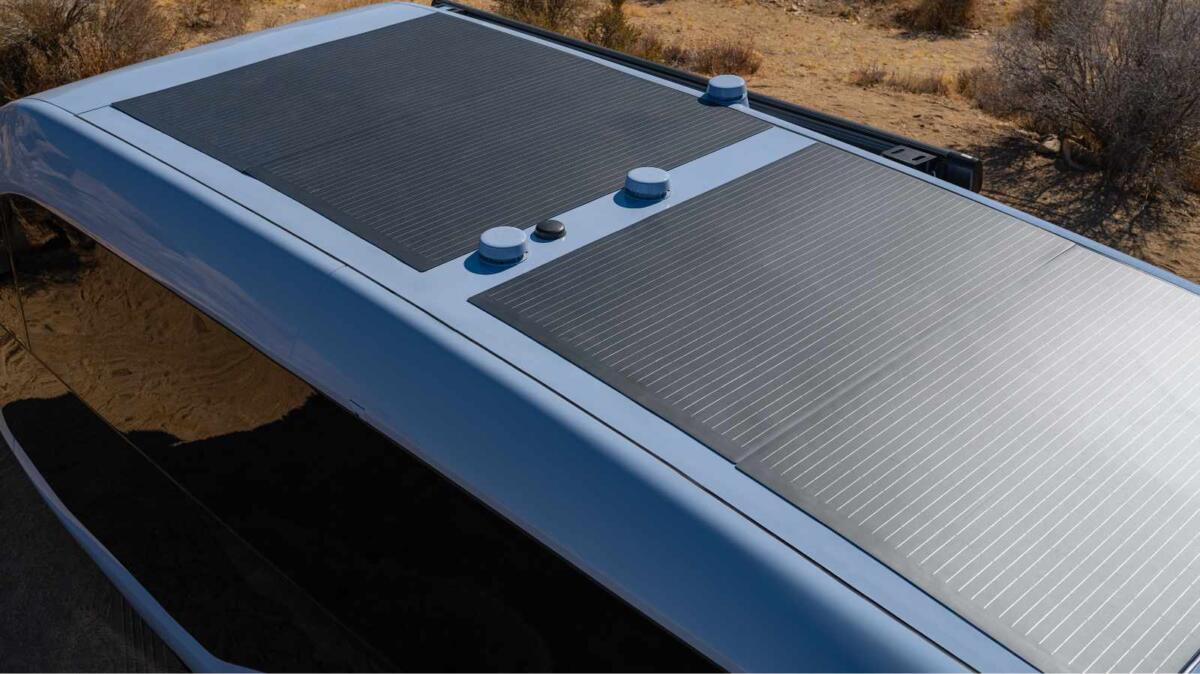
Should you choose the version that incorporates electric drive, the Pebble Flow uses its 45 kWh on-board battery to actually mitigate the inefficiencies of towing. With two drive motors plus a tremendous amount of solar on the roof, the Pebble Flow can actually use these motors to eliminate the inefficiencies of towing a trailer.
That means that hooking up a trailer won’t tank your fuel mileage. But, should you be towing with an electric vehicle, it also won’t tank your range.
For a while, there seemed to be a lot of interest in this sort of technology in things like the Airstream eStream as well as in the Lippert Edison chassis, although nothing has been said about either of those in more than a year.
Like any other EV, the Pebble Flow charges using existing EV charging technologies. However, most of these are back-in sites, so what does this mean? Considering how easy it is to hook and unhook as well as back the Pebble Flow, you can have it unhooked and backed into the charging site in just a few moments.
Charge other things or power your house from the Pebble Flow
Another thing the Pebble Flow offers is the ability to tap into that electric power and charge up your tow vehicle or provide backup power to your home if there’s a power outage. And, because of that, there may be tax credits that the Pebble Flow is eligible for since it can be a backup power source for your home. Or for your EV.
Everything in the Pebble Flow is electric, from cooking via an induction cooktop like this Duxtop that I reviewed to the convection/air fryer microwave.
The climate control, too, is all-electric, including heat. While this might be concerning, know that modern HVAC systems can be remarkably efficient. Think of how much better something like a mini-split is than a traditional climate control that is likely in your home or business. Pebble uses a heat pump system, which is about as efficient and quiet as it gets.
“We have a good heater and it also has to be silent. We are well aware of RV heaters coming on in the middle of the night and waking you up,” said Pebble’s Chief Technology Officer Stefan Solyom in a video interview. “I think you’ll find the Pebble Flow is very capable when it comes to winter camping,”
“This coming winter we plan to do a lot more testing,” echoed Bingrui Yang, whose first RV trip was during winter.
You don’t have to have a lousy, rattly, inefficient roof-top A/C unit. And that’s more of the Pebble story.
Aerodynamics
While technology is part of the story when it comes to not needing anti-sway bars, so are aerodynamics. Let’s face it. Every RV maker talks a good aerodynamic story and delivers squat. Pebble is different here, too.
The trailer has been designed to be slippery through the wind. The shape is square but also rounded off.
There are no big things protruding through the roof like air conditioners or other wind dams. The top is almost completely flat, yet slightly curved, and is almost totally covered with solar panels. There’s a ridge down the middle where Pebble has run all the cables for the solar panels.
Further, there is a nose that looks like it would have a propane bottle in it, but it doesn’t. Instead, it’s a feature to help with aerodynamics. It actually raises and lowers depending on if the Pebble Flow is in camp mode or tow mode. The nose piece helps to make the Pebble more efficient in cutting through the wind.
It also conceals that heat pump climate system.
Camp mode
On the subject of camp mode, there’s a system called “InstaCamp”. I had already shared the Magic Hitch functionality where the trailer unhooks itself and you can put it where you want with the app.
InstaCamp takes over from there so that, once you’re where you want to be, the trailer then locks the wheels and levels itself with four corner stabilizers. Once that operation is done, it then deploys the steps and you’re ready to camp. That’s it.
There is a provision to take over if these automated systems let you down in the app’s “More Mode” but the process seems rather seamless. And no more wheel chocks. Or swearing. Hooray.
More modes in the Pebble Flow
I haven’t even gotten to the basic camping features yet, but this 25-foot trailer is well designed for actual camping.
One of the things you might notice is that there are no blinds over the windows in the trailer. Instead, using either the app or switches in the trailer, you can instantly turn the glass from transparent to opaque. Who needs curtains?
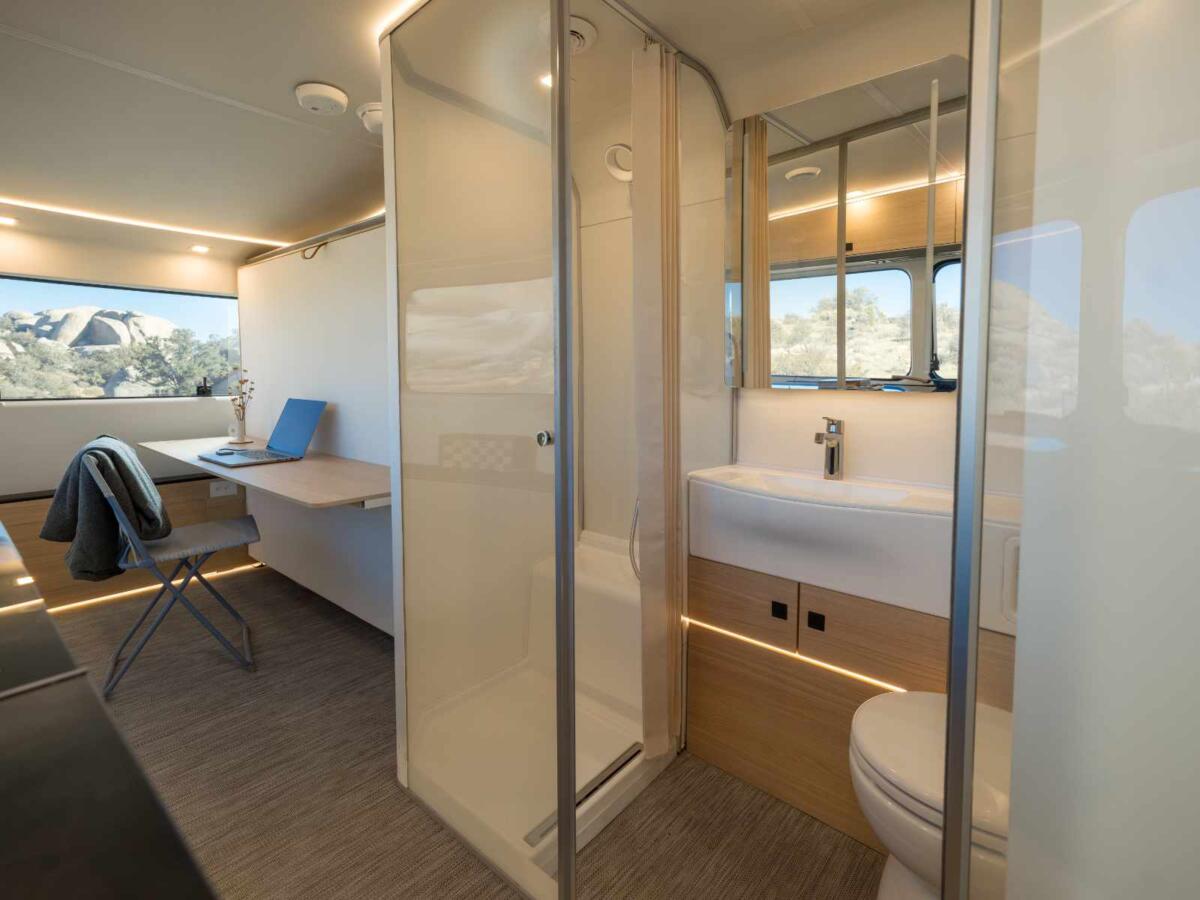
This is true of the glass surrounding the bathroom, as well. Sure, you could be in there putting on a show for your friends but, should that one creepy friend come over, touch the button and the glass becomes opaque. Magic.
Though, to be honest, I’m not sure why the bathroom needs this feature. It’s pretty slick, but I can’t imagine ever camping with others where the glass wouldn’t be in opaque mode.
Camping basics
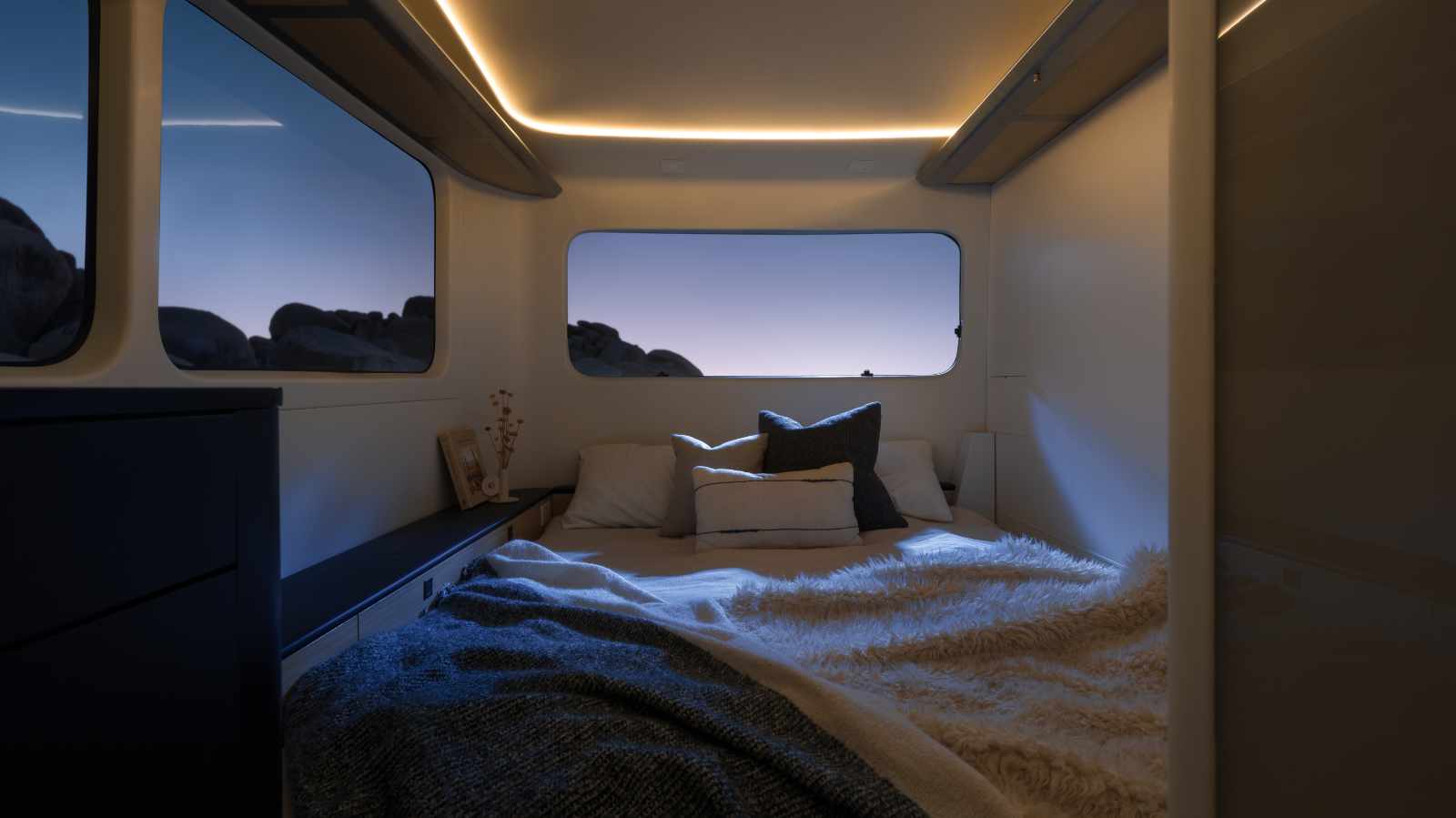
Something I like is the layout of the interior with huge windows on the camp side—where they belong.
In the back is a Murphy bed but one that, by day, offers a desk with a large, white wall behind it. The desk spans the full length of the queen-sized bed, so it could work for two people. But you can close off your laptop confuser and simply pull the bed down. It will accommodate the thickness of your computer easily.
Now, this is not a walk-around queen, so you will find yourself either skootching or sliding your way into bed.
There’s another bed at the front of the trailer that forms when you drop the table in the U-shaped dinette. This is much like the inTech Terra Magnolia in layout and function.
Something I also noticed—the cabinet door latches were positive, mechanical latches—as they were in vintage trailers. I have zero idea who thought it was good to eliminate those, as this is a vehicle. Kudos to Pebble for these kinds of latches. It’s little stuff like this that will actually work well over time.
Interesting bathroom
The bathroom on the Pebble Flow is another place they’ve done some interesting things. The toilet has good space around it and is a porcelain unit. But it’s more—it’s also a macerating toilet, which means it takes what you have made and turns it into a mush, essentially.
One of the good things about a macerating toilet is that it can actually pump the contents of the black tank uphill if needed and, typically, uses a smaller hose than the traditional stinky slinky we’re all accustomed to.
I’ve already mentioned how the glass around the bathroom can turn opaque at the touch of a button.
Lastly, the shower is also spacious and has a seat in it as you might find in some fifth wheels.

Conclusions
I think a lot of people are going to focus on the electric drive system and get lost in the whole EV side of this trailer. But, just from the standpoint of eliminating pain points in an RV and building things differently, I think the Pebble is on to something here.
Depending on the success of the initial launch, and I hope it is very successful, perhaps some of the rest of the RV industry could discover that it’s actually no longer 1967. Though the price of these is going to limit the number of buyers, of course.
Think of all the things we all complain about—lack of windows, poor design, lousy towing, poor build quality. If Pebble just solves these problems alone, then you have something very special here. Then you add the smart bits and it’s over the top.
With the good aerodynamics alone Pebble is revolutionary, especially considering that there isn’t an A/C unit like a tumorous growth on the roof of this thing.
Something that’s much like EV is that the Pebble can receive over-the-air updates, so what it has now might be even better tomorrow.
Exciting concept
I’m looking forward to following the path Pebble takes to see where it goes. I’d really like to take one out for a week and share that experience with you. But, in the meantime, this is a pretty exciting concept. Oh, and the price is not much different than an Airstream yet is head and shoulders above any other travel trailer on the market in terms of innovation.
Production will begin in early 2025 and the first deliveries will be available in spring 2025. These customers will receive the exclusive Founders Edition of the Pebble Flow, fully loaded with all options and upgrades, plus the opportunity to select a limited-edition color, at a price of $175,000. 😳
Customers can place a fully refundable $500 deposit today at pebblelife.com/preorder, customize the Pebble Flow to their preferences, and explore available options, specs, and pricing.
More about these RV reviews
These RV reviews are written based on information provided by the manufacturers along with our writer’s own research. They are based on information from a single unit and may not reflect your actual experience. Shop your RV and dealership carefully before making a buying decision. We receive no money or other financial benefits from these reviews. They are intended only as a brief overview of the vehicle, not a comprehensive critique, which would require a thorough inspection and/or test drive.
Tony comes to RVtravel.com having worked at an RV dealership and been a life long RV enthusiast. He also has written the syndicated Curbside column about cars. He also works closely with a number of RV manufacturers to get an inside look at how things are done and is a brand ambassador for Rockwood Mini Lite with his wife, Peggy.
You can also check out his RV podcast with Peggy.
##RVDT2553


So tired of trailers that do not offer a walk around bed! But, to each their own. Not worth the money without that, or having to carry a honey wagon another pricey expense for a trailer at over $100,000, imho. And, all systems better have a manual override. In the end, much will be learned and introduced to the market, which is always a good thing, because we all know improvement is, desperately, needed.
Got my attention when I saw it was missing the big noisy lump on top. Sometimes I feel like we are trying to sleep under a lawn mower. I’d love to see a change to heat pumps or mini-splits. But we all know this industry resists practical changes. Maybe someday they will offer this new thinking in a Class C.
I’ll be getting in line to get the $175,000 version. The interior reminds me of a hospital OR. I really like lighter interiors but this looks stark to me. I don’t trust this much automatic ‘stuff’. Too much to go wrong. I still worry about my electric windows going south . . .
This will sound crazy, but there are health benefits being given up by having everything done for us while we sit on our butts and watch everything being done for us. Just my opinion, of course.
Thank you, Tony! Interesting. Agree, the tank capacities, especially lacking the shower water-saving feature, are disappointingly small. Interesting that dumping the tanks is so odd. Or maybe not so odd. Our 2022 Newmar New Aire has the same dump sequence. It was not explained to me during the walk-through at the dealership. Took a few minutes to figure it out. Even though our black and gray tanks are separate, they are dumped simultaneously if using the macetator. Following on Tommy’s comment about the OR-like interior, is the interior easily personalized? Have a great day and safe travels! 🙂
Very interesting. When I first saw the photo I thought it was a lawn sprinkler.
Tony, I always enjoy your comedy “ The idea is to dramatically simplify the RV experience by using technology to accomplish this. “ Now that is funny!
Funny – that’s sort of what I thought as I was writing that but it also makes sense.
Think of any modern vehicle – you can cross the country on a whim and basically never need to think about any tools, for the most part. Fuel/air, radiator and so many other systems are just adjusted automatically as need be. No worries about re-jetting carburetors for altitude or turning off your AC as you go up a hill.
So, to that extent, cars are much simpler to operate.
Until they’re not, right? When something goes wrong on a modern vehicle it goes very wrong and it takes a special talent to resolve it.
Dave, and the line about the “laptop confuser”. 😂
Sorry for the negative comment here, but in attempting to read this article, and others in the past, my screen jumps all over the place and back to the top. This feature make the article unable to be read without great frustration. This is as important as the quality of the article itself. Please find qualified individuals to fix this issue.
Bill, what device are you reading this on? Most of the complaints we get like this are from readers using iPads. I thought we had improved the reading experience by tweaking the technology a couple of weeks ago. We have a new ad management company and there have been bumps in the road with readers’ experiences. Trying to maximize everyone’s experience based on them viewing on different devices — desktop, mobile and tablets — has been challenging. –Chuck/publisher
Lots about the Pebble that appeal to us and could convince us to get back into a trailer. The bed layout stops us cold, though. This is one situation where the Pebble guys/gals, presumably all young, may want to recruit some older less agile folks to check on the bed “scooching”.
As a retired electronics engineer and all-around DIYer, Im rather impressed. I can see this generating a new niche RV market. As far as practicality for our type of camping, it’s mixed. We already set a limit of 200 miles per day and have been known to go less than 50 to the next overnight. So it’s amenable to that, even with a EV tow vehicle (and campgrounds that offer charging) . However, longer term no-hookup camping, like we did at Quartzsite last winter, is questionable given our creature comfort needs. Bigger tanks, a backup power source for extended cloudy weather, and propane cooking are things we use now in our motorhome. Just like EV range improvement, this needs power growth.
Thank God that people from outside this, disaster of an industry, are joining in. Nothings perfect but this is far more reasonable than a Bowlus or Living vehicle. If it wasn’t for Australia, Europe and some from Canada, Our campers would still look like a 2008 Jayco. I look forward to the end result.