

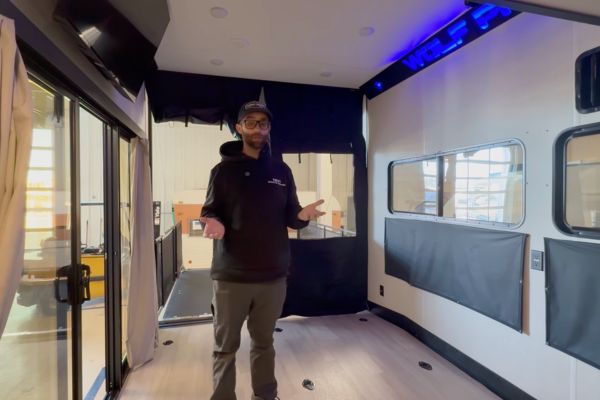
After years of fixing RVs, a mobile RV tech starts to notice patterns that never change. The same failures show up across brands, price points, and model years. So when people ask, “What would be different if RV techs built RVs?”, the answer isn’t fancy features or more screens. It’s a short list of build choices that would make ownership less stressful.
In the video at the end of this post, Nick Buchanan, That RV Tech, shares five changes he would make. These changes focus on long-term reliability and repairs that don’t feel like a constant battle.
#1 Stop leaks at the source with real flashing and better sealing
Leaks sit at the top of the “why RVs fall apart” list. Owners hear the same warning over and over: Check roof and exterior seals every few weeks, or water will get in and rot the rig. Meanwhile, homeowners aren’t climbing on the roof every six weeks to keep their walls from turning to mush.
The fix starts with basic building practices, especially flashing. In normal construction, materials overlap so water sheds outward instead of running into a seam. RVs often rely on exposed sealant lines and hope for the best. Lap sealant acts like flashing on paper, but the execution leaves too many failure points, and repair access rarely gets much thought during design.
If a technician called the shots, flashing and sealing details would come before floor plans. That includes the roof edge, wall openings, transitions, and anywhere water can track into a gap.
#2 Replace weak electrical connectors before they melt
Nick calls out two repeat offenders: plastic 50-amp shore power connectors and push-to-fit RV outlets. He replaces burned parts often enough to keep multiple spares on the truck, which says a lot.
The problem is simple: Loose connections create resistance, and resistance creates heat. Over time, heat damages the connection, which makes it even looser, and the cycle keeps going.
- Loose connection
- Resistance builds
- Heat increases
- Connection loosens more
- Failure and melting follow
The wiring between devices often looks similar to what’s used in houses, but these two components cause a lot of the drama, including the “space heater” arguments people get stuck on.
#3 Quit installing fragile awnings and go with proven designs
Nick wouldn’t put common RV awning brands on his product at all (including names like Solera, Dometic, Carefree, and Girard). Not because awnings are a bad idea, but because too many struggle with wind, rain, and sun damage.
Better awnings already exist in the patio world, and they’ve been around for decades. Nick also leans toward manual awnings, since simple gear tends to survive longer than motors, sensors, and touch controls.
#4 Use non-RV appliances and stop depending on the same supplier
Appliances and slide components generate a huge share of warranty headaches. Nick points to Lippert (and its Furrion-branded products) as a major source of frustration, while also admitting RV-only appliance makers in general haven’t done great.
Here’s the business problem: When a fridge dies a week after purchase, the owner blames the RV brand, not the appliance logo. That’s why he’d source from established appliance companies, and he’d spend money on R and D (research and development) and stronger supplier contracts.
#5 Cut floor plan chaos and build only a few models really well
Too many floor plans hurt quality because assembly teams never get enough repetition to build true muscle memory. Nick expected some newer brands to narrow it down more, but the industry still churns out layouts.
He likes the auto example: Vehicles such as the Econoline stayed largely the same for years because the formula worked. Trim packages can change, but the core stays consistent. He’d build three or four floor plans, track the most common warranty issues, then make careful updates each model year.
Nick also likes a bonus idea: Offer an empty, blank-canvas floor plan more often, closer to how a house isn’t sold fully furnished.
Conclusion
None of these fixes require magic—they require priorities. Better flashing, stronger electrical parts, tougher awnings, non-RV appliances, and fewer floor plans would knock out many of the problems owners complain about year after year. If a manufacturer nailed even one or two of these, that brand would climb fast in real-world recommendations.
MORE LIKE THIS:
- The RV industry needs a ‘Tony Certified’ standard
- If you wrote a letter to an RV manufacturer, what would you say?
- RV show reflections: Can we trade gimmicks for quality, please?
- Why is there no industry-wide RV quality control?
- What can a dinette cushion tell you about RV quality? Lots!
- The hollow promise behind RV ‘Quality Assurance’ badges: Nothing but a ‘tax stamp’
RVT1250


The RV industry counts on us being under-informed, and people like this tech & you folks are working to change this.
I often disagree with Nick on technical points. But this list seems like solid steps everyone would benefit from.
My number one is stop using plastic Pex-B connectors, elbows, tees and fittings and use proper lead free brass instead. The connection is the weakest point and using the cheapest materials available is just begging for hate mail. Using the same Pex-B connectors on the low pressure braided wrap hose (PBT) is of equal indifference since those take a different fitting end due to the larger I.D.
RV Engineers obviously don’t ever use their designs! Boatbuilders mastered no leaks, RV builders don’t even try! Residential electrical components and appliances work, USE THEM! Design floorplans for Americans, not pigmies. Stop trying to sleep 20 in a 19′ trailer. Stop cramming oversized cabinets into EVERY nook & cranny. EVERYONE uses the bathroom, make them bigger! Showers bigger than a phone booth! Toilets so crammed in a shoehorn is needed to sit! If it has a tankless water heater, include a Showermiser! ALWAYS build in a water heater sufficient for a NORMAL shower, especially when on full hookups! (Sailor showers are for sailors!)
A pet peeve of mine is that there has been no effort to make a much more efficient furnace. If a house furnace can have a plastic chimney…..
You could roast a wiener at the exhaust from an RV furnace.
I figure 50% furnace efficiency at best.
We use a Wave Catalytic Heater, that is 99.6% efficient, when temps are above 25 F and at 25F turn on the furnace to heat our tanks, but turn the Wave down to save energy.
Yes, we know how to vent and have second LP and CO detectors.
All very good points.
But how much would all of this do to increase the prices, and how many people would rethink their purchase?
Two things I do agree with are the awnings and electrical outlets.
Push a button and the awning deploys and retracts. The old style mechanical awnings had very few problems and the framework and mounting was much stronger
.
Receptacles? Since there is no actual electrical code followed, it all comes down to the time that the ‘stab on’ connections save.
Agree with all 5 points. Our 2008 TT still had the original (manual) awning and hardware in great shape when we sold it to its 4th owner in 2022. Okay, it took a little longer to deploy, but emphasis on the little. And its design was more flexible to work in more conditions. I’ve replaced the fabric on our 2017 and truth is I don’t expect to make it to 10 years without another replacement. Have also had to replace parts that failed under normal (not windy) use.
Got to be a better design for liquid waste handling and the current gravity only systems. Liquids take the path of least resistance, but anything other than liquids get pushed to the edges. Of course chemical and gadget producers would have to look for other revenue streams to stay in business.
It’s the marketing boys and girls that keep wanting new models for their ads.
Best thing ever: Quit putting the bed in a slideout!
The manufacturer of my Class C (Hoosier Custom Cruiser) makes 1 design and does it well.
I always tell those who ask me about RVs, to get in the shower and on the bed, to see if it fits them. Even ruler measurements do not tell the whole story. Also, should check if the vehicle is useable with the slide both in and out.
Good ideas, and I hope they see the light of day!
I’ll argue about push-to-connect electrical plugs, however. I’ve had more hassles, failures, and ridiculous expense from the ‘lock’ type plugs that are tricky to seat, get cracked rings that can’t be replaced, and are even more susceptible to scorching, etc.
If my next potential rig offers a detachable ‘locking’ cord, I’ll move on to a unit with an onboard cord with a simple plug. The rig end stays safely out of the weather and doesn’t have to be fussed with to connect at every stop.
Maybe if everyone boycotted purchasing a new RV for a year the industry might take notice? We have a 2022 Winnabago View D. It’s crap compared to our old 2009 Winnabago View A.There’s only 1 poor gas burner, with an induction burner next to it you can’t use it and the microwave at the same time.You can’t use the really bad Murphy bed without the slide out you need a step stool to get onto it, it converts to a useless couch.Refrigerator only runs on electric.The micro convection oven is unconveniently located at ground level. The window coverings are crap we’re talking 1980s mini blinds and pull down roller blinds. I’m seriously considering keeping our 2009 ($35k) and selling the ’22!!!!
SO does any one know what these better awning brands are? I am curious.
I agree with all and would add drawer slide installation seems to be an afterthought. Pull out those drawers and see how the slides are attached in the back. A drawer can hold 20 + lbs of stuff and in my experience the point of failure is the back attachment
I am in south Texas,does anyone know where I can get a seal kit for my hydraulic leveling jacks. I have contacted lippert and they said replace jack they don’t sell seal kits.
Good advice, but the only companies that would make those changes are new ones trying to stand out from the “old” crowd. Thor and FR aren’t going to make changes like these because they have suppliers locked into long-term contracts, have warehouses full of the “old” parts, appliances, awnings, etc., and have cheap Indiana labor as young as 15 with only OJT. They cut back on model numbers during Covid, then immediately went back to “business as usual” as soon as possible. “RV” and “quality” are mutually exclusive terms!
Good points all. Looking at the comments I am reminded of several difference between RV’s and boats. Boats are 100% fiberglass, not laminated aluminum over wood designs. While there are different levels of craftsmanship in boat building I don’t know of a single one made in the last 50 years that wasn’t 100% fiberglass construction.
The stuffing of cabinets and other seemingly useless additions are there to impress the uninitiated, regardless of the brand in question. Glitz sells, but practicality needs to be actively peddled. Sadly even the boat industry has fallen victim to the glitz vs practicality and that chasm opened up at least 20 years ago.
They always talk about RV’s being like rolling earthquakes going down the road. Ageee about boats, my last sailboat was 30 years old and can promise you that it had gone through more beatings than my RV will ever see, yet cabinets stayed put, electrical was neat and fastened down not to move, doors stayed put. Why the industry doesn’t bring QA engineers in from auto industry or similar and tie pay to warranty issues across the board is beyond me. They have to spend millions on claims along with the support needed to do all that.