

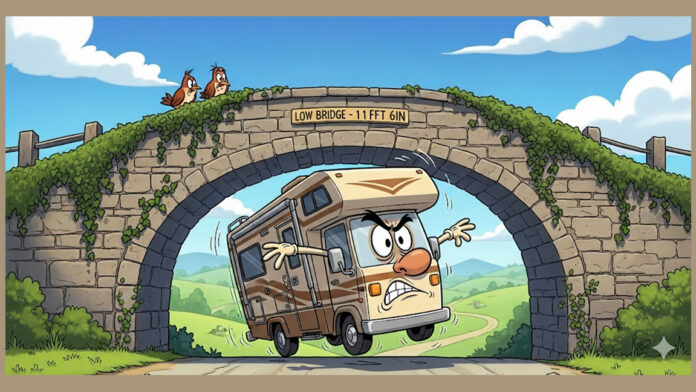
An RVer passing through South Bend, Indiana, had a double-dose of misfortune. Shortly after changing a flat tire on his rig, he passed under a low bridge and tore off his roof air conditioner and two roof vents. He summed it up by saying, “Might be time to hang it up for 2025.”
How likely are you to “trim your top” on a low-hanging bridge or building portico? What can you do to lessen the chances? Do you know how to measure RV height?
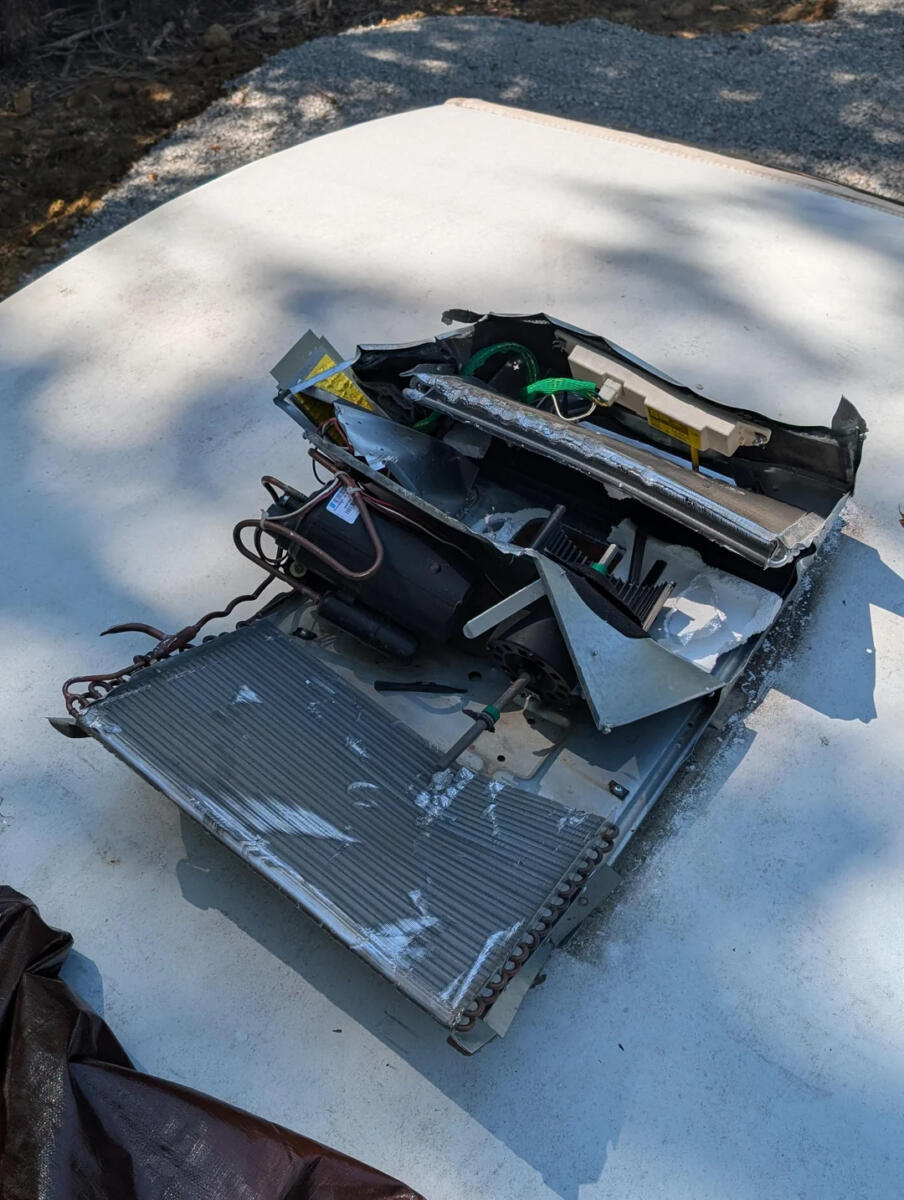
Insurance providers like Progressive highlight that “striking low-clearance objects” is a common cause of major RV damage. These incidents often result in costly repairs due to damage to rooftop components such as air conditioners, vents, and satellite dishes. While RV-specific statistics are hard to come by, bridge and tunnel strikes by all vehicles hitting the overhead, a bridge pier or support, happens somewhere between 11,000 and 18,000 times each year. That information comes from the National Academies of Science, Engineering, and Medicine.
The result of all these bridge strikes is an enormous financial toll. In Texas alone, fixing damaged bridges runs about $7 million a year. Replacing an A/C unit is certainly a lot less, but it’s a big hit for any RVer. Not to mention the time taken away from your trip and (gasp) the embarrassment of it all. So much better to never come close to a bridge strike.
How to measure RV height
Standing next to the side of your rig, eyeball where highest point of the rig is. It’s often the air conditioning unit, but some rigs have a higher roof point. Fifth wheel trailers with their lifted front ends are common.
Once you know the high spot, carefully climb up with a tape measure in hand. If an accessory is the high spot, measure from the edge of the roof nearest the high spot, down to the ground. Then measure the distance from the top of the high accessory to the roof level and add the figures together.
Some have suggested using a laser pointer or laser level, parking it at a known height at the side of the RV, shooting the beam over the top of the rig. Then using a yardstick, measure how much lower (or higher) the rig is in comparison to the laser beam.
Or go “low tech.” If the highest point on your roof is, say, the A/C unit, get a long, flat board (1×4, for example), stick it on top of the A/C unit, let the board reach across over the RV side. Now measure up to the bottom of the board from ground level to get the RV height.
You’ve got the numbers, but what do you do with them?
When the RV height is known, write it down on a tag, index card, post-it note, whatever you have, and put it in clear sight of the driver’s seat. Here’s a caution: We’ve “printed” all manner of information using a label-maker. Trouble is, most label makers use a thermal system, and the info we “printed and stuck” often blackens (or browns) into oblivion. Put your numbers on something that will last.
That will help you when you’re dealing with “marked height” objects like bridges and gas station canopies.
Don’t make the mistake of fully relying on a “height knowledgeable” GPS. Keeping your eyes open while driving is essential, even with the latest tech gadgetry. Remember the driver of the commercial bus who tried to stuff his 13′ high rig through a 9′ high bridge opening. Driver excuse: “The GPS was set for bus, and it didn’t say anything about this bridge!”
Of course, with GPS or an old-fashioned paper height reminder, things can get tricky that aren’t marked. Tree limbs in a campground are a favorite “roof poker.” If you’re not sure, STOP, get out, and eyeball. Or even better, have your navigator hop out and guide you through the problem.
Don’t be afraid to get yourself out of trouble (read this as: learn how to back your rig up). When traveling through Upstate New York, we had plenty of occasions where we had to back the fifth wheel away from low bridges—usually kept hidden around a corner with no prior warning.
We’ll leave you on a high note
Your RV’s roof is not a bumper car. Know its height, keep that number in plain sight, watch for low-clearance warnings, and don’t be shy about hopping out for a quick eyeball check. One misjudged bridge or canopy and your air conditioner will remind you who’s boss. A little prep now beats a lot of repair bills—and a lot of embarrassment—later.
RELATED
- Have you measured to learn the exact height of your RV?
- Motorhome attempts to pass under low bridge. Not pretty
- Video: Motorhome ripped to pieces trying to pass under low bridge
RVT1227

I would also like to point out the dangers of water drainage “ditches” in Kansas that go across main roads. There is a particular one in Meade coming into town from the state park with our paint on it. It also snapped the locks on our tow bar. The “Dip” sign just before we got to it didn’t do the depth of the dip justice! I cringe to think what would have happened if we hadn’t been going as slow as we were!
Many towns and cities have ridiculous changes in pavement levels, just trying to gas up in Salt Lake City without tearing off a waste valve was a challenge. One really has to keep both eyes out watching for dips and little ‘cliffs’ when in towns and cities. We get used to interstate driving where there are no abrupt changes in the pavement.
10′ 3″.
As a short person, I used to love saying ‘I’m eleven-three’!
I used a semi truck routing app when I traveled through upstate New York to avoid low clearance bridges.
One important point is to measure the height of your rig while it’s connected to your tow vehicle, and not just parked while disconnected. Often times, the high point is significantly higher when coupled to the truck. That is the height that matters.
My model brochure had the height. I physically double-checked it. I rounded up to the next foot, added another foot. And that is the height I take as minimum to creep through.
And why doesn’t every campground hang a clearance sign on every tree branch hanging over the camp site? LOL My spouse is (self-admitted) lousy at guiding me back into a camp site, but she is terrific at watching tree limbs.
I keep a 35′ Stanley “Fat-Max” tape measure in the truck for measuring branch heights. Now if I could just remember to use it every time! LOL!
Always add an extra foot to the height of your unit because even though you might be ok. the road may be rough under the bridge and you could bounce into the bridge if it’s close But with extra clearance you’ll hopefully be ok, but it doesn’t hurt to slow down. You never know, they could have resurfaced under it and never changed the signs!
We have a Garmin for RV’s that keeps us away from low clearances. But, its routing isn’t always the best. I think we will get the Rand McNally motor carriers map book.
The Rand McNally motor carriers map book is the only thing we use to map our trips across country or any trip we take. Better safe than sorry.
It doesn’t help. They keep making RV’s taller.
To this day, I’m amazed at the number of RV travelers who rely on Google Maps, Apple GPS, Waze, or similar GPS for navigating with their 12-14 foot high RVs. Even most YouTube Influencers use either one of the above systems, or the dash mount head units with GPS.
I started using a Magellan Unit when I started RV’ing, and switched to a Garmin about 9 years ago. The Garmin isn’t perfect, but it hasn’t tried to take me under any 11-foot underpasses.
I’ve added a list of “point of Interest” (POI) files to my Garmin RV 780 from a web site called “lowclearances.com”, that let’s you customize which bridge heights to include. For example, my fiver is 13′-3″ max. so I can choose 14′-0″ or lower, 13′-9″ or lower and so forth. That way it doesn’t ping all the time. In the end though, nothing beats paying attention.
Driving from Peekskill, NY in our motorhome, we needed to get onto the NJ Turnpike. The sign said “No Commercial Trucks” as we got onto southbound Palisades Parkway. We obviously weren’t a commercial truck I thought. After a while, I saw 3 things simultaneously: a state police car going northbound starting to cross the median in front of me, an arched bridge with a sign that said “10 Feet” and and exit ramp right before the low bridge. I took the exit and the police car didn’t pursue.
Since then, I’ve learned that most parkways prohibit commercial vehicles. Our Garmin will often try to send us on those prohibited roads.
Been very happy with RV Life Pro membership & the Trip Wizard that has many low bridges in the info. We put in our height (I like to add a foot, my DH doesn’t) in case of resurfacing over the years. So far, so good….
Don’t forget to measure the overall height with the air suspension system in road or travel mode! Also, remember road into bridges and tunnels get fresh overlay repairs – signs aren’t always timely updated. Two inch overlay is common!
Merritt parkway in Connecticut was posted “No commercial vehicles.” The bridge clearances got lower as you went west (toward New York) but there was no real warning. We went through three progressively lower, each time saying, “surely if there was a lower clearance ahead, there would be a warning.” And, the exit ramps were on the other side of the bridges. After the third one we decided to get off and a very nice man (in a commercial vehicle) led us over to I-95. State definitions vary, but in Connecticut a “commercial” vehicle was anything used for business purposes, nothing about size.
At the New York line there was a huge sign saying “Truckers: Stay off Parkways – low clearances.”
We measured our class-a at 11′-3″ at the front A/C, eight years ago upon taking ownership of my parents old RV. We stop and take note of any overhang/bridge that is marked 11′-6″.
In my parent’s previous RV, they did rip a roof A/C off late one night on a senior living entry roof. The reason for the accident was driving upset. My mother could not sleep due to nearby train horns, and woke my step-dad. Let’s just say she persisted they drive away, in the middle of the night. One wrong turn, and a bad decision later,….off came the A/C.
Sometimes it’s easy to forget you’re not driving the family sedan, especially if you’re new to your RV.
Before crossing into Canada last summer we added a 4 METER note to the 13’ 1” sign in bright yellow on our dash. Feet and inches won’t help in Canada.
I used our vinyl cutter to put a sign at the top of my windshield ‘RV Height 12.5 ft’. I put it on the inside readable from the drivers seat. This reminds me when I see a bridge height sign whether I can clear without issue.
Thank you for the important reminder to know your rig’s dimensions, Russ and Tina! Have a great week and safe travels!