

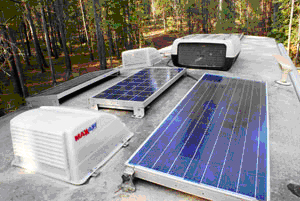
Planning on outfitting your RV with solar? You might move more quickly if you want to save some money. RV solar panel prices will likely increase soon. Yesterday, December 11, the Biden administration announced it will double import tariffs on some solar panel components imported from China.
Solar panel prices hit as tariffs jump to 50%
Beginning next month, solar wafers and polysilicon will see their tariffs jump from 25% to 50%. Solar panel prices could be directly hit. Solar wafers are the electricity-producing portion of solar panels, and polysilicon is used in solar panel construction.
U.S. Trade Representative Katherine Tai issued a written statement about the administration’s move. “The tariff increases announced today will further blunt the harmful policies and practices by the People’s Republic of China,” she wrote. The move is to both penalize China, and to build up U.S. investments in domestic solar panel production.
“These actions will complement the domestic investments made under the Biden-Harris Administration to promote a clean energy economy, while increasing the resilience of critical supply chains,” Tai’s statement added.
Just because it’s not made in China doesn’t mean prices won’t be affected
China has been a major supplier of solar panel components. Even if the panels are manufactured outside of China, if the producers utilize Chinese solar wafers or polysilicon, it would appear the tariffs would apply. RV solar panel prices, which have gone down over the years, could start heading the other direction.
For more information on RV solar panels, click here.
##RVT1187b


This is not only going to affect the RV industry, but the entire Solar Industry in the US.
I do not justify buying from China, however, saying this will build up the investment and production here also will not lower prices. The cost to build manufacturing plants and buy the needed materials from offshore suppliers,plus the increase in labor costs, may actually inflate the cost even more.
The same will happen when higher tariffs are imposed on Canada and Mexico and other countries that make cars and trucks sold here.
The big three have plants in both countries.
Are the foreign car companies that have plants here going to be affected? The answer is yes.
Your not wrong on some of the potential consequences of tariffs Bob.
Here are a couple of more potential consequences:
1,2,&3. Domestic companies that are having trouble competing with slave labor in China or low wages in Mexico will become more competitive and then get busier thus hiring more AMERICANS that will in turn pay taxes on the good wages they are earning, contributing to lower unemployment and a stronger economy. Once the first company proves increased revenue and profit, otherS will join in, start companies and again,….. more jobs, more tax revenue and an even stronger economic outlook FOR ALL AMERICANS.
In the large multinational I was in, they just moved purchases or production to other “low cost Geos” like Vietnam, Korea, or former USSR Eastern block nations like Hungary & the Czech Republic. While it didn’t create U.S. jobs it may have at least helped weaken China a bit.
IMO, if a foreign country is “dumping” or engaging “unfair” practices, slap tariffs on them. If not, find a way to incent U.S. companies to produce more here through various tax credits or other incentives.
Side note: China wages are lower than here, but so is their cost of living. Also, wages there have come up a LOT. They aren’t the lowest anymore.
The best incentive will be some deregulation and a 15% top tax rate for companies that produce American made with American made. Lower taxes lowers prices.
A further incentive to offset the costs to Re:Onshore the operations for companies currently offshoring the labor and production of components or finished products.
IMHO, it is simply better to reduce our reliance on foreign sources. The best example came during Covid when we relied on China for medical supplies and medications.
A lot of diferent legs on the “Tarrif Stool”, including the threat of tarrifs simply being a negotiation tactic.
The problem in America is the high union wages drive the prices of products and services up. While Americans, veterans, senior citizens and low wage earners get small cost of living increases. Our politicians have large salaries, but won’t increase the minimum wage.
“…if the producers utilize Chinese solar wafers or polysilicon, it would appear the tariffs would apply.”
Well, I haven’t read details, but have experience with tariff, imports, and classification for customs. In all my experience, the classifications,codes, and Country of Origin are determined by the place where the final form was manufactured or materially changed into that form. So if solar panels are materially transformed (manufactured) in Vietnam containing components from other countries, the panels carry a COO of Vietnam for import.
Funny, Biden was just slamming Trump tariffs, but kept most from Trump’s 1st term and is adding more! 🤔
I have similar experience over 40+ years in textiles/garments sourcing throughout most of Asia. Took an early retirement, and have been out of the trade for 8 years now, but I’ll assume not much has changed in CofO rules, nor the Harmonized System and the HTS. People freaking out over some possible new tariffs in addition to the over 5000+ items already falling under CofO rules and HS/HTS since forever makes me wonder why they won’t avail themselves of readily available info found on Google, or better yet, DuckDuckGo. As is the case of your concluding comment, for example.
When ole humpty gets back in office and deports all the workers …who is gonna fill their shoes? I seriously doubt if many Americanos will jump right in and pick up the hammers, shovels and trowels these people were using.
aaaaand, how does your comment relate to tariffs on solar panels?
Interesting. When Trump talks about tariffs,it’s all over the news. When Biden does it you don’t hear about except here.Thanks you! I read where Biden kept most of the tariffs Trump put on China when he was in office. Tariffs aren’t necessarily a bad thing. They can be used to make an even playing field if another country subsidizes their products so they can sell it cheaper here and use that to hurt American made businesses. I’m not sure how many solar panels are made in the USA.
Thank you, Russ and Tina! Good to know. I would like to add solar, but can’t justify it because we never boondock. Of course, with it, we might, but that is a moot point. Am glad to understand the industry better. Happy new year and safe travels!