

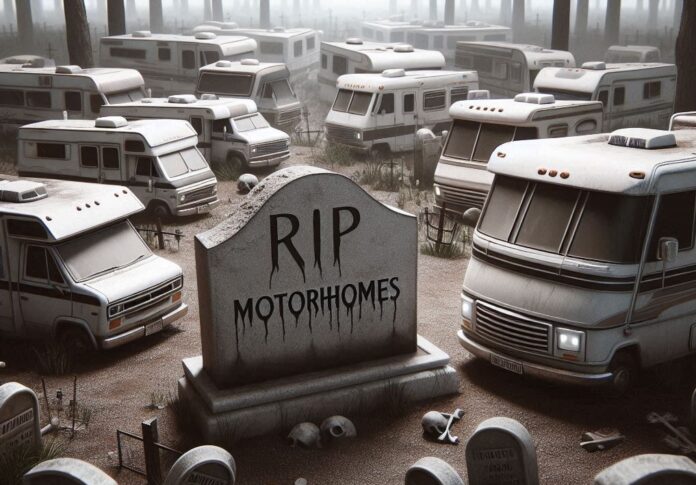
As the RV industry evolves, one trend is clear: Motorhomes, once a cornerstone of the market, have seen a steady decline in sales over the past four decades. In 1984, motorhomes accounted for nearly 38% of all RVs shipped to dealers. Fast forward to 2024, and that number has plummeted to just 10%. In January 2025, only 2,723 of the 27,629 RVs shipped in the U.S. were motorhomes, averaging less than two per state per day. The question on everyone’s mind is: What happened? And perhaps more importantly: What does the future hold for motorhomes?
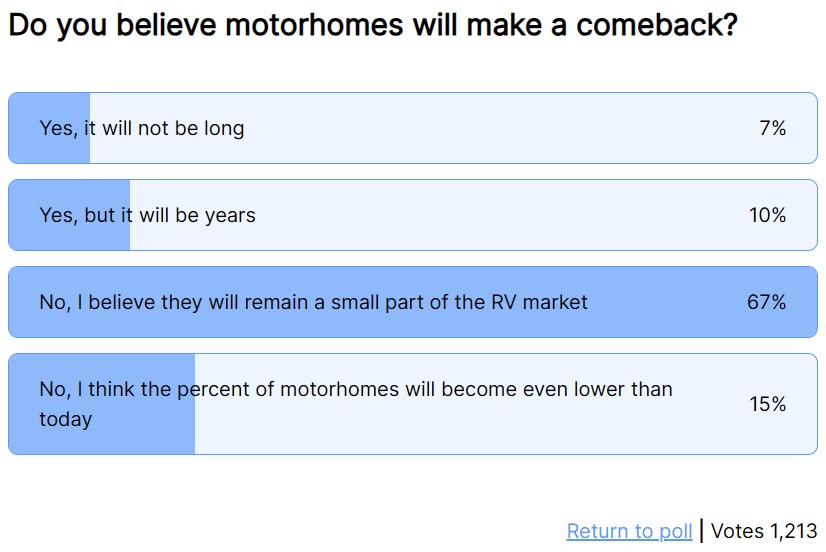
We recently posed this question to our readers and received a range of insightful responses. Along with a poll showing 67% of respondents believe motorhomes will remain a small part of the RV market, these comments paint a vivid picture of the challenges and opportunities ahead for this iconic RV category.
Long-term ownership and declining demand
“I think motorhomes are in a similar situation to SxS UTVs. Most folks who want one have one, and they are a longer-term ownership. You don’t have to replace them so often,” writes Old Wrench.
This perspective highlights a key issue: Motorhomes are durable and often meet owners’ needs for years, if not decades. Unlike towables, which some families might upgrade more frequently, motorhomes are a significant investment that doesn’t require regular replacement (or at least they shouldn’t…).
Safety concerns and logistical challenges
For some, safety is a major factor in steering away from motorhomes. C. Spencer points to crash test videos conducted in Scandinavian countries, calling Class A motorhomes “like toolsheds on wheels.”
“I would never feel safe on the road in one of those. If you’re a family that travels, aside from the safety concerns, there are logistical issues—you can’t go do any sightseeing or shopping without bringing everything with you. You could tow a car, but not really anything that would fit a larger family.”
Motorhomes as a security advantage
Despite safety critiques, Donny sees motorhomes as a security advantage in remote camping situations.
“We sometimes overnight in a rest area when traveling and also do a lot of USFS and BLM camping in off-the-beaten-path areas. Our choice was a motorhome for safety and security reasons. If an undesirable situation were to arise, I felt like we would be sitting ducks in a trailer with no way to get to the tow vehicle. With a motorhome, just jump in the driver’s seat and leave.”
Affordability and practicality
Affordability is another major hurdle for motorhome sales. As J B succinctly puts it, “Who in the hay can afford a fancy new motorhome nowadays? If one has to work for a living, it is a doubtful desire.”
Many readers echoed this sentiment, noting that the high cost of entry, coupled with maintenance expenses, makes motorhomes less accessible for most buyers. Ralph adds that motorhomes are “the least efficient way to travel/camp because you need a toad. Now you’re pushing two engines, two chassis, two vehicles to maintain.” In contrast, towable trailers and fifth wheels are seen as lighter, cheaper, and more practical options.
Fuel costs and market cycles
For MattD, the cost of fuel plays a significant role in motorhome demand. “Does anyone here think there’s a correlation between the cost of fuel and Class A motorhome demand? I mean, we’re talkin’ 6 mpg—that is a big turnoff! If we get fuel costs down, and I mean down consistently, folks may start buying Class A’s again.”
Ron, however, remains optimistic, pointing to historical cycles. “Just look at past cycles. They always have come back.”
The rise of towables
One undeniable trend is the increasing popularity of towables. Lonewolf attributes this to the changing demographics of RV owners.
“Younger campers today—about 40% of today’s RVers are under 40—equals lower-cost entry-level campers. Plus, more households have a pickup in the driveway already, making the jump into the lifestyle quicker and cheaper.”
Kim highlights the versatility of towables, saying, “RV towable trailers have gotten a lot nicer and offer more than they used to. I tow my camper with an SUV that I can use for everyday needs when not camping. It’s nice to disconnect the trailer and use the vehicle for outings.”
A shift in travel preferences
Finally, some readers believe the broader concept of RVing is evolving. D Loyd observes, “I think the entire concept of ‘camping’ or ‘RVing’ is reducing. Taking things like travel speed, convenience, and cost into account, many are simply staying in hotels and flying or driving to their destinations for about the same money.”
Will motorhomes make a comeback?
The poll results suggest a mixed outlook. While 17% believe motorhomes will make a comeback, the majority (67%) think they will remain a niche segment of the market. Meanwhile, 15% predict an even steeper decline. Marie B. remains optimistic about motorhomes’ appeal for certain buyers, sharing her personal experience:
“For us, we didn’t have, nor wanted, a big truck and wanted the convenience of the motorhome. Never have regretted it.”
Whether motorhomes are truly headed toward extinction or simply adjusting to a changing market, one thing is clear: Their role in the RV landscape is evolving. As manufacturers innovate and consumer preferences continue to shift, the future of motorhomes may depend on addressing concerns like affordability, fuel efficiency, and practicality. All we know? The debate is far from over.
##RVT1202


I recently attended the FMCA convention in Perry, GA and there were at least 1200 Class A units attending. What was very apparent was the age demographics of the owners. Mostly older folks who take pride in their coach as they would their home. I have downsized to a class b now that I am in my 70s. I think the new generation is very mobile and driving a huge coach is not in their future. I think manufacturers will have to shrink their class a units to a more European size in the future if they hope to survive. I recently saw an example of this with Tiffins new class C coach which is spacious and efficient. These Class A coaches are so beautiful I would hate to see them go.
Frank, I think you nailed it. As I look around parks, the demographics of those climbing out of a motorized coach versus a towable is consistent and quite predictable. It seems more common to see a young couple hop out of a 5th wheel than a motorhome. The entry level price point between the two might influence the decision more than OEMs want to admit.
Our 40ft toy hauler motorhome and 8 yr old F150 TOAD fits us well. It’s versatile and I don’t need a 80K-100K diesel truck to pull a towable. The 8yr old F150 TOAD is 5000lb curb weight and is going strong and a much better fit for my daily driver. A bonus is the F150 TOAD can easily haul some additional camping junk and a Kayak. We’ll stick with this setup for the foreseeable future.
I’m surprised no one mentioned the regulatory uncertainty. CARB has been clear on its disdain of ice, especially diesel engines and so has the EPA. The complexity required of diesel engines emissions is becoming cost prohibitive for manufacturers and therefore consumers. In spite of the current administration, the war against these engines is sure to come back with a regime change. There is simply no practical and affordable alternative right now for an alternative propulsion system so it seems a bleak prospect.
CARB is being dismantled by the current administration. Can’t wait.
Yes, they have become a niche market for at least 2 reasons. We moved up to a DP in 2018 after 2 TT and a 34′ gasser. The DP was second hand of the best quality we could afford and suited what and why we RV. AND the quality of MH’s has so declined starting with Covid and the consolidation of manufacturers with the “race to the bottom line”. Our 2006 Tiffin 40QSH DP was in excellent shape; and we keep it that way; is Pre DEF made when “quality” was still a word people understand. Lastly our venue are dog trials and will only stop when we stop going and showing our dogs. Our DP fits our “style” of RVing.
At the beginning of the article the author quotes percentages of units shipped in the different years. I believe the shift in numbers is due to the change in accommodations for transient workers. Many of these workers that used to rent apartments or hotel rooms when they moved to another job now just bring their home with them rather than pay rent and then have to pack everything to go to the next job. Plus their families can be with them.
There’s a huge variety of ways to camp and a corresponding variety of people. We all find what works for us. A Class A is a big investment that not all will choose, but it’s the choice for us. To each his own. 😁
I have a DP and love it. We tow a Jeep Wrangler because we go off roading. We could not pull a large enough trailer to meet our needs with the Jeep. Also, our Jeep is a lot easier to park when we go places.
Yet, all the parks are booked up months in advance.
Motorhomes are Big, Heavy, Fuel Inefficient and Difficult/Expensive to Store. And that’s just beginning!
With a motorhome you have “House Problems” sitting on top of “Truck or Bus Chassis Problems”. Definitely NOT inexpensive to repair or replace anything when problems or breakdowns arise in the House or the Chassis!
Motorhomes are not DIY friendly for service or repair for the average owner. Insurance is Mo Money. Licensing and registration of a motorhome is Mo Money. Areas and sites of interest you want to visit and are able to access is less. Camp sites typically cost Mo Money. Tires and brakes are Mo Money to replace.
Why would you want a motorhome?
Bull, they work well for a lot of us. We’ve had ours for nearly 20 years and would probably buy one again.
Yeah, if I wanted to sink my $$$ into a Class A, it would be an older Newmar that has proven its mettle. I wouldn’t trust any new motorhome brands built after 2018.
Says the guy that hasn’t owned a motorhome and is justifying his choice of towing a trailer.
Lol.
Motor homes have been glorified so much they are out of reach for the average working stiff anymore.
New ones can be very expensive. Used ones are quite reasonable.
For us, the motor home is ideal. We usually rv in parks with fhu’s. Very easy to set up, with a panoramic windshield for views of the river, etc. If we happen to take a long trip we rent a car if we’re staying a week or so.
As seniors, we just bought our first motorhome, a used Class C. We want the ease of hook ups, as compared to our previous travel trailers and our 5th wheel.
As quasi preppers, I’m glad to have a self contained “home” should the Cascadia Subduction Zone in the PNW give way.
We went from a 5th wheel to a Class C when I turned 75. But it is only 26′ long, fits in a Walmart parking lot or Flying J RV parking space, is fully accessible with the slide in, and gets 14 diesel mpg. We have no toad, just E-bikes. Our RV has 500w of solar panels, lithium batteries, a 2kw inverter, a 12v fridge, a 12v TV, and a 12v evaporative cooler (no 120vac air conditioner). So everything electric can be used anytime, whether in an RV park or boondocking in the Rockies, without resorting to the generator. In 4 years, we have used our generator for one hour while camping; the other 18 generator run-hours are from periodic exercise at home. We will never go back to a trailer!
Depends on if you’re a destination camper or traveler.
Obviously there’s no right answer, to each his own works best. I do think that there’s going to be an uptick in sales of class C and class B versus class A as others have said here that own class C’s they either use e-bikes or rental car or use their motorhome to get around. We have a 2009 Winnebago View (24.5′) on a sprinter chassis and it suits us just fine easy to drive and maneuver carries everything we need and has plenty of space for us. We’ve put 40,000 mi on it just in the last 4 years at an average of 15mpg. I added solar and lithium batteries along with a diesel heater and It’s been the most practical RV I can imagine.
I see a lot of posts that are just justifying what they own. A motorhome was ideal for us.
You aren’t “pushing two engines”. What a ridiculous statement. We towed the car we normally use at home with the transmission in neutral. Don’t even know it’s back there.
Motorhomes aren’t going away.
Thank you for summarizing the comments, Emily! We had DP #1 for 6 years (only used it for 5 of those) and 48,000 miles. We now have had DP #2 for almost 3 years and 23,000 miles. Once we return from this summer’s planned trip to Alaska and the Pacific NW, we likely will be around 38,000 miles. At that point I may begin to lobby for DP #3. We’ll see. If there is a #3, then it likely will be the last one we buy, but #2 may already be that. Have a great weekend and safe travels!
Except for engine noise on the interstates, our 2017 Winnebago Navion, 26 foot Class C is the best RV ever built. Newer models have minor improvements, but not our propane, battery, engine refrigerator. While driving, we can go back and get snacks or go potty. With the slideout, we have Lots of room. When we want, we pull our Smart Car toad. No decrease in mileage–which is better than most of you: 15 mpg. We lived in it full-time for 7 years–no problem.