


Dear Dave,
We’ll be leaving Pembroke, Ontario, Canada, for Texas on November 1st. I was thinking I’d put 2 gallons of RV antifreeze in my freshwater tank and run all my outlets until I saw some pink. We’ll have a few days of potential freezing. We also have an Aqua-Hot furnace that heats the basement. Do you think this is necessary? And, if so, if we accidentally ingest some RV antifreeze, is it harmful? We will take bottled water for coffee and cooking. —Mike, 2013 Thor Tuscany 45LT
Dear Mike,
I have not had much experience with Aqua-Hot in the winter; however, I have traveled and camped quite a bit in cold weather. Plus, every year we have a winter festival honoring the music of Buddy Holly, Ritchie Valens, and J.P. Richardson (The Big Bopper) called the Winter Dance Party. It is held in February, and it is always below freezing. We use several motorhomes for the bands as green rooms, and it has always been a challenge keeping them from freezing.
What I have found over the years is even in the rigs advertised as having heated basements for year-round use, there can be several “pockets” in compartments and even cabinets that have poor air circulation. They can get very cold and the small 1/2” pipe can freeze. Even plugged into 50-amp service and constantly filling the LP tanks, we have had a few occasions where the pipes have frozen. So, we have experimented with space heaters in the service compartment as well as 60-watt bulbs in critical areas.
What works to keep system from freezing
What does work 100% of the time is just what you recommended: filling the freshwater tank with about 10 gallons of RV antifreeze and running it through the system. I doubt 2–3 gallons will get you very far.
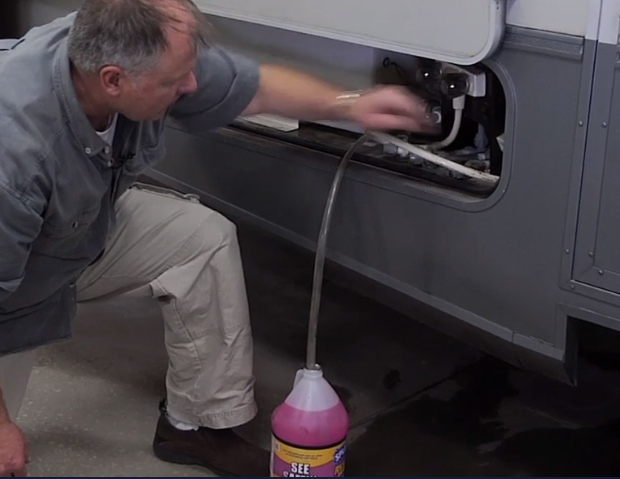
Also, check to see if your Thor has a winterizing valve rather than filling the freshwater tank. There should be a switch or valve in the service compartment with a hose. Turn the switch and the onboard water pump will draw from the hose, which you can put in the RV antifreeze gallon jug rather than the tank.
We then have gallon jugs of water in the bathroom and kitchen so people can use the toilet and wash their hands. This generally keeps them from being in contact with any of the pink stuff. However, we always have a few that just flush the toilet or turn on the sink without thinking—which is fine, because it is non-toxic.
Is RV antifreeze toxic?
The Food and Drug Administration (FDA) has labeled RV antifreeze made with ethanol or propylene-glycol as “Generally Regarded As Safe” (GRAS), and safe to be used in the freshwater system. However, the propylene glycol in larger quantities can be toxic for pets, so make sure you clean out the pipes and freshwater tank thoroughly, or make sure they don’t have a way in ingest it.
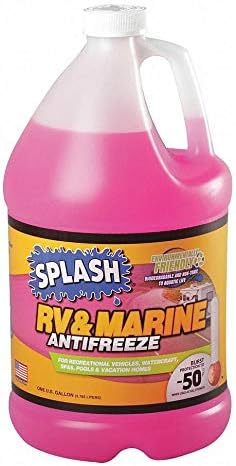
Automotive antifreeze is made with ethylene glycol, which is toxic to both humans and animals. So you definitely want to make sure you read the label and get the correct antifreeze.
My preference
As I stated, I have traveled and camped often in below freezing and even below zero temperatures throughout the country. My choice is to drain all the water in the freshwater tank and blow out the lines. Filling the freshwater tank does leave a funny taste that I can detect and it seems to take quite a few cycles to get rid of it.
I blow out the lines and add a few gallons of RV antifreeze to the black and gray water tank, then have ample jugs of water for the bathroom and kitchen and drinking water in the refrigerator. This way I can still use the toilet and sinks, and rest assured that nothing else will freeze.
As for the shower, whether you blow out the water or run RV antifreeze through the system, you won’t be using the shower unless you do a military type shower with the extra water, which I have done. It is fairly cold—unless you keep the water jugs by a heat register!
You might also enjoy this from Dave
What maintenance does an Aqua-Hot system require?
Dear Dave,
What’s the best maintenance for our Aqua-Hot heating system? It’s not working at the moment, but I’m chasing down a repair tech. —Mike, 2013 Thor Tuscany 45XT
Dave Solberg is a leading expert in the RV industry and the author of the “RV Handbook.”
Read more from Dave here.
##RVDT2231


Being born in Ontario and now having lived in the USA for a long time, I don’t think that his trip from Pembroke to Texas will require much in frost areas if at all. At least where it will actually get cold enough to solidly freeze your unit from working.
I am not an expert or even close, so yes, do what Dave tells you, but look. at your Farmers Almanac and decide.
We travel from Toronto to the Southwest leaving mid-December. As Dave does, we also blow out all the lines with air, adding RV antifreeze to the gray and black tanks. We bring water jugs for washing and the toilet. I never want to have any type of antifreeze in my freshwater tank or lines.
If you’re winterizing, be sure to shut off your ice cube maker for your refrigerator! I have a shut off valve under my sink cabinet that’s kinda hard to find, but there should be one in that area, usually connected to 1/4″ clear/white poly tubing that goes to your ice cube maker.
Snoopy
I don’t think the supposed underbelly heat vents that manufacturers say prevent freezing, actually prevent freezing. Our 2012 Arctic Fox has those (as shown in a factory tour) and we’ve had two freezing events that took two days to thaw. Tank heaters might do a better job, but even then, they do not prevent line freezing. One episode happened in Houston in a VERY rare freeze while camped there. The other was on our way HOME from Houston where we had no choice but to keep on truckin’.
My solution? Don’t move in cold weather – ha
Ethanol blend is more poisonous than the propylene-glycol blend. Ethanol is also flammable. Both are bad in large quantities though. When I de-winterize my trailer, I open the low point drains and catch the A/F in the original containers to be recycled. Most chain auto parts stores will recycle it.
Propylene-glycol is also used as a food preservative in very small quantities.
Thank you, Dave!
Putting the A/F in the fresh water tank is waste of money. 2-3 gallons will probably not pump through. The line to the pump is not right at the bottom of the tank, but an inch or so above the bottom.
Because of the shape of the tanks on TT’s, a lot of A/F lays on the bottom and takes forever to flush out. Plus, some water in the tank will not cause problem even if it freezes. The water freezing has a lot of room to expand.
A winterizing kit is not expensive or hard to install.