

By Cheri Sicard
Sweltering summer days in an RV, van, or tent can quickly test anyone’s patience. Most coolers just keep drinks cold, and most portable A/C units cost a small fortune. The Solo Windchill 47 changes things up by offering both features in a single, rugged package.
The hands-on review in the video at the end of this post from the team at Playing with Sticks covers how it stacks up in the real world and whether this cooler-and-A/C-unit-in-one is worth packing for your next outing.
What is the Solo Windchill 47?
The Solo Windchill 47 is a portable hybrid cooler and air conditioning unit. It swaps the makeshift fan-over-ice hack for a built-in heat exchanger that actually pumps out cold, dry air. Instead of blowing damp or tepid breezes, this model is built to noticeably change the air in a small trailer, tent, or camp space!
To transform from cooler to A/C mode, the Solo Windchill 47 needs three things:
• Ice: Regular or block ice, but don’t go above the fill line.
• Water: Just enough to fill a little sump at the bottom, activating the pump.
• Power: Use the included lithium battery or plug into a portable power station.
Inside, a proper heat exchanger chills hot, humid air and spits out cold, dry air.
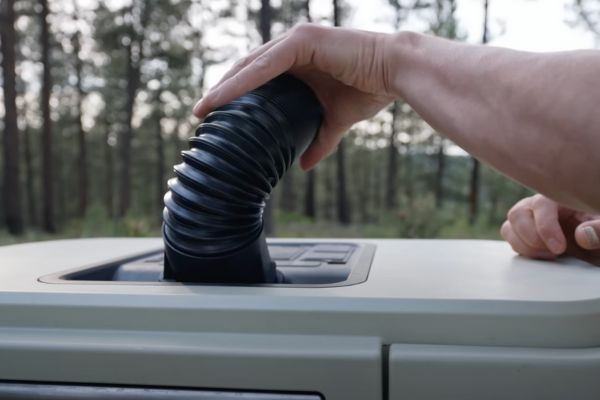
This isn’t just a basic ice chest with a gimmick. The Windchill 47 rolls on big all-terrain wheels and sports a telescoping handle (although it can stick). There’s a beefy lid with a warning—close it gently, or risk pinched fingers. Users get a drain, a bottle opener, accessory rails, a side table, a retractable air hose, and both USB-A and USB-C charging ports. The air intake vent needs to remain open for best performance.
On the downside, sized at 47 quarts, the Windchill 47 is only a bit bigger than the popular 45-quart rotomolded coolers, but it feels a lot heavier in practice, especially after the ice melts into dense water. The design takes up noticeable space and isn’t easy to haul solo.
Air conditioner cooling modes overview
The Solo Windchill 47 offers three main modes:
• Eco mode: Runs the fan over ice, mimicking the classic DIY “fan on a cooler” hack.
• Max cool mode: Activates the full A/C setup, with heat exchanger and water pump, for cold, dry air.
• Mist mode: Shoots out a powerful mist, perfect for outdoor family use or quick cooldowns.
Even basic eco mode pumps out a strong, chilly breeze. With max cool, users reported the air feels “like an A/C room.” Mist mode can spray far and cool a group at once, adding a bit of playful fun.
Real-world testing inside a camper trailer
Tested on a 95°F day in a sealed camper, the Windchill dropped the temperature from the high 80s to 75°F and cut humidity from 60% to 44%. Cracking a vent in the camper for heat to escape sped cooling, driving temps down below 70°F in minutes. It’s not quite house-level air conditioning, but in tight spaces, it makes a real difference.
The cold air hose fits nicely into a tent or a teardrop’s window using a custom cutout (plexiglass or wood). With the air intake vent open, there’s solid airflow. Placing the unit in the shade keeps ice from melting too fast.
Battery and power consumption details
Power draw depends on the mode:
• Eco mode: 20–21 watts
• Max A/C: 23–25 watts
• Mist mode: 29 watts
The unit comes with a 10 A or 17 A lithium battery, and the bigger battery gives about 4 hours of max AC runtime. A DC power port on future models would help reduce energy loss through inverters.
Running A/C or mist modes ramps up ice melt—24 lbs. of ice can vanish in 4 hours of constant cooling. If used as a regular cooler, the Windchill retains cold on par with other roto models. Pre-chilling, using block ice, and limiting AC use stretch out ice life.
The Windchill runs as quietly as a household fan on low or medium, but the high fan can sound like a hair dryer. Mist mode may seem louder on camera but is quieter in person, especially when using the extension hose.
Practical considerations: Weight and portability
Once loaded with ice and water, it’s hefty and awkward for a single person to lift. The telescoping handle only works well from one side. Plan on using a hitch carrier or getting help for longer walks or hauling.
Retail price is $649 with the 10 A battery, or $699 with the 17 A battery. Competing A/C units like the Zero Breeze or EcoFlow Wave 3 cost around $1,300—and can’t double as a regular cooler. The Windchill 47 offers both functions at about half the price.
It’s ideal for campers or trailer owners who have ready access to ice and power. It’s a strong fit for families at summer events, teardrop trailer fans, or anyone who wants a portable cooling solution for the lake, sports sidelines, or backyard.
Summary of pros and cons
Pros
• Dual-purpose cooler and A/C unit
• Portable cold air anywhere
• Good battery runtime
• Affordable compared to most portable A/Cs
Cons
• Heavy, especially when full
• Increases ice melt when running A/C
• Requires vent open for best cooling
• No direct DC port (yet)
• Noisy on high fan
Order from the Solo Stove website.
RELATED
- More than one million Igloo coolers recalled due to finger amputations
- What are the three best RV air conditioners? A tech magazine answers
- Top 3 cooler hacks that will make your ice last longer
- How can I make RV’s central A/C work better when it’s 115 out?
- RV air conditioning mess: Don’t let your A/C get completely clogged
RVDT2710

Thank you, Cheri, for presenting this fascinating combination. I was surprised by how well it showed as an air conditioning unit. Have a great day and safe travels!
The other day, I believe Mike Sokol, clarified, there’s no such thing as a solar generator. Thank you! Today, we’re battered with atempts to make a swamp cooler an air conditioner. Please Stop. Stop the inbetween blurbs touting portable A/C’s, that too, are glorified swamp coolers. This gadget reduces humidity, but does it as well a traditional air conditoners? Maybe, but that wasn’t disclosed. We may be in a time where compressorless cooling units perform as well or better than traditional A/C’s, so say so, and say it immediately, upfront.There are people that don’t know how A/C’s work; They don’t need too! For many of your subscribers, RV Travel is the bastion of truth. Keep it that way.