

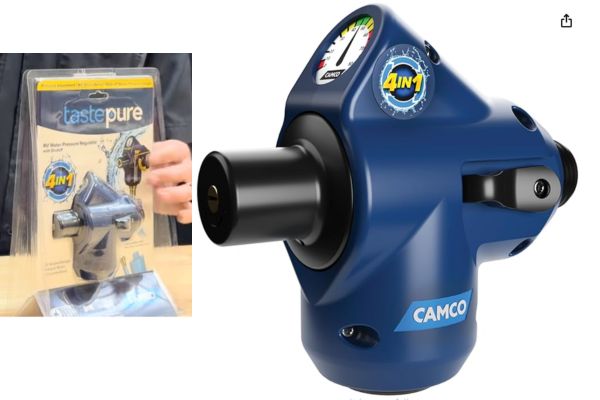
RV water hookups can turn into a pocket full of little brass parts fast. Nick from That RV Tech spotted a new Camco accessory at Menards that aims to replace that pile with a single piece. He shares his thoughts in the video at the end of this post.
Nick’s first look at the Camco TastePURE 4-in-1 was positive for one simple reason: It cuts down on clutter. Still, one design problem stood out as soon as it came out of the box.
What the Camco TastePURE 4-in-1 gets right
Camco combined several common RV water hookup parts into one unit. The device includes an adjustable pressure regulator, a shut-off valve, a 90-degree elbow, and a pressure gauge. For RV owners who hate keeping track of separate fittings, that is the whole point. One part can replace several small accessories in the storage bay and make setup quicker at the campsite.
Why the 90-degree elbow matters
The elbow is not there for looks. When a hose sticks straight out from the RV water inlet, its weight can pull down on the connection. A 90-degree fitting keeps that weight closer to the wall, which usually helps in a few ways:
• It reduces stress on the water inlet.
• It helps prevent kinks at the connection.
• It keeps the hose from pulling down on the plumbing.
That is why the elbow part of this design makes sense.
Why the “4-in-1” label feels stretched
Nick’s first critique was the name. After a closer look at the packaging, Camco lists the four functions as pressure adjustment, 90-degree strain relief, shut-off valve, and pressure gauge.
That is how the company gets to “4-in-1,” but he still sees it as more of a 3-in-1. The gauge is part of the regulator assembly, not a separate accessory. For him, counting the regulator and gauge as two separate things feels like a marketing push.
The main problem is bulk at the RV wall
The bigger issue is weight. Because all those parts sit in one assembly, the unit is larger and heavier than a basic brass elbow. In the video description, he notes that it sticks out about an inch-and-a-half from the side of the RV.
That changes the whole strain-relief idea. A part meant to reduce pull on the inlet still hangs off the wall with more mass than a simple elbow. He felt that detail should have been caught before the product hit the shelf.
A simple fix for a future version
Nick’s suggested fix is simple: Add a stand-off foot or brace. If a small support rested against the RV wall, it could help carry the weight and reduce leverage on the inlet over time.
He also noted that an adjustable version might work better on stick-and-tin RVs, where wall depth can vary. For owners who like to tinker, a 3D-printed support could solve the problem.
A good idea that still needs field time
Even with the criticism, Nick’s take stayed upbeat. He likes seeing companies such as Camco try new ideas that make RV life easier, even when the first version misses a detail or two.
He also plans to test it in real use, because a quick bench impression is not the same as a weekend at a campground. Nonetheless, he says that Camco has a good concept here. The 4-in-1 makes RV water hookup simpler, and that alone will appeal to a lot of owners.
The weak point is the leverage hanging off the inlet. If Camco adds better support in a later version, this could become an easy add to an RV water kit.
It’s available on Amazon here.
RELATED
- Why RV water pressure regulators are essential
- Water pressure regulators keep geysers out of your RV
- Beware damaging your RV with high water pressure in campgrounds
RVDT2923
Will be awkward if your filtration system requires the regulator be placed before the filter.
Shouldn’t the pressure regulator be placed at the source to take the pressure off of the supply hose?
Most of the time, the regulator is installed on the water supply bib before the hose, not the water inlet on the RV. This also protects the hose from pressure fluctuations.
Plus, standard procedure is to shut off the water at the bib, in case the hose breaks or starts to leak. We always turn the water off at the source.
A standard regulator at the bib right next to the shutoff and a 90º elbow solves both problems. And is probably less expensive.
Two other problems are, first the description calls it a “Tastepure” device. This makes people think it is a also a filter.
The second is the use of plastic fittings instead of brass. Easily cross threaded or damaged.
Can’t argue with most. Most hoses are rated for 80-125 psi. Most parks rarely exceed 60-70psi. I do carry a dedicated water pressure gauge to check park pressure if at a new park. I’ve abandoned the idea of an adjustable regulator, but like the built in good/bad pressure gauge. And I want the disposable filter in front of the regulator to keep grit out of my regulator. The shut-off at the wall is to disconnect the still pressurized hose and safely point it to let off the pressure.
Do you need an adjustable pressure regulator? If so, great. But what I use is a brass 90, Camco’s fixed regulator with gauge ($25), and a plastic Y with shut offs and quick connects. Cost is less, weight is less. Why the Y at the wall rather than spigot? I also carry a much shorter (and therefore lighter) coil type hose for the black tank flush (backflow preventer at the flush port).
For the rest, I have a 25′ potable-water version pocket hose, quick connects on the filter with a 2′ hose between filter and park spigot. My whole setup rides in a small bucket. The bucket contains any leftover drips between setups. A minute to connect, maybe 3-4 minutes to drain and stow.
looks like the hose will hang down and cover by black flush inlet, so I would have to wiggle around it.
Thank you for the video and summary, Cheri. I like having a regular pressure regulator at the city water faucet, followed by an in-line water filter, next the water softener unit, my water hose, and then the whole-house water filter. This seems a bit of a solution searching for a problem to solve. The simplicity and elegance of the traditional 90° brass elbow remains the standard for reducing stress on an RV city water wall connection. Have a great day and safe travels!