


Hello Dave,
We need to replace our house batteries. Our current batteries are 2 NPD 12V 250AH AGM Sealed Batteries. Our coach is a DP [diesel pusher] running a 300 Cummins 6.3. What batteries would you recommend for this coach? Thank you. —Kurt, 1992 Vogue Prima Vista
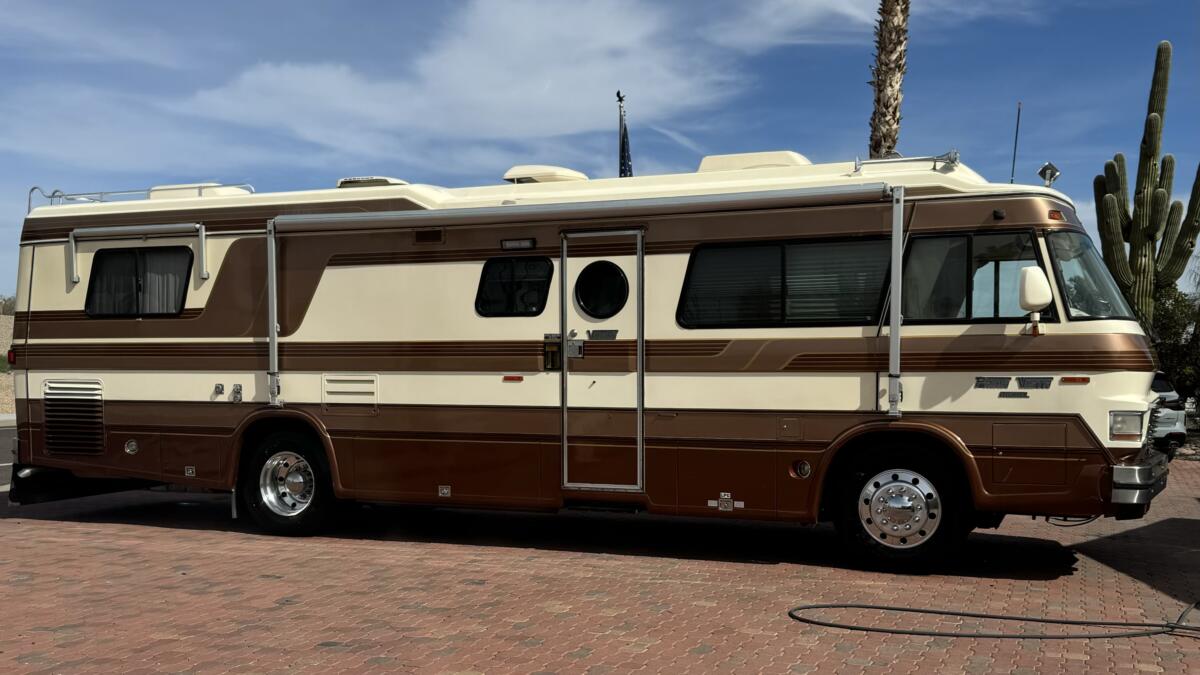
Hi Kurt,
What a beautiful coach! I remember being at the FMCA National Convention in 1991, working for Winnebago, and that coach was across the aisle from our display. At the time, we had nothing that would compete in that motor coach class! We also had the luxury of using a similar Vogue in 1993 when we played in the National Softball Tournament in Birmingham, AL. It was ironic, as we were sponsored by Winnebago Industries and the local Winnebago dealer picked us up at the airport in a Vogue demo unit. He let us use it for the extended weekend as a getaway at the baseball diamonds.
OK, back to the batteries. Originally, I believe this unit came with four 6-volt batteries connected in series and then parallel. They were most likely Trojan brand flooded lead acid (FLA). This unit requires a lot of 12-volt power. That is why, many years later, someone installed two 12-volt batteries that were rated at 250 Ah each.
I am not familiar with the NPD brand so I did a little research. I found they are sold by a company called Power Storage Solutions and are listed as NPPower model NPD 12-250AH Deep Cycle Batteries. Their website lists usage for solar, wind, and electrical vehicles, but no mention of RVs, so that is probably why I have not heard of them. They do look to be a very good quality battery, just not a common brand used in the RV industry.
What is the best battery for your RV
This is a question I get quite often from readers and especially at my seminars across the country. There is no “stock” answer that will work for everyone. The best battery for your rig depends on the following factors:
- How often do you dry camp or camp without a connection to a recharging source?
- What is your amp hour consumption?
- How long do you intend to dry camp or, more important, how long do you need battery power before recharging?
- How much do you want to spend?
How often do you dry camp
Dry camping or boondocking means staying in a location that does not have power, water, or dump stations, so you will need to rely on your on-board systems, which means battery power. Batteries simply store energy which is rated in amp hours, which will be covered later.
If you are going to be camping in locations that almost always have access to shoreline power, you do not need to spend much money on a huge battery bank. The converter or charger will provide a constant 13.2 volts, so a cheap set of FLA batteries will be sufficient. Keep in mind, this will limit you to the amount of time you may occasionally want to spend a night in a rest stop or Walmart parking lot. Also, they most likely will not last more than a year or two.
What is your amp hour (AH) consumption
As stated above, batteries store energy, and that is rated in the amount of amps that can be provided per hour, or Amp Hours (AH). So a 100 AH battery can provide 100 amps for one hour.
To calculate what your rig requires for amps per hour, you need to identify what appliances and 12-volt components will be running. This is the hard part, as it is difficult if not impossible to determine how many lights will be on for how long, how many times the LP appliances will “cycle,” and what else will be drawing power. Other factors include power used by the water pump, roof vents, and any 120-volt appliance that is powered by an inverter such as a TV or, the biggest power monster, a residential refrigerator. Another power monster is an LP furnace, which draws power for the fan and can drain a battery fast.
As I stated, it is difficult and not a perfect science. However, several battery and solar panel companies have developed power calculators that will at least get you started with what you have in your rig and how often you use them. I have found these three to be the best.
These all have calculators to at least help you think about what is being used and get a general ballpark of the power requirements of your rig and your RV lifestyle.
What do you mean, “I can’t have it all”? Flooded Lead Acid (FLA) and even the Absorbed Glass Matt (AGM) batteries that you currently have can only provide 50% draw down power or they will become defective. So the 250 AH AGM batteries you have connected in parallel would only provide 250 AH when they were in new condition.
Advantage of AGM batteries
The advantage of AGM is they are completely sealed with less gassing and less prone to sulfation attacking the plates. That means they will provide superior AH capacity for a longer period of time versus the FLA batteries. FLA and AGM batteries can only be drawn down to 50% capacity before damaging the cells. So your two 250 AH batteries actually have 500 AH capacity but will only be able to provide 250 AH of power if they are not sulfated.
It is impossible to accurately calculate the amp hours you will need for your type of camping as everyone is different. However, using the calculators on the websites and getting some real world feedback from RVers, the average RVer uses 75-150 AH per day. That’s with moderate appliance usage and not a residential refrigerator or appliance such as air fryers or fancy coffee machines. One other 12-volt power drain is the LP furnace, which requires 12-volt power for the fan and can drain a battery in a short period of time.
How long do you intend to dry camp
For an overnight stay using mostly LP appliances and not the furnace, you will be able to get by with a low AH battery. However, if you are planning to dry camp for several days, you will need to multiply the AH daily requirement by the number of days. And keep in mind, the more people that will be coming along, the more lights, toilet usage, showers, and such will also amplify the 12-volt requirements.
How much do you want to spend
High AH FLA batteries and even the AGM NPPower models you have in your rig were top of the line a few years ago. They provided 250 AH, which meant you could typically go a weekend before the needed to be recharged. Those batteries were most likely in the $300-$400 range each. Lithium ion has been the hot button lately. They can be drawn down to 100%, but the cost is $800-$1000 per battery. And you cannot just drop a new set of lithium batteries into a rig without verifying the charging system and many other factors, such as cold weather considerations and length of cable.
Answering these questions and analyzing your RV needs will help determine the best battery for your rig.
You might also enjoy this from Dave
Do’s and don’ts when replacing RV batteries
Dear Dave,
We’re beginning our 5th year full-timing in our Vilano. I suspect we may soon need to replace our two 12-volt batteries. I would like to know what to look for in choosing replacement batteries. I’d also like to know the correct procedure to remove the old batteries and install the new ones, including the do’s and don’ts and things to watch out for. Thanks. —Bob, 2018 Vanleigh Vilano 325RL
Dave Solberg is a leading expert in the RV industry and the author of the “RV Handbook.”
Read more from Dave here.
HAVE A QUESTION FOR DAVE?
Send your inquiries to him using the form below.
##RVDT2394


If getting new batteries, a good first question is if you are happy with what you have. If so, replace them with like batteries.
If not, what specifically is it you don’t like? The maintenance or corrosion in the battery bay (FLA)? They don’t hold a charge long enough? etc. Then use the great decision tools Dave provided above to make a decision that fits the available space & weight limitations and your budget.
I recently replaced my 12 Y.O. bank of 8 220aH AGMs. Almost always plugged in. Residential fridge. Wanted to save weight. Replaced with six of the same.
Thank you, Dave! 🙂 What a beautiful RV!?!?! Thanks for including a picture of one. 🙂 So elegant! Thank you, too, for links to the three power-use estimators. I vascillate between just buying all the lithium ion battery capacity that I can afford and logically deciding by using such a calculator. Thanks again and safe travels! 🙂
I didn’t know why you wouldn’t just switch to lipo4 as they are generally rated at 3000-8000 charge cycles and you can discharge them quite safely down to 10%. So if cost is a factor consider the available watt hours, amperage they offer which is basically double (agm or fl) and the longevity, you could easily get 10 years with a good lipo4 and they also offer built in bms and sometimes Bluetooth. Prices have come down and are close to AGM you can generally get 200amp lipo4 for around $400. Battle Born cost more. On an older coach you may have to upgrade your charger controller. But in the long run you’ll be better off switching and you’ll save a few pounds in weight.