


By Dave Helgeson
A recent tip on a social media site recommended pulling the breakaway switch to prevent RV theft. The author likens it to setting the parking brake on a car and pulling the key out of the ignition, preventing a thief from hooking up and towing it away. Thankfully, since this is the worst tip I have ever read, the post was removed shortly after I read it. This was most likely the worst tip ever for preventing RV theft.
I will explain why it was a bad idea below. But first, let’s review the function of a breakaway switch for those who may not fully understand.
A breakaway switch is required on any type of trailer that is equipped with electric brakes. If the trailer disconnects from the tow vehicle in transit, the cable/lanyard pulls a pin out of the breakaway switch, fully activating the trailer brakes via power from the house battery. This is equivalent to the brake control in the tow vehicle applying full power to the trailer brakes in an emergency. Learn more about breakaway switches from the late Gary Bunzer, the “RV Doctor,” here.
Why pulling the breakaway switch to prevent RV theft is a bad idea
• A thief could easily defeat this “theft protection” by clipping a wire to the breakaway switch, thereby cutting power to the trailer brakes.
• A thief could use a pin from another trailer parked nearby to insert in place of the one removed. Note: The pins on breakaway switches are not unique like a key to an ignition. There are only a couple of varieties of breakaway switches and pins manufactured. This is akin to the 751 keys used in almost all RV baggage doors.
• If you are dry camping, the electrical draw from the trailer brake magnets will quickly deplete the house batteries, allowing the RV to roll away via a thief towing it away or gravity.
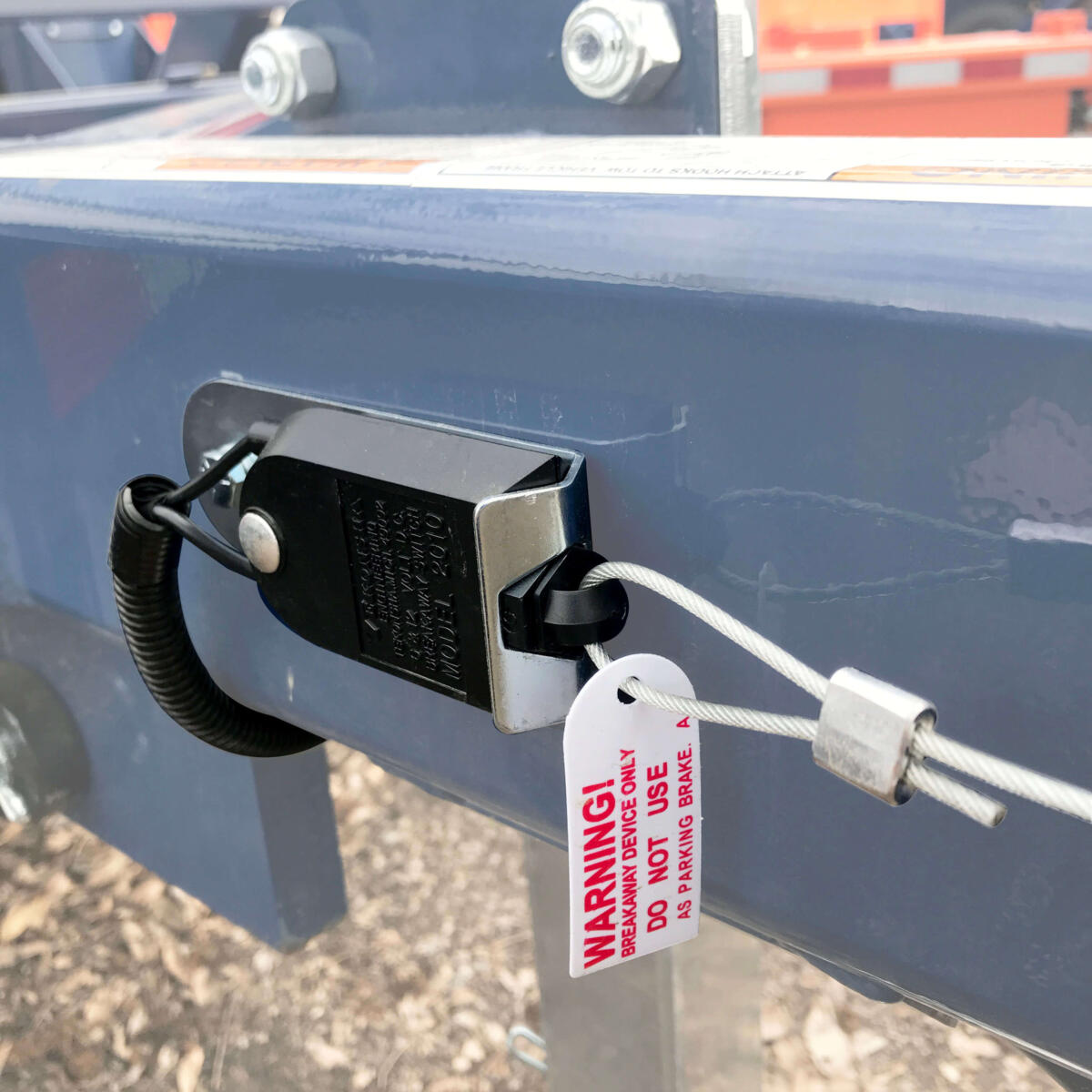
RV theft or not, leaving your breakaway switch engaged for an extended period could be catastrophic
Remember, a breakaway switch is only designed to supply power to the brakes long enough to stop the trailer if it were to separate from the tow vehicle. This very short period would provide insufficient time to deplete your house batteries or provide time for overloaded brake wiring to heat up.
Potential outcomes for leaving the trailer brakes applied via the breakaway switch for an extended period:
• Dead house batteries: As mentioned above, if you are dry camping and relying on your trailer brakes to keep your RV in place, once the house batteries are depleted, your RV could roll away if not properly chocked.
• Electrical fire: There is no circuit protection (fuse or circuit breaker) on most travel trailers or fifth wheels equipped with a breakaway switch. Once the switch is activated, you have upwards of 3 amps per brake magnet flowing through the switch and brake wiring. There are multiple things that go seriously wrong involving load from the trailer magnets, the breakaway switch, shorts to ground or resistance/corrosion. RV theft prevention? Forget it. Just leave the pin in your breakaway switch.
The breakaway circuit and brake coils are not protected by a fuse or circuit breaker, per this astute RVer’s observation.
You can overload the breakaway switch
With the electric magnets drawing three amps each, you could overload the breakaway switch, resulting in a fire. Example: A triple-axle fifth wheel would draw upwards of 18 amps (6 magnets X 3 amps per magnet) when the breakaway switch pin is removed. Add in twenty or so feet of brake wire from the breakaway switch to the rear axle (distance is resistance), along with a bit of corrosion in the switch and wiring connections. (After all, these components are all under the RV getting sprayed with water and road salt.)
In addition, amperage is increasing as voltage decreases. You could easily have a 20-amp load, or larger, flowing through a breakaway switch equipped with 16-gauge wire rated to carry 15 amps over a length of 3.8 feet, and some say considerably less. With no circuit protection, the excessive amperage flow on a light 16-gauge wire could cause the wire to melt, or catch on fire, possibly igniting other components of your RV.
A short circuit is another potential fire risk while the breakaway switch pin is removed. If something were to short the hot line between the breakaway switch and magnets, the unprotected circuit would quickly get hot and melt until causing a wire to fail, opening the circuit or, worse, catching your trailer on fire. Examples: Exposed windings on a magnet grounding out to the brake drum, an equalizing bar being dropped on the hot wire of the breakaway switch on the tongue of a travel trailer, or a wire detaching and becoming pinched by a stabilizing jack, etc.
RELATED
- 9 ways to prevent travel trailer theft
- New catalytic converter device stops thefts. Brilliant concept
- Lessons learned from the theft of our RV in storage
- RV Doctor: Trailer breakaway switch and inverter questions
- Where do you hitch your breakaway cable?
RVDT2947
Fully agree. If you want to lock your wheels to deter theft, buy a wheel lock. I personally wouldn’t want to cart one around while traveling, but might be just the thing at a storage lot.
For the record, I built a tongue jack dolly to maneuver our small travel trailer in tight spaces. I can activate the trailer brakes with a switch on the dolly handle that works through the 7-pin connector. The idea was to set the brake just long enough to slip a chock in place. Not to be an actual parking brake.
If you want to prevent your travel trailer from being stolen why not buy a hitch lock? I’m sure there are other deterrents out there also. I’m sure there are 5th wheel options too.
Thank you for the discussion, Dave. Thank you for re-running the article, Emily. Interesting suggestion, but easily understood why is a bad idea. Have a great day and safe travels!