

Here’s a nugget of conventional, albeit incorrect, wisdom about RV water heaters: “Steel tanks require an anode rod to protect against rust, but because aluminum doesn’t rust, aluminum tanks don’t require an anode rod.”
Unfortunately, that’s not quite accurate. Actually, both types of tanks require cathodic protection. But Dometic has cleverly integrated the protection into the tank lining itself. Suburban has chosen to rely on a separate, replaceable anode rod.
An anode rod will lay down its life for its friends
Not sure what an anode rod is? Well, you see, city water carries minerals and heavy metals that eat away common metals. Unchecked, these elements will corrode the walls of the metal water tank, which is pressurized under operation up to 80 psi. Abandoned, after enough time the water heater’s tank will corrode, pit, crack, and fail.
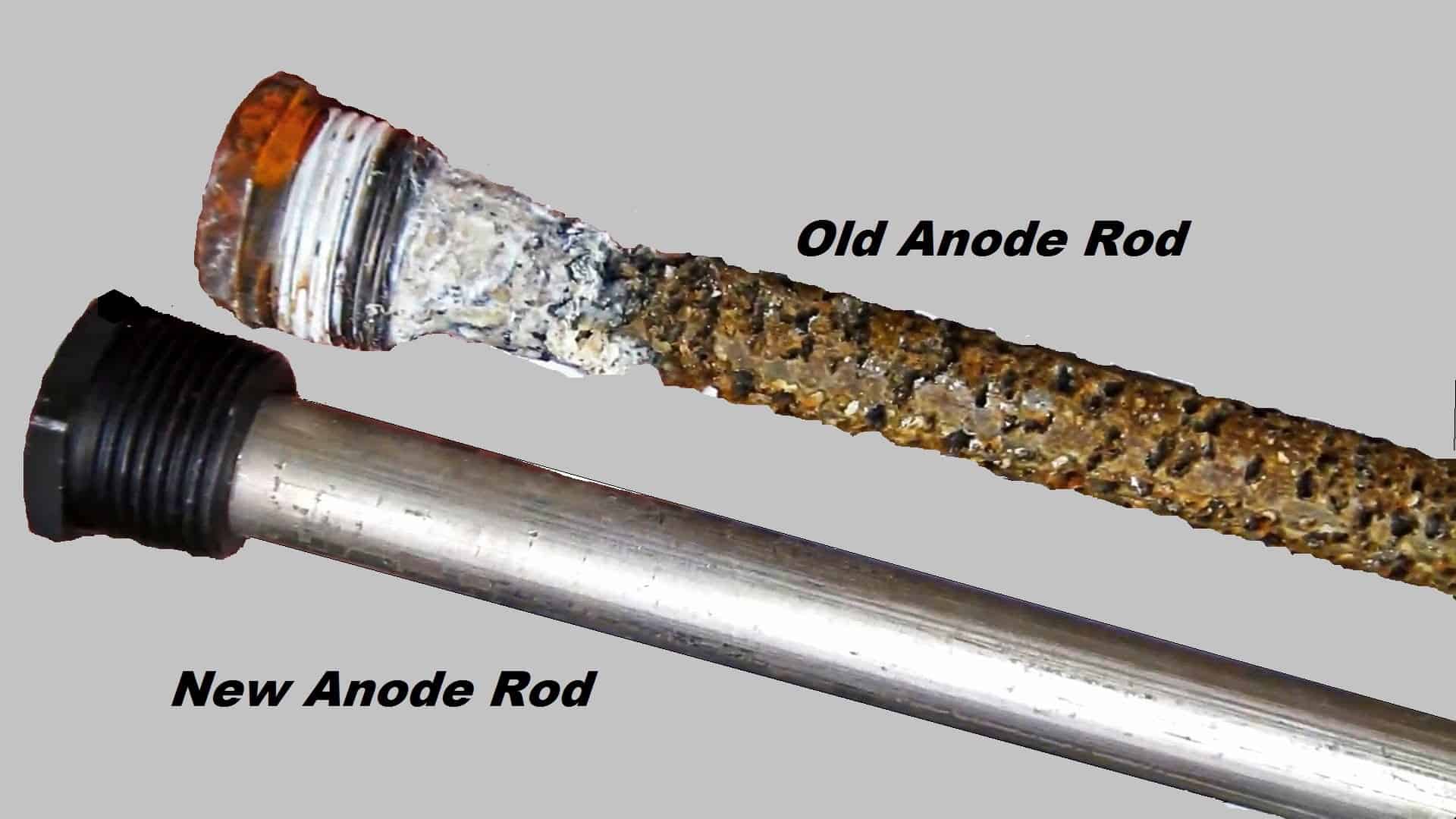
Passive anodes lay down their lives for their friends. The corrosive elements eat away the metal of the sacrificial anode instead of the tank. Once an anode rod has about 25% life left, it should be replaced. Many RV owners make a habit of replacing their anode rod once a year while draining and descaling their water heater while winterizing, or while sanitizing and bleaching during dewinterizing.
Two types of anode rods: magnesium and aluminum
There are two types of water heater anode rods. All standard RV anode rods are 0.75 inches in diameter and 9.25 inches long.

• Magnesium: Best for soft water and the widest range of protection. It’s the most common choice for RV water heaters.
• Aluminum/zinc: Best for hard water and water rich in sulfates, which can cause a rotten egg smell. Aluminum anode rods typically corrode slower than magnesium. However, they may offer less protection because of aluminum’s relatively benign galvanic potential relative to carbon steels.
Does a Dometic aluminum tank still need an anode rod?
Now, as I said, both Suburban (steel) and Dometic (aluminum) tanks do actually require cathodic protection. However, Dometic has integrated the anodic material into the tank lining; Suburban uses a replaceable anode rod.
Suburban uses a glass-lined steel tank. In the perfect world, no anode rod would be required, because the glass enamel electrically isolates the tank metal. However, over time, micro cracks and pinholes develop in the glass lining. Water sneaks in. Galvanic corrosion begins. The anode rod is recruited into action as the next line of defense.
Dometic, on the other hand, fuses a layer of 7072 aluminum (aluminum + zinc) to the interior of their high-strength aluminum tanks. This 7072 aluminum layer is a permanent integral anode, which should last the lifetime of the tank. No aftermarket rod is necessary.
That’s why Dometic will tell you that an aftermarket anode rod is NOT recommended for their conventional 6-, 10-, and 16-gallon water heaters. It already has a built-in anode. Plus, the steel threads of an aftermarket anode rod can easily gall or seize when screwed into the aluminum tank threaded fitting (normally reserved for the drain plug). Good luck unscrewing that!
RELATED
- RV water heater anode rod and flush wand explained
- What’s the difference between types of anode rods?
- RV Electricity: Time to check the water heater anode rod
- No anode rod in RV water heater. OK to install one?
RVTDT2922


Atwood tanks use a plastic plug. After Dometic bought Atwood, the design was changed to a plastic cap. With no internal threads, owners cannot mistakenly install an anode rod.
Thank you for the explanation and discussion, Andrew. Have a great day and safe travels!