

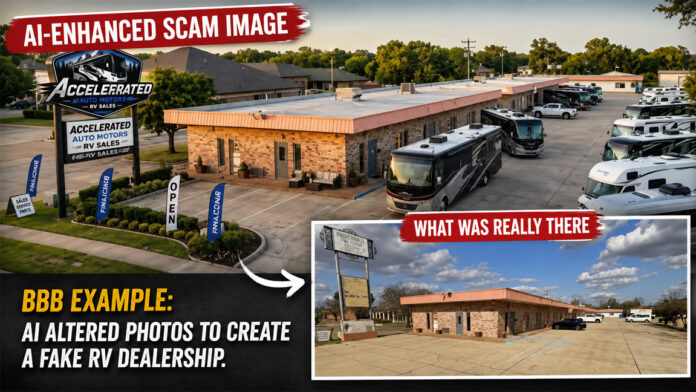
Fake RV dealerships are becoming harder to spot. A polished website. Professional photos. Rows of gleaming RVs priced just low enough to make you wonder if you’ve found a bargain.
The problem? Increasingly, that may not be enough to prove the dealership even exists.
The Better Business Bureau is warning that scammers are now using artificial intelligence to create convincing fake RV dealer websites and Facebook ads. In some cases, AI is being used to alter photographs of dealership buildings, making vacant lots or unrelated businesses appear to be legitimate RV dealers. The goal is simple: Convince shoppers to send a deposit before they discover the dealership doesn’t exist.
Unlike the scam websites of a few years ago, many of today’s AI-assisted fakes are far more convincing and can be difficult to spot.
For RV buyers, it’s a reminder that the old advice—”If it looks professional, it’s probably legitimate”—no longer applies.
The photos may be fake
Years ago, scam websites often gave themselves away with blurry photos, poor grammar and obvious spelling mistakes.
Artificial intelligence has changed the game.
With today’s AI tools, scammers can build a convincing dealership website in minutes. They can alter photos to make an empty storefront look like a busy RV lot, write believable advertising copy, and even create convincing Facebook ads and business pages.
That doesn’t mean every attractive dealership website is fake. It does mean appearance alone is no longer enough.
Six checks before you send a dollar
Before sending a deposit or arranging financing, spend a few minutes verifying the dealer.
- Look up the address independently. Don’t rely on the website’s map. Enter the address directly into Google Maps and Street View. Does it actually show an RV dealership? Are there RVs on the lot?
- Verify the dealer license. Every state requires licensing for RV or vehicle dealers. Most state motor vehicle agencies provide online dealer-license lookups.
- Call the published number. Talk to a salesperson. Ask specific questions about a particular RV, including its VIN, and ask whether it’s available for an in-person inspection.
- See whether the dealership exists anywhere else online. Legitimate dealerships usually leave a digital footprint—manufacturer listings, customer reviews, local news coverage, service information and years of online history.
- Reverse-search the dealership’s photos. Upload one of the dealer’s images into Google Images or another reverse-image search tool. If that same photo appears under a different dealership name—or on unrelated websites—that’s a major warning sign.
- Never pay a deposit you can’t recover. Be especially wary if you’re asked to pay by wire transfer, cryptocurrency, gift cards or other payment methods that offer little or no buyer protection.
“Appearance alone is no longer enough.”
Watch for these red flags
While AI has made scams more convincing, the warning signs haven’t disappeared.
Be suspicious if you encounter:
- Prices that are dramatically below market value.
- Pressure to act immediately because “another buyer is waiting.”
- A seller who refuses an in-person inspection.
- Requests to move the conversation away from the dealership website and into text messages or private messaging apps.
- Excuses for why the RV can’t be seen right away.
- Requests for payment before you’ve verified the business.
One warning sign doesn’t necessarily mean you’re dealing with a scam. Several together should send you looking elsewhere.
Trust, but verify
The overwhelming majority of RV dealerships are honest businesses that work hard to earn customers’ trust. Unfortunately, scammers know buyers often become focused on finding the perfect RV instead of verifying who’s selling it.
AI can fake photos, websites and Facebook ads. It can’t fake a real dealership with real inventory and a valid dealer license.
Before you send a deposit, spend five minutes proving the business is real. Those five minutes could save you thousands of dollars—and a lot of heartache.
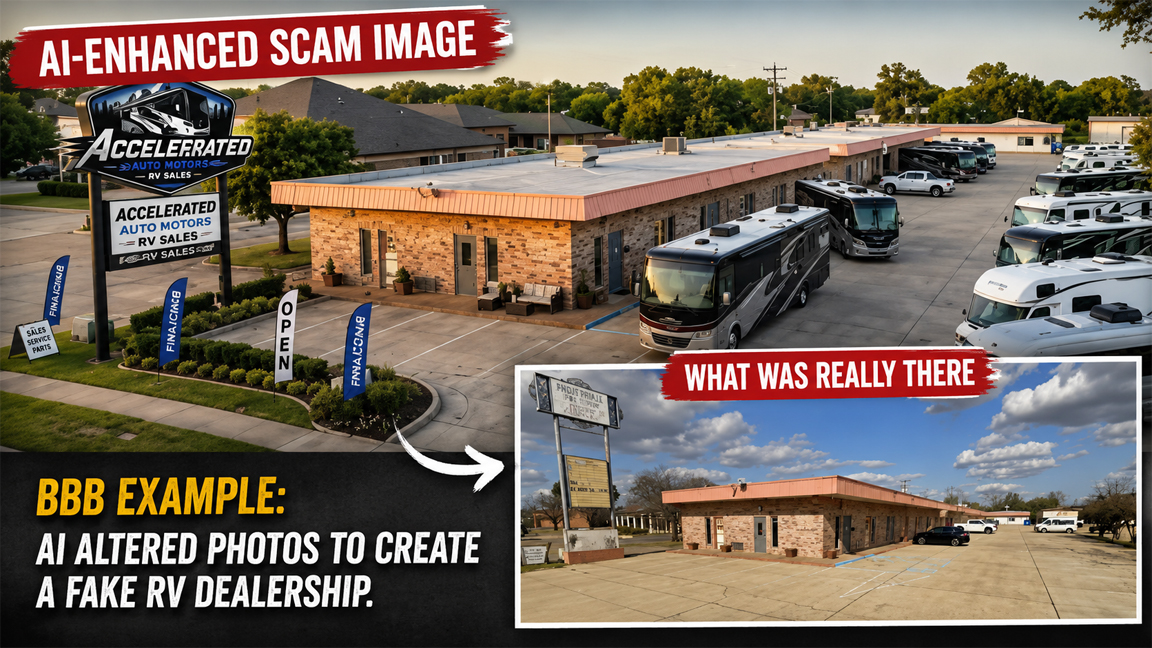
In the image above, one image was created to sell an RV scam. The other shows what was actually at the address.
The Better Business Bureau says AI is making fake RV dealerships far more convincing, making it more important than ever to verify before sending money.
Sources
BBB warns of AI-powered RV dealer scam targeting Facebook
Better Business Bureau: Vehicle and equipment impostor scams
Better Business Bureau Scam Tracker
RELATED
- RV market outlook 2026: Thinking about buying an RV? Dealers may stay motivated
- Buying an RV: What is the markup on an RV, and what should I offer the dealer?
- Ex-RV salesman offers shopping tips for new rig
- RV shipments are improving—but buyers may still have the upper hand in 2026
- RV shipments start off 2026 with a thud
RVT1271b


There’s one right now posting ads on RV Trader with fake pictures and a complete fake website showing beautiful high-end coaches at 33% of retail value…