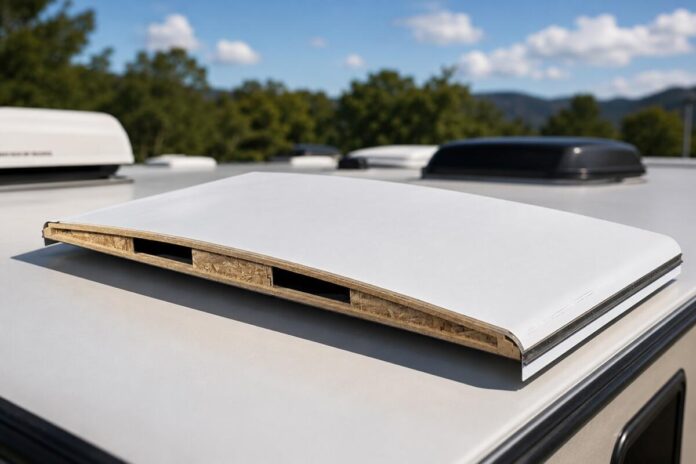
An RV roof is one of the biggest sources of anxiety. Why? Water intrusion, soft spots, damaged decking, and expensive roof repairs have plagued RVs for decades. That’s why Azdel’s newly announced upgraded composite roof deck has generated so much attention across the industry.
Better than before
Developed in partnership with Impact Guard®, the new Azdel Onboard® Composite Roof Deck replaces traditional wood roof decking with an upgraded composite structure. It’s designed to be stronger, lighter, waterproof, and far more resistant to impact damage. While the revamped system won’t eliminate every potential roof problem, it represents one of the most significant advances in RV roof construction in years.
RV roof weak points
Many travel trailers and fifth wheels still use plywood or oriented strand board (OSB) as the structural roof deck beneath the rubber or TPO membrane. Those materials are affordable and easy to work with. However, they share one major weakness: They’re made from wood.
If water finds its way past a damaged membrane or failed sealant, wood decking can absorb moisture. Over time, that can lead to swelling, rot, mold, delamination, and expensive structural repairs.
Even when leaks never occur, wood roof decking can flex under heavy loads, hail impacts, or people walking on the roof.
The new Azdel Onboard® Composite Roof Deck
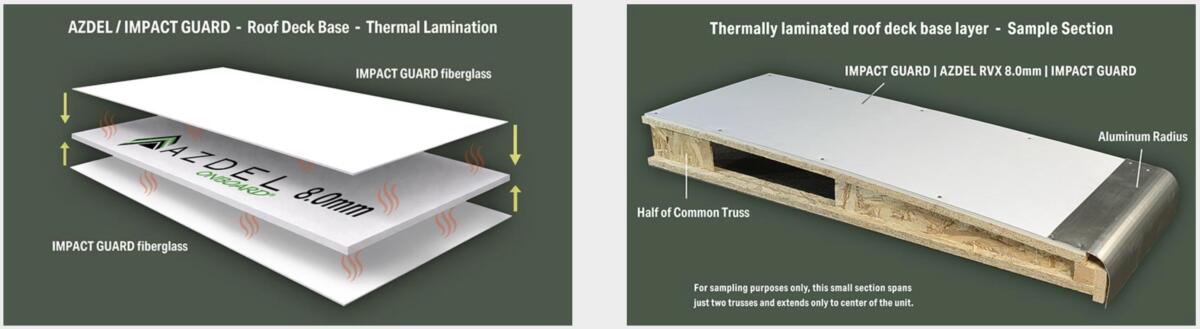
Instead of relying on wood, the new system uses an 8mm Azdel RVX composite panel laminated with fiberglass layers supplied by Impact Guard. The materials are thermally bonded rather than glued together. This creates a rigid composite structure while still allowing enough flexibility to conform to curved RV roofs.
The finished roof deck includes multiple fiberglass layers that wrap continuously over the roof structure. This creates a seamless composite surface intended to resist moisture while also increasing strength.
Better RV roof protection
Will the revamped Azdel roof provide better protection for RV roofs? In many ways, yes.
Because the structural deck contains no wood, it cannot absorb water or rot the way plywood or OSB can. That doesn’t mean owners can ignore roof maintenance. A punctured membrane or failed seal still needs immediate attention. However, eliminating wood from the roof deck removes one of the biggest causes of long-term structural damage.
The composite construction is also more resistant to impact. Falling branches, hail, and people walking on the roof are less likely to permanently damage the deck beneath the roofing membrane.
The result should be a roof that’s better able to withstand years of camping without developing soft spots or hidden water damage.
Impressive strength
Azdel demonstrated the new roof deck with side-by-side load testing.
According to the company, a conventional OSB roof deck began showing audible structural distress at roughly 1,100 pounds. That roof deck ultimately failed around the 2,000-pound mark.
The new Azdel composite roof system, by comparison, supported more than 2,300 pounds while maintaining its overall shape during testing.
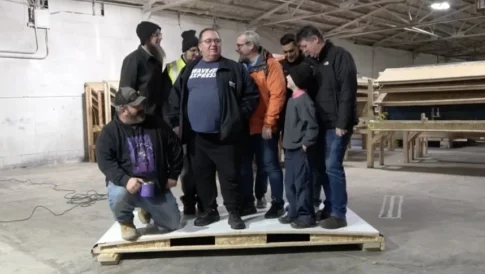
The company also demonstrated multiple adults bouncing on an improved Azdel roof section without visible structural damage. While no one should treat an RV roof like a trampoline, the demonstration illustrates the system’s increased rigidity and load capacity. It’s pretty impressive!
No more roof inspections?
Wait! Don’t cross off “roof inspection” just yet. Even the strongest roof deck still depends on the roofing membrane, sealants around vents and skylights, and proper maintenance. A damaged membrane can still allow water into the roof assembly. The difference is that if moisture does get beneath the membrane, the new composite deck itself won’t swell or rot like wood.
Owners should continue performing regular roof inspections and resealing roof penetrations according to the manufacturer’s maintenance schedule.
Lighter weight?
Composite materials typically offer a better strength-to-weight ratio than wood products. Lower weight means manufacturers can add other desired RV features or simply reduce overall trailer weight for RVs made with this new material.
While Azdel hasn’t published exact weight savings for every application, lightweight construction has long been one of the company’s primary selling points for its wall and floor products.
Cost
The new-and-improved Azdel roof will almost certainly cost more. Neither Azdel nor RV manufacturers have announced pricing yet. However, composite materials generally cost more than traditional wood decking. The roof also incorporates multiple fiberglass layers and specialized manufacturing processes that increase production costs.
Whether buyers actually notice a significant increase in MSRP will depend on how individual manufacturers package the feature. Some companies may reserve it for premium models, while others may eventually make it standard equipment if production costs decline.
For many RV buyers, paying somewhat more upfront could be worth it if the new Azdel roofing reduces the likelihood of major roof repairs later.
Which RVs will use it first?
No manufacturers have announced widespread adoption yet. I’d expect the improved Azdel system to appear first on higher-end travel trailers and fifth wheels. It will eventually expand into additional product lines if there’s strong consumer demand.
Since Azdel materials are already widely used in RV sidewalls, front caps, rear walls, and some floor systems, manufacturers already familiar with the company’s composites may more quickly adopt the new roof deck.
Good news
Most RV owners never think about roof decking until something goes wrong. Unfortunately, by the time soft spots or leaks become visible, repairs can be expensive.
A waterproof composite roof deck won’t eliminate maintenance, but it does remove one of the biggest vulnerabilities found in traditional RV construction: structural wood that can deteriorate after prolonged moisture exposure. That means Azdel’s announcement of new-and-improved roofing is good news for RVers.
Does your current RV have an Azdel roofing system? Tell us what you think about this new-and-improved product development. Use the comments below to do so.
RELATED
- Do roof coatings really stop roof leaks? RV tech weighs in
- Can you seal over old RV roof sealant?
- Preventing roof leaks in a way you may not have considered
- The benefits of RV roof vent covers
RVT1271b