

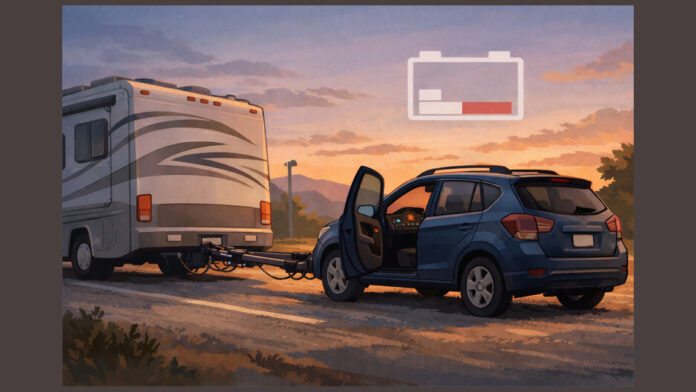
Flat towing a car behind a motorhome looks much the same today as it did years ago. The hookups are familiar, the steps are routine, and most RVers have the process down cold.
Yet one frustration hasn’t gone away. After a long day on the road, you unhook—only to discover the towed car won’t start.
That’s why a recent product release from Roadmaster caught our attention. The long-established flat-towing manufacturer has introduced a wireless battery disconnect designed to reduce parasitic battery drain, without requiring dash switches, firewall drilling, or interior modifications.
Flat towing itself isn’t being reinvented anytime soon. But as the vehicles RVers tow grow more complex, small upgrades that reduce friction—and lower the chances of ending the day with a dead battery—are starting to matter more.
Why dead towed-car batteries are still so common
Modern vehicles don’t really shut off the way older ones did. Even with the ignition off, many cars keep systems awake in the background—steering locks, security features, body control modules, and infotainment systems among them.
During a long towing day, those small draws add up. After several hours behind a motorhome, it’s not unusual for a towed vehicle’s battery to be weak or completely drained by the time the destination is reached.
Charge lines from the motorhome can help, but they don’t solve every situation. Some vehicles still draw more power than they receive, while others don’t behave well with constant charging. That’s why battery disconnects became a common part of many flat-tow setups in the first place.
The tradeoffs of traditional battery disconnects
Conventional battery disconnects do the job, but they often come with compromises RVers have learned to tolerate rather than enjoy.
Installation typically involves routing wires through the engine compartment, drilling through the firewall, or mounting a switch somewhere inside the vehicle. For older cars, that may not be a big concern. For newer vehicles—with crowded dashboards, airbags, and tightly packaged electronics—it can feel invasive.
Even when professionally installed, the disconnect switch often ends up in an awkward spot. For DIYers, the installation itself can be enough to delay or discourage the upgrade altogether.
What RVers should know before adding a battery disconnect
A battery disconnect can help prevent dead towed-car batteries, but it doesn’t replace manufacturer towing procedures. Some vehicles still require specific ignition positions or fuse pulls when flat towed, and supplemental braking systems may continue to draw power—making a charge line from the motorhome necessary in some setups.
Ease of use matters. A simpler disconnect process makes it more likely RVers will use it consistently, rather than skip it. And while a disconnect helps manage battery drain, it doesn’t make a vehicle towable if the manufacturer says it isn’t.
Why ease of use matters
Any battery disconnect works only if it’s used consistently. The easier it is to disconnect and reconnect the battery as part of the towing routine, the more likely RVers are to actually do it every time.
That’s where newer approaches are drawing attention. Reducing wiring, avoiding interior modifications, and simplifying the steps at hookup and unhook don’t change the fundamentals of flat towing, but they do reduce friction.
Over time, that reduction in friction can mean fewer dead batteries, fewer jump-starts, and fewer small frustrations at the end of a travel day.
A real-world example RVers may see this season
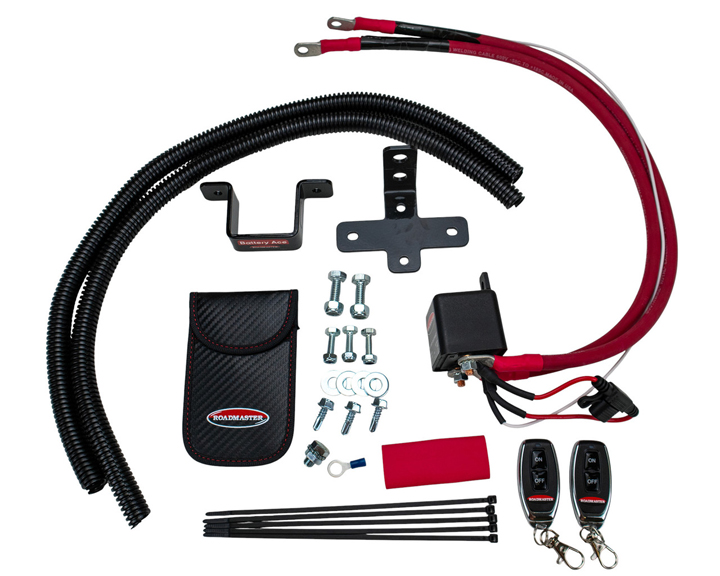
One example of this newer approach comes from Roadmaster, which recently introduced Battery Ace, a wireless battery disconnect aimed at flat-towed vehicles.
Instead of a dash-mounted switch or firewall wiring, the system uses a small key fob to isolate the vehicle’s battery. Roadmaster designed the disconnect to reduce parasitic battery drain during towing and storage, and includes a signal-blocking pouch to help prevent unintended activation while driving.
Battery Ace is sold through Roadmaster’s dealer network for RV towing and other 12-volt applications. More details are available here.
MORE ON FLAT TOWING
- Owner destroys brand-new Jeep while flat towing it. You won’t believe the damage!
- Flat towing vs. dolly towing: What is the best way to tow?
- The five best flat-tow vehicles for 2025-2026
- Towing with an EV is exposing challenges RVers have faced for years
- Towing gone wild: Extreme towing, stacked rigs, and insane RV setups
- 11 of the most common towing mistakes and how to avoid them
- Improper trailer hitch extension—A disaster in the making
- Is your RV tow package safe? You sure?
RVT1245


I think a DC to DC charger powered off the 7th pin is far better than a battery disconnect under tow.
Unless your supplemental brake system is actuated by the compressed air from your coach and the breakaway system requires no power, killing the power to an electronic supplemental brake is a really, really bad idea. Even if you use a surge brake like on an NSA Elite Brute II, defeating power is a risky endeavor. Electric door locks, hood releases and dash cameras all stop functioning.
You can buy simple key fob remote battery disconnects on Amazon for under $20 that work incredibly well. Plus, they will automatically disconnect if the battery drops below a certain voltage, thus leaving you enough to start your car. These simply connect to the battery neg terminal and then the neg cable attaches to it.
Bruce and Vince, thanks, I knew there had to be a less cost option.
Maybe someday the big companies will learn, when they look at their balance sheets.
Installing mine this week.
If your car’s owner’s manual says you need to disconnect the battery as part of the towing checklist, you have two options.
The first is a manual switch that requires opening and closing the hood each time you go through your checklist. The other option is a relay.
The battery ACE is a key-fob remote-control relay. Other relays work by pressing a button, usually mounted somewhere inside the car. The battery ACE doesn’t require running the wire and mounting a remote control switch.
On my last car, I charged the battery while towing from the RV. But my new car’s owner’s manual says to disconnect the battery… I am using the battery ACE.
You didn’t share the price of the Roadmaster’s battery disconnect. Neither did their website. That always turns me off, they should be upfront, if they want my $$$.
Hi, David. The one in the post is the Roadmaster #768. There is a similar one on Amazon, the Roadmaster #766, for $229. I’m “assuming” (there’s that word that gets me into trouble sometimes) the #768 is newer and has different features, and probably costs more than the #766. But it gives you a ballpark figure, anyway. Have a good night. 😀 –Diane at RVtravel.com