

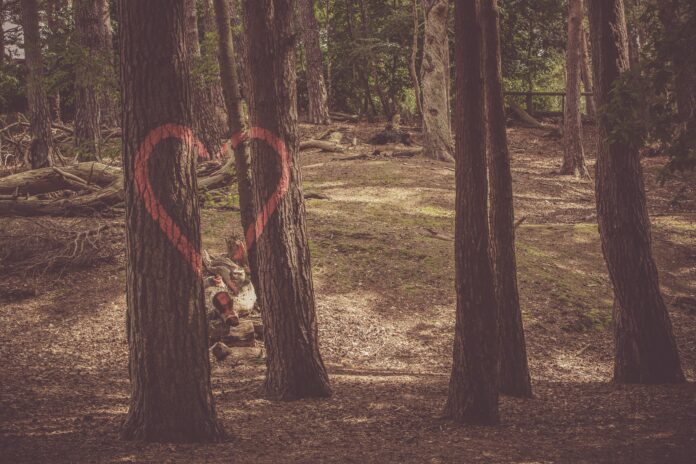
I often see it on passing freight trains or adorning overpasses and the exterior walls of abandoned city buildings. To those wielding their cans of spray paint, graffiti is “an artistic expression that communicates with the masses.” To me, graffiti is vandalism, plain and simple. What alarms me is how it continues to appear in our parks, landmarks, and other natural spaces. Don’t people know that graffiti has consequences? I’ll explain.
Graffiti is an ecological disruption
On a recent forest trail hike, I noticed a towering oak tree that had been “tagged” with spray paint. Trees are especially vulnerable to graffiti because their bark acts as a protective barrier against pests and environmental stressors. When this barrier is compromised by paint, the tree’s health can deteriorate, leading to potential long-term damage or even death. (If you read my previous story about purple paint on trees to mark property borders, you should know that a specially formulated paint is made and used for this purpose. This paint will not harm trees.)
Altered habitat
So many creatures, both large and small, live in the forest. Graffiti within their habitat can lead to habitat degradation because the painted surfaces may repel or harm creatures that call these places home. Insects might avoid laying eggs on painted surfaces. Birds may refuse to create nests on “tagged” branches, and wildlife that relies on camouflage to hide from predators might find it harder to blend in against brightly colored backgrounds, increasing their vulnerability.
Eyesore
Graffiti can drastically alter the aesthetics of an area. I suppose the “artist” felt his brightly colored artwork added visual appeal to the forest setting. To me, it was an eyesore. The graffiti disrupted the natural beauty and serenity of a very special place. It angered me.
Historical impact
You may have seen graffiti in other natural places. Sometimes these locations hold deep spiritual and cultural connections. Defacing these areas can be deeply offensive and disrespectful to indigenous communities because “tagging” can erase the heritage and/or stories associated with these honored locations.
Costly
Removing graffiti is costly. One park ranger put it this way: “Depending on the damaged surface, it can take hours for park staff to remove graffiti. We use a variety of remediation equipment and often must carry this equipment to remote sites. Repairing vandalized sites is costly, but what’s worse is that often, a damaged site can never be fully restored to its original condition.”
Leave no graffiti, leave no trace
No, I don’t believe that RVtravel.com readers “tag” or deface natural spaces. However, preventing graffiti is a job we can all share. Talk to your children and grandchildren about the consequences of graffiti and impress upon them the importance of keeping our natural spaces pristine for future generations. Participate in community cleanup days and support park rangers and others who regularly work to eliminate graffiti and other forms of vandalism. Always remember: Leave no trace!
##RVT1118


Graffiti is an URBAN art form. In Europe especially, there are few sloppy gang related splotches of paint. They are well planned, executed, and mostly enjoyable public art. But likewise in Europe, the woods are (mostly) revered. In many places the only constructions you will find are built from items laying in those same woods. Nothing brought in and nothing taken out.
It is a different world here in the U.S. where far too many people can’t seem to think beyond their own immediate needs or the next 5 minutes.
No, it’s just vandalism. Trying to pass it off as an “art form” only legitimizes the problem. Doesn’t matter how “well-planned and executed” it is, if it despoils an environment, either natural or manmade, it still just vandalism.
Any art form becomes vandalism when it is put on someone else’s property without their permission. Public property isn’t “mine”, it’s everyone’s, so you have to get everyone’s permission! You do that through the democratic process- not through taking the “right” to deface it.
The problem is that even if they are caught NOTHING will happen.
I have a park behind my house and the shelter there was paint balled. I found out who did it and the parents thought their child should paint the shelter for free. I contacted the city and was told this is not possible as it would be taking a job away from a city worker. Final result: no penalty for the offender.
It’s all about me-me-me. It is really disgusting to see the paint and the carvings in wood. And yes, the trains. Those (many of them) people supposedly can’t afford to live decently, but can afford to buy paint cans. I remember when trains looked like trains. The idiots are overjoyed when a new boxcar or hopper or gondola joins the fleet, they make a mess of it immediately. Too bad they don’t get a life. It is nothing but vandalism. Bridges are favorites. In areas where we still have wood covered bridges, the sweeties go to work on bridges. Trees, big rocks, tunnels, nothing is safe.
It’s not just in parks or forests that this happens. My wife and I used to scuba dive in Balmorhea State park in west Texas. During our lessons our instructors would emphasize leaving the dive site as pristine as possible. One year several colleges brought their students there because the drought had dried up their normal training sites. I was appalled at the graffiti left and damage done to this spring fed oasis by supposedly intelligent people. As was stated earlier in the comments, it’s just vandalism.
Petroglyphs on rock walls. We revere these as wonderful history. Register Rock in High Rock Canyon in NV where the wagon trains plodded through – and those hearty folks chipped their names and the dates on several rock walls. we revere these as history to be preserved. Cave dwellings with all manner of carvings, scratchings, and paintings chronicling a period of history. We revere these as well.
Don’t get me wrong. Graffiti is WAY out of control and I, like everyone else, really dislike it. But, times have changed eh. Pile on . . .
Tommy, I will “pile on”. I agree with you. However, historically it took time and thought to leave that “graffiti” behind, with some sort of purpose in the “artists” mind.
Today, whether spray paint or stupid comments on social media, it is all too instant and without thought or purpose to do nothing but to vandalize. The lack of time, thought, or purpose has made us a “hit and run” society.
Am I the only one that considers the human built pile of stones a form of graffiti? Someone has altered the natural terrain. Yes, there are occasions where it is used to mark a trail but most are not even near a trail.
Build your monument at your home, not on public property. Please leave nature how she designed it.
No, you are not the only one. The rock piles seem quite juvenile and silly. At least a person can knock most of them over.
I’m afraid that you may be “preaching to the choir,” Gail. I strongly agree with you, but I wonder if any who do this can hear you.
My thoughts precisely, I doubt very seriously if anyone applying graffiti reads this newsletter so your writing is falling on blind eyes.
“No, I don’t believe that RVtravel.com readers “tag” or deface natural spaces. However, preventing graffiti is a job we can all share. Talk to your children and grandchildren about the consequences of graffiti and impress upon them the importance of keeping our natural spaces pristine for future generations. Participate in community cleanup days and support park rangers and others who regularly work to eliminate graffiti and other forms of vandalism. Always remember: Leave no trace!”
Gail clearly noted her concerns – read it again above! She is at least – starting somewhere with someone! “US” who do care!!!
I have to agree with you Bob..blind eyes and deaf ears too