

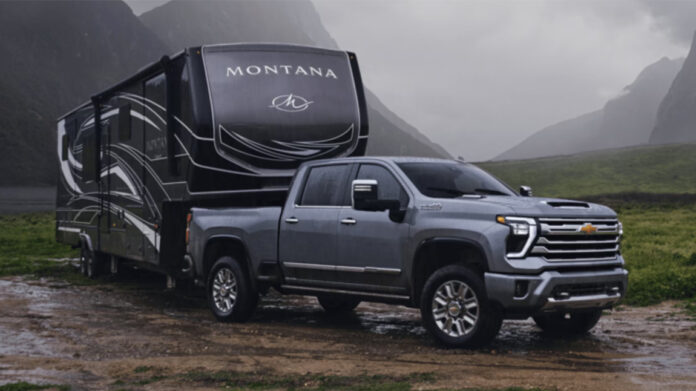
If you tow a travel trailer or fifth wheel, the truck you drive matters. It matters for towing capacity and hitch setup, of course. It also affects how insurers price your coverage. So, is your truck on the list of “high-risk” trucks? Read on!
Why these particular trucks?
Insurers “flag” models because their calculations say certain models are more expensive to insure. Here are the main reasons the cost of insuring a vehicle may be elevated:
• Repair and replacement costs. Ownership-cost and repair-cost analyses from sources like Edmunds and RepairPal are considered when determining insurance costs. Heavy-duty and luxury-trim trucks can carry much higher long-term repair and insurance components in their “true cost to own.” According to Edmunds, this is because parts and labor for big diesels, high-tech electronics, and specialized components are pricier.
• Crash history, recalls, and driver demographics. IIHS (Insurance Institute for Highway Safety) and NHTSA (National Highway Traffic Safety Administration) testing and recall records affect how underwriters view a model’s risk. Some trucks have struggled with newer crash-test protocols. At the same time, studies of driver-incident patterns show that certain brands and/or models tend to be associated with higher incident rates. Insurers also factor this into their pricing.
• Theft. The National Insurance Crime Bureau’s Hot Wheels data show full-size pickups regularly appear on most-stolen lists. That directly drives up comprehensive and/or theft-related claims for certain models.
What “high risk” can mean for you
If your truck is deemed higher risk, you can expect one or more of the following:
- Higher annual premiums (especially for full coverage and comprehensive)
- Stricter underwriting (more questions about how you use the truck and who drives it)
- Reduced availability of preferred discounts
- In rare cases, an insurer may decline to renew a policy.
For RVers who tow, there’s another wrinkle. Insurers will check whether you have the right endorsements or limits for towing. They recognize there is higher liability and potential damage to third parties when towing. This makes proper tow limits important.
The “high risk” list
The following list names the top five trucks ranked “high risk” by insurers. Remember that the model year, trim, factory options (e.g., electronics, tow packages), and geography can affect insurer classifications. For those reasons, treat this list as a consensus, data-informed ranking rather than an absolute scientific score.
1. Chevrolet Silverado (especially full-size 1500 and HD or heavy-duty lines)
Why it’s at the top: The Silverado family consistently shows up as one of the most-frequently stolen full-size pickups in reports from the National Insurance Crime Bureau (NICB). This drives theft exposure. Repair and replacement costs for some Silverado trims (and the sheer number of Silverados on the road) also push insurers to higher premiums.
2. Ford Super Duty family (F-250, F-350 and other HD variants)
Why #2: Super Duty trucks produce higher claim severity when they’re damaged. Big rigs equal big repair bills, and some model years have been singled out in reporting and recall rounds that affect insurer risk assessments. High theft numbers in certain Ford pickups also contribute. For RV tow owners, the higher cost to repair a heavy-duty collision is a major insurer factor.
3. Ford F-150
Why #3: The F-series (including the F-150) appears near the top of NICB stolen-vehicle lists and has sizable ownership and repair costs for certain trims. Since so many folks own F-150s, there are more thefts and more claims, both of which insurers track. Some recent recall activity has also increased underwriting scrutiny.
4. GMC Sierra (1500 and HD)
Why #4: Closely tied to Chevrolet Silverado (shared platforms and parts), GMC Sierras show similar theft and repair-cost patterns. That pushes insurers to treat them as higher risk than many other trucks.
5. Ram 1500 / Ram HD (2500/3500)
Why #5: Ram trucks can be expensive to insure in many markets because of repair costs (especially for heavy-duty or luxury trims). Some model years have mixed safety test histories, as well. Several industry cost-of-ownership reports place Ram among the pricier truck brands to insure.
Ways to reduce insurance rates
There are practical steps RVers can take with insurance carriers to reduce or manage rate increases. Here are a few suggestions.
• Talk to your agent before you buy or trade. If a particular model is known to cost more to insure, an agent can run likely-quote scenarios. They may also suggest alternatives with similar towing capability but lower insurance exposure. Shop multiple carriers because insurers weigh makes and models differently. One carrier’s “high-risk” might be another’s “acceptable” risk.
• Ask about and document discounts. Many insurers offer discounts for anti-theft systems, factory safety packages, driver-assist features, and usage-based programs. Some companies offer multi-policy (home+auto) discounts. Installable options (e.g., alarm or immobilizer systems, GPS trackers) may also help you reduce premiums. However, don’t assume the discount is automatic. Ask for it and document the equipment on the policy.
• Consider higher deductibles and usage-based underwriting. Raising your comprehensive and collision deductibles will lower premiums. Just make sure you can handle the higher out-of-pocket costs if you need repairs. Many carriers also offer pay-how-you-drive plans (plug-in or app) that can earn you discounts if your driving is safe.
• Take defensive-driving or towing-specific training. Some companies give credits for mature drivers or defensive driving courses. There are also towing clinics that teach hitching, weight distribution, and emergency procedures. Knowing safer towing tips may reduce risk and can help your renewal argument with an underwriter.
• Add or confirm correct endorsements and limits for towing. Make sure your insurer knows the RV’s value, the hitch class, and whether you have trailer brakes and sway control. If you haul expensive fifth wheels or use the truck commercially, you may need commercial or specialty endorsements. A mismatch is the quickest way to have a claim contested later.
If theft is the issue, add anti-theft measures and trackers. NICB theft data show pickups frequently on theft lists. A visible, hardwired GPS tracker or LoJack-style recovery system and wheel or steering locks can be persuasive to an underwriter. They may qualify you for a discount.
Have your truck rates recently increased? Tell us in the comments below.
RELATED
- Lawsuit accuses GEICO of unlawfully raising insurance rates
- Should you cancel your RV’s insurance while storing it?
- Did your RV insurance rates skyrocket? Here’s what to do
- Readers share their RV insurance experiences
RVT1288


It amazes me how insurance actuarial professionals do mental gymnastics to justify their theoretical hypotheses. Yes, the more trucks on the road, the greater the risk but the greater the number of trucks on the road also creates a greater number of premiums. Insurance has become legalized extortion.
So, you pretty much list every major model of tow-capable truck out there (nobody is towing anything bigger than a pop-up with a Tacoma, so…)
I’m on my 4th Silverado, I’ll never quit, what are we all supposed to get V.W. vans with signs on the rear window: Too slow, too bad?
I’ll keep my 430hp Chevy over a 60 h.p. Vweee.
The article and list are both moot points because the only other full-size pick-up not mentioned is the Toyota Tundra. Insurance companies will come up with a list of reasons why this vehicle or that one costs more to insure, which is just another way for them to justify their ridiculous rates. Gail missed in her piece is that the Ford F-150 is the most stolen vehicle in the U.S., according to the last list I consulted back in the Spring.
You’re right, Lonewolf. The F-150 is still wildly popular with thieves!
How do they get our swell trucks with chipped keys and alarms?
Just tow trucks that hook and beat feet?
I have the steering wheel thingy but with the now new cordless tools, nothing is safe..
That’s mostly because it’s the highest selling pickup, thus there are more of them on the road
Insurance companies have been screwing us over since the beginning of time..We have to have it or we can lose everything we have worked for all of our lives.
There’s no stopping them.
I had PEMCO for 50+ years with no claims.
Now I live in an area that they consider high fire danger. HA!
I’m still here as well as my neighbors, for me 22 years.
They cancelled all of my now neighbors, many who had the same history as me..
No way to give them what they deserve……Aaarg Matey!
Thank you, Gail, for the information! We tow a vehicle rather than our RV. We do have a 1997 Dodge 3500 with a flatbed that we use as a farm truck. As you easily can imagine, our insurance rate on the truck is small. Have a great day and safe travels!