

When summertime comes, so do the RVers. In some cases, hordes of them, all congregated in one campground. As the temperature rises, air conditioners come on—until, woops! Campground voltage drops, and A/C units can actually burn up. Or, it could be your microwave oven. Ask us—We’ve “zapped” a microwave from too little power. You can protect against RV low voltage—and you don’t have to spend a fortune.
Old parks—new parks: Any of them could have RV low voltage problems
Old RV parks often have an old electrical system that may well be underrated for the needs put on it by present-day RVs. But hang on, even newer RV parks can have a problem. The electrical code for just how much “juice” needs to be available isn’t based on full occupancy. But if your park is “loaded to the gills,” you may face a low voltage issue. If the electrical system voltage is consistently below 108 volts, it can cause damage to RV electrical and electronic gear.
Your air conditioning system is one of the most easily affected. It takes a set amount of power to operate and it MUST have it. If the voltage is low, then the unit will still function but it will run hot. This puts a huge strain on the compressor motors and, given enough trouble, something’s gonna break—and it won’t be cheap to fix.
Avoiding the problem
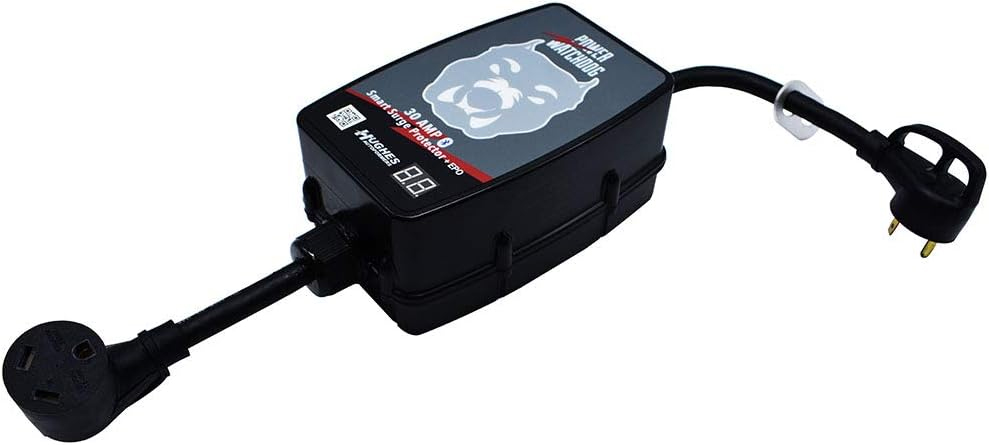
An RV power monitor/suppressor is a great way to protect yourself. The device plugs into the park pedestal, and your RV shore power cord into the monitor. Most have surge suppression to protect you from power spikes. The prices on these systems are coming down. We’ve seen some for sale for 30-amp RVs for as little as $80. Can you rely on them? Without testing them, we can’t be sure. Of course, you can spend more on a “name brand” unit and probably sleep better.
But what if you can’t afford one of these right now, or what if your existing monitor has “given up the ghost” and you haven’t replaced it? Here’s a device that will show you the park voltage, and additionally tell you if there’s a bad wiring situation at your pedestal. For less than $25 it’s a safety bargain.
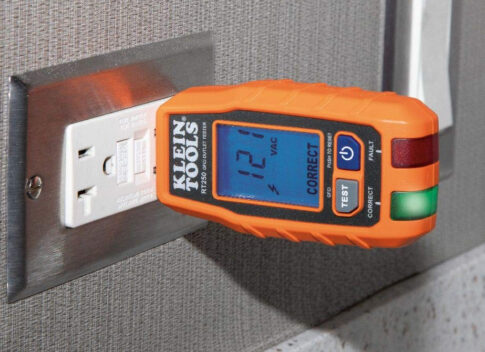
Klein Tool’s RT250 is an electrical receptacle tester that tests the wiring conditions at an electrical outlet. Its LCD displays the voltage and identifies wiring faults. You could use an adapter to “step down” from the 30-amp outlet (or maybe two to come down from 50-amp outlets), testing the circuit before you plug in your shore power cord.
Or, you could do the “two person test.” Plug it into a shore power outlet inside the rig. One inside the rig watches the monitor as the other plugs in the power at the pedestal. The inside person verifies that the power monitor shows “good” wiring—no reverse polarity, no “no ground” situations—any of which can lead to safety issues.
Leave it plugged in and keep an eye on it
Once you’re satisfied the wiring is safe, leave the monitor plugged in to keep an eye on voltage levels. Before firing up the A/C or using the microwave, eyeball the power monitor. If the voltage is below 110 volts, beware. Fire up your A/C and double-check the voltage. If it’s at or below 108, we’d recommend you shut the A/C off—you risk damaging the unit.
If you decide to buy a pedestal plug-in monitor/suppressor, READ THE FINE PRINT. Some of the “inexpensive” surge suppressors we found for sale didn’t “cut out” until the voltage went as low as 104—even 103. By the time these characters shut off the power to “protect” you, that $1,000 air conditioner on your roof could be toast.
It could be a hot summer. Keep your cool with your A/C, and don’t lose it to low voltage.
RELATED
- Beware of low-cost but dangerous knock-off RV parts
- The most deadly RV electrical mistakes
- Always unplug your RV while working on wiring
- Electric power: Learn to read the meter at your campsite
- Know your plugs: 50A vs. 30A RV hookups—When 50–30 doesn’t equal 20!
##RVT1200


We have the Watchdog hardwired in and it has saved us on numerous occasions from low voltage. While it can be annoying for the AC to just shut off, with a look at the mobile app it shows the actual live voltage which notifies us that here is a power issue and allows use to monitor. On 50 amps sometimes issue is with just one line and we can turn that AC unit off.
Our Progressive Industries 50 amp surge/low voltage performed flawlessly! It does trip when in one of these situations.
A year back it stopped working. I called Progressive and they said no problem, send us a copy of the purchase receipt and we will send you out a new one!
As I purchased it on Amazon, it was easy peasy.
How good is that for customer service?!🇨🇦
While I rarely need it, I still carry my Hughes Autoformer just in case. My Newmar has built in incoming power diagnostics and surge protection, but that won’t help boost voltage if we happen upon a park with that condition.
Autoformers don’t allow you to “pull more power” from the park system…a commonly held misconception. They boost voltage by scaling back available amps. The formula of A x V=W can’t be undone. If a park has inadequate power you can suffer by hurting certain appliances, or with an autoformer run fewer things but with good voltage.
Our Progressive EMS-PT50X has protected our coach twice during our current trip! It scans/detects a problem and blocks faulty electricity passing through to the coach. Not cheap to buy, but cheap insurance.
2 years ago we stayed in a KOA in Maine. It was summer and hot. My 50A Progressive EMS was showing 109 vac. Turning on our A/C dropped it to 105. The 43 ft. class A MH next to us had a Hughes Autoformer in use. I contacted the manager of the CG about the “voltage sag.” He attempted to explain the problem by blaming his electric utility. He claimed that “they can’t send me the power I need.” An examination of the wiring in the park revealed that his old wiring was never designed to provide 50A power to multiple users running 2 A/C units. A complaint sent to KOA HQ received the standard answer “our Kampgrounds are privately owned and we’re not responsible.” We changed our plans and moved out.
We are on our second Watchdog 50 amp surge protector. The Watchdog DID NOT protect us from a pedestal low voltage condition. In fact, the under current caused the surge protector and the RV plug to melt together, ruining both.
Unfortunately, your experience is not uncommon. Surge protectors can trim spikes but they cannot generate electricity to offset voltage dips.
Thank you for the suggestion, Russ and Tina! Have a great week and safe travels!
Our low end surge suppressor helped avoid a hot skin situation last week. As has been suggested I plugged the suppressor in before plugging in the trailer and discovered the pedestal had an open neutral which could have resulted in the frame of the trailer being energized. Turns out they were not supposed to have let anyone use that site. We were assigned another site.
Thanks for the important reminder, George! We’re glad you were so careful and avoided what could have turned out very badly. Have a great day! 😀 –Diane at RVtravel.com
The built in overload/ over heat should protect the compressor. Not that they may fail but I personally think someone is instilling fear. The klixon is designed to prevent damage from low voltage and too much heat. Keeping unit clean of dirt and bugs gets cool gas back to the compressor.
Not a “low voltage” tester. 12 volts is low voltage
They were referring to a low 120 volt reading
I use one of these and the 30 amp adapter before plugging it. Using the adapter also let’s you know the physical condition of the receptacle.”Loose contacts”
I also have a small meter that plugs into a receptacle inside the trailer.
I can see the voltage at a glance.