


Dear Dave,
The latch of my trailer coupler seems to stick and does not release easily. Should I apply grease to the ball to lubricate it? —Tim, 2001 Jayco
Dear Tim,
A conventional “bumper pull” trailer, as us old-timers call it, can get corroded and rusted as it is exposed to the elements while being towed down the road. Here are the main components of the coupler.

When the unit is being towed, the rear wheels of the tow vehicle will kick up rain, snow, and dirt that can not only cause the metal components to rust but also fill the coupler with grit. There have been times when I have released the latch and raised the trailer jack while the back of the tow vehicle almost leaves the ground.
Old school RVers have applied grease to the ball and inside of the coupler to lubricate it. However, in my opinion, this only makes it worse as the grease attracts and holds dirt and grit and does very little to lubricate the tension spring and under jaw.
This can happen whether you are using a traditional receiver hitch or weight distribution hitch, as most have a similar ball and coupler that is exposed to the elements while towing down the road.

Plus, the weight distribution hitches have a swivel connection called cam bearing, where the spring bars are connected to the main head. While most weight distribution hitches have grease zerks at the cam bearings, your traditional hitch does not.
What is the best lubricant
Search the internet and you will find dozens of products recommended by both certified RV technicians and DIY RVers. Almost everyone recommends to initially clean the coupler and components with either a wire brush or rag to remove any dirt, grit, or major rust.
Since the coupler cradles the ball and will get some pivoting, there will be friction and scraping or even gouging of the two metal surfaces. For years I have been using CRC Silicone with PTFE, which is a Teflon-type component. However, it has not done much to reduce rusting of the tension spring and other components.
I have found that spraying the underside of the coupler and all the components with Corrosion X has been the best for my application for the past four years. It is a rust inhibitor as well as lubricant. You can find it on Amazon here.
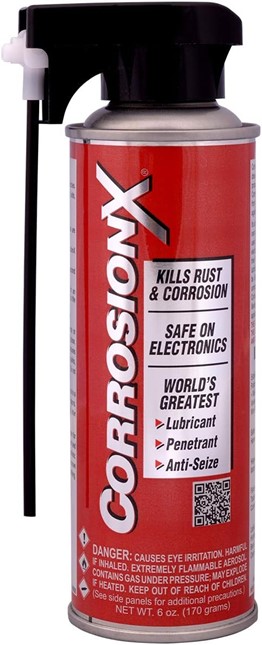
I spray it on the receiver hitch, ball, coupler, tension spring, under jaw, and even the hitch pin, and have had a smooth disconnect since using it.
You might also enjoy these posts from Dave
- Hitch ball on trailer’s anti-sway device is scarring. Should I be worried?
- Our trailer came off hitch ball while being towed. Can grease cause that?
- Should a hitch ball be greased or not?
- Warning: Welded hitch broke loose and “toad” took off! Preventable?
- Can weight distribution hitch bars get weak?
DAVE HAS ANSWERED MORE THAN 1,000 readers’ maintenance and repair questions. Read a directory here. There is so much to learn!
Dave Solberg is a leading expert in the RV industry and the author of the “RV Handbook.”
HAVE A QUESTION FOR DAVE?
Send your inquiries to him using the form below.
RVDT2827


I have had the problem getting the trailer and ball separated on my 2023 Outdoors RV and previous Jayco Jayflight. TT. Never had a problem with a 2000# dump trailer I have. I do grease it most times and it happens whether greased or not. Previously on a 2021 Jayco I couldn’t get it off and took it back to the dealer Because I couldn’t get it off and after driving an hour it came off. Hate the hitches they put on.
One big problem with the ball not coming loose is the shape of the coupler socket.
The ball will catch on the front of the socket because of it’s shape. Chocking the wheels before uncoupling will help, but if the trailer is pulling on the ball it will still stick.
When raising the trailer, watch to see if it is lifting the truck. If it does, just back the truck up a little or put it in neutral. The ball will release.
Mine sticks often. I discovered by applying my foot brake, releasing the parking brake, putting the truck in neutral and then slowly releasing the foot brake releases tension on the ball. Sometimes backing or pulling into a spot keeps tension on the ball. This can be done with the trailer wheels chocked.