I wrote in RV Travel newsletter issue 753 about how the voluntary subscriptions to the newsletter help my staff and me place the interests of our readers ahead of advertisers. Here’s an example of why this is important.
An acquaintance of mine was recently asked to write a coach review for a large national RV magazine. He drove to a dealer, picked up the RV, then spent a few hours driving it around. He didn’t stay in it overnight, nor did he even hook it up.
But he did experience enough to tell me, “I really didn’t like it.” He said he was familiar with the same model coach from eight years earlier. “It was built far better,” he said.
The magazine where his review will appear is funded primarily by advertisers, including the manufacturer of the RV he tested. My friend knows that if he is honest with his review, writing negatively about the coach, the magazine will not be happy because it will risk offending an advertiser. It’s entirely possible that an advertiser could pull its advertising over a bad review: it happens in all media, not just those in the RV industry. In a major RV magazine, this could easily amount to $150,000 a year (or much more) in lost income.
And so my friend said he will do his best with this review, noting it will be a challenge to come up with something positive, considering all the things he disliked. What readers of the published article will read is a wishy-washy account of the RV with most of what my friend did not like left out.
This is why Consumer Reports does not accept advertising, and why it’s a trusted source of product information. It tells it like it is without fear of offending commercial supporters. Its appreciative readers respond by subscribing to ensure the magazine’s continuing impartial coverage.
That is the same reason my staff and I hope to get to a point where our subscribers provide enough support that we can write without any worry of losing an advertiser and its money.
Dear Gary, Love your articles and I have learned so much from you. I have a 2013 Itasca. It has hydraulic stabilizers which level it, but right now it is parked in my driveway which has an incline to the road. I want to be able to use it when family comes to visit but I am trying to figure out how to get it level. The front is probably sitting 10 to 12 inches lower than the back.
I was told, or read in the manual for the stabilizers, that you should never lift the RV up so high that the tires leave the ground, so I don’t think I can use them to level it. I saw your article about making ramps out of treated 2-inch lumber and wondered if you thought that would work for me? I would probably have to use six, 2 x 10 pieces, each a little longer than the first. Also, is it better to raise the front end or the rear? I assume the front, since there is only one set of tires. Thanks so much for your help. —Carol B.
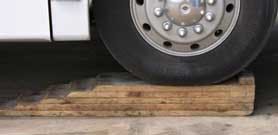
Dear Carol, Indeed, those tapered leveling blocks are your best bet, as well as raising the front axle only. Never allow the tires to leave the ground, especially the rear tires. The emergency brake must be engaged and the transmission in Park, both of which affect the drive axle, so keep those rear tires on the ground.
The photo is of a reader’s setup. Notice the “stop” block on the very top. Don’t risk running off the top block and damaging sidewall or frame components. —Gary
Dear RV Shrink: After a recent rainstorm I found a pool of water on my makeup table in our motorhome bedroom. There is a small window there and my husband says it checks out fine. He looked at all the seals inside and out and says they are fine.
With that report he dismissed the problem as a freak accident. I told him water leaks are not a freak accident, but he refuses to pursue it any further.
I hate to be a nagging wife, but don’t you think he should work on it until he finds the cause? —Mad as a wet hen in Helena
Dear Helena: I agree — work on the problem until you solve it. Leaks are nothing to ignore. They can cause permanent damage it you let them go and continue to flow.
Work as a team. Spray water on the window and figure out where the leak begins. Before you do anything, check the weep holes. Most RV windows have a couple weep holes to let water seep out the bottom of the window track. These holes often clog with debris. When that happens it can overflow to the interior of the coach. Often, clearing those passages will solve your problem.
Remind your husband that one small leak can sink a mighty ship. Deal with it now.
Give this column to your husband. Tell him to “Read it and weep.” —Keep Smilin’, RV Shrink
This food preparation set offers a modern take on maximum utility with minimum space, perfect for the RV lifestyle, where all space is valuable and should be used to maximum efficiency. Eight durable plastic BPA-free pieces in all necessary sizes for preparing food in your galley/kitchen nest together in a neat stack with a small footprint.
The set includes: • 10.5-inch large non-slip mixing bowl • 9-inch colander • 7.5-inch sifter • 6-inch bowl • Measuring cups: 1 cup, 1/2, 1/3, and 1/4 cup
The colors offer a modern neutral palette of stone, graphite, blue and light grey. An aesthetically pleasing addition to any RV kitchen, and all pieces have sturdy handles for easy handling. The manufacturer, Vesper’s Kitchen, offers a money back guarantee if you are not completely satisfied.
FEATURES: SPACE SAVING DESIGN – Compact nesting kitchen set including mixing bowl, colander, measuring bowl, sifter and measuring cups. EASY GRIP HANDLES – Mixing bowl, colander, sifter and measuring bowl all have convenient easy-to-grip handles. LIGHT WEIGHT and no need to worry about breaking like heavy Pyrex glass bowls. NON-SLIP BASE – Mixing bowl includes a non-slip base, quieter than stainless steel bowls.
Great RV accessories for motorhome, travel trailers and campers.
You can find this nesting food prep set on Amazon.
You can find Bob Difley’s RVing ebooks onAmazon Kindle.
Hot summer days are still ahead, resulting in hot, sleepless nights as well. If you are a boondocker/dry camper and don’t always have adequate – or any – electrical hookup to run your power-hungry air conditioner, what to do?
Geizeer is a personal, eco-friendly, portable mini-ice cooling with refrigerant device, which consumes less than 1 cent per day.
Geizeer is made of wood, a perfect thermal insulator. Externally it is composed of two shells in wood and metal finishing frames. Internally it contains a rechargeable battery, a micro USB with PCBs, a DC brushless fan and an ice pack.
The two lower and upper halves of the body overlap to form a cube. Half of the cube, that serves as a base, provides an isolated space for a rechargeable battery and a PCB with micro USB. Above this space, where the cooling elements are housed in the lid, is a brushless fan. The air is sucked from the grid in the upper half, cooled inside the cube, and pushed out through the slots that divide it in half.
Geizeer use is very simple. Simply drop the previously frozen ice pack (from your freezer) into the lower half of the cube, replace the top half, align the blue dots and the fan begins to run.
The fan draws hot air through the upper grid which forces a loss within the cube where the shape of the ice-pack allows diffusion of air to the gel. It is sufficient to cool a room of about 130 square feet – about the size of a 16-foot long by 8-foot wide living space – by about 5 degrees.
Electricity, they say, is a wonderful servant, but a lousy master. Many RVers have concerns about electrical safety in their rigs, and we get occasional letters on the subject. Here’s one we received from a concerned reader:
“One item I feel is important and should be passed along to the readers concerns the use of leveling boards/blocks and the grounding of a trailer. While taking a class on electrical issues involving fifth wheels, motor homes, pop-ups and trailers it was noted that campers should NOT place their metal leveling jacks in direct contact with the ground be it earth, gravel, sand, blacktop or concrete. This will in effect ground the trailer through that action. A camper should only be grounded through the electrical plug only.
“With that in mind, it is important to place thick plastic or rubber between the ground and the jack. If wood is used (as in leveling boards), plastic or rubber should still be used between the jack and the ground as wet wood can conduct electricity. The typical orange squares sold at RV supply stores are excellent to use; but there are other low cost options such as nylon kitchen cutting boards and pieces of plastic deck boards cut to a proper length. There are other options but these are two of the easiest to obtain.”
We could envision crowds of RVers rushing Walmart, clearing out store stocks of plastic cutting boards, provided this matter of not grounding an RV through levelers were true. To protect our readers (and potentially Walmart security) we ran the issue past our “resident expert” on RV electrical safety, Mike Sokol. Mike has 40 years in the industry, does the RV electrical safety lecture circuit, and is author of the book, No~Shock~Zone RV Electrical Safety. (Available at Amazon.)
Mike wants to set this matter straight, because there’s a difference between “earth grounding,” and “neutral bonding.” To make our RVs safe, it’s necessary for the ground wire in our shore power cord (the green wire) to be “bonded” to the neutral bus of the electrical service panel our rig connects up to. This same panel makes a connection to a ground rod, what Mike likes to refer to as an earthing rod. This ground rod serves two purposes. First, if electrical insulation should fail, and electrical power be floating on exposed metal, the ground rod acts as a path to help prevent electrical shock. Secondly, a ground rod also provides a path for static electricity (even lightning) to make its way safely to earth.
Where folks sometimes get confused is in the matter of bonding the ground to the neutral. Under the National Electrical Code, there should only be one point in a system where the ground and neutrals meet – and no more. However, that same code says you can have multiple ground rods. Putting your RV’s stabilizers or levelers in direct contact with the earth could be likened to having more earthing rods – and no danger to it.
Mike feels that many people – including some electricians and electrical engineers themselves – get confused about this issue in that the word “ground” has different meanings – and most of them have nothing to do with electrical ground wire safety. For example, you’ll find in most rigs that the frame of the RV acts as a “ground” for 12-volt DC power. The frame acts as a return path for voltage, and functions just fine, whether hooked up to earth ground when the shore power cord is plugged in, or when completely disconnected from a shore power connection when driving down the road.
In any event, Sokol assures readers, it’s perfectly fine to put down your levelers or stabilizers without adding any sort of “insulation” between the foot and the ground.
It’s easy to find a campground when traveling, even in unfamiliar territory. You simply pull out your Trailer Life or Woodall’s Campground Directory and find one. You can also use the Campground Owners of America directories to find the fanciest of amenity-filled RV resorts or a near-the-freeway overnight mom-and-pop campgrounds with easy in and quick entry back on the freeway in the morning.
But what do you do if you are on a tighter budget and can’t afford campgrounds that have excess funds to spend on advertising and camper magnets like swimming pools, recreation halls and golf courses? Or you would just like a little more space for yourself and don’t need a bunch of amenities?
There are alternatives. Forest Service (both federal and state) campgrounds usually have overnight fees less than half of what privately owned campgrounds and resorts charge, but don’t expect hook-ups, WiFi or cable TV connections. Go to the Forest Service website to find federal campgrounds along your route of travel, or do a Google search for state forest campgrounds wherever you are.
When traveling on Bureau of Land Management lands, which are spread over the 11 western states, primitive camping (boondocking) is allowed anywhere you can pull safely off the road. Follow a dirt road for a hundred yards or so and you may discover a nice, quiet, desert campsite all to yourself — and its costs you nothing.
When traveling through the countryside of many states, particularly in the Midwest, stop at small town police stations, chambers of commerce, or recreation departments and ask about local or regional campgrounds (almost always for the use of local campers and usually deserted except on weekends) that are never advertised or listed in campground directories.
Also look for camping possibilities when in or near national or state wildlife refuges, fishing access areas, regional or county parks, Indian reservations, national monuments, national grasslands, state fairgrounds, and on public utility lands.
If you use a GPS, log what you find into your waypoints or locations log so you can find them the next time through.
You can find Bob Difley’s RVing e-books on Amazon Kindle.
By Chris Dougherty Chris Dougherty is a certified RV technician. Here is a letter he received from a reader while he was serving as RVtravel.com’s technical editor.
Dear Chris, I have a hot water tank that runs on electric or propane and after a couple years it no longer heats with electric. Any suggestions? —Barbara
Dear Barbara, I am assuming that you have checked the usual culprits, including the AC circuit breakers and the switches on the wall, and on the water heater if there is one.
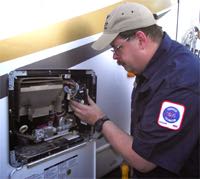
The easiest thing to do is confirm the AC power is getting to the element terminals, which requires using a multimeter and removing the cover from the electric element. With the power on if there is power at the element, then the element has burned out, and can be easily replaced. A water heater element wrench is needed to get the element out of the empty tank, and can be purchased at your local home center. The replacement element for your water heater can be purchased online or from your local RV service center or parts supplier.
Warning: You are dealing with live electricity and water. If you’re not comfortable with this repair, please seek the help of a certified RV technician.
Learn about RV camping, RV travel, RV news & much more. This newsletter, now in its 15th year of continuous publication, is funded primarily through advertising and voluntary subscription contributions from our readers. Thank you!
Editor’s corner By Chuck Woodbury, editor Chuck (at) RVtravel.com
I will soon be homeless. My condo went on the market Monday and a day later there were four offers. If all goes well, Gail and I will move into the motorhome on August 3.
Dealing with little stuff.
Fortunately, we have already given away or sold most of our possessions. Two-thirds of mine went to charity or my family. I sold a few things, and stored other important belongings at my office, which I will keep for a year or two. Two employees will attend to business matters while I’m roaming the countryside. What remains of my possessions will go into the new, 32-foot Winnebago Adventurer.
By this time next week I’ll have my 2008 Winnebago View on the market. It should go fast: Sprinters are very popular these days and mine is in great shape.
So the plan is to find a nearby RV park to live in for about two months. Gail’s son is getting married in late August in the Seattle area, and after that we have plans to fly to Hershey in mid-September for the big RV show.
Once back, we’ll hit the road. We’ll tow a manual transmission Honda Fit.
We’ll stay in the West this year, maybe getting as far as the Gulf in Texas. It’s one popular RVing area that I’ve never visited. I suspect we’ll return to Edmonds in December or January and stay a couple of months to visit friends and family and for me to catch up with business affairs on the homefront. We’ll likely head slowly east after that.
The new home
So far, the hardest part of getting ready for full-timing, besides deciding which of my possessions to keep, is where to store what’s left in the new motorhome. We’ve put Post-It notes on all the drawers and cupboards with ideas of what should go where. Gail is taking charge because my brain does not know how to organize anything.
There is still much to do before I become a relatively free spirit. I’m very excited, but also a little apprehensive. It will feel strange not having roots. Sometimes I wonder if, on some not-so-distant occasion, I might suddenly be overcome with anxiety and think, “Yikes, what the heck have I gotten myself into?”
TRUE STORY: Someone just reminded me of this: Years ago I was dining in a small cafe in Prescott, Arizona. A man walked in and asked the waitress if the cafe sold cigarettes. She shook her head. “Nope, don’t sell ’em,” she said. Then she pointed across the street. “Check there, at the health food store.” Yup, true story.
Did you miss last week’s issue of RV Travel?You can read it here. Reading this newsletter on a smartphone?The newsletter is designed to be read on a computer. If you are reading on smartphone, you’re missing a lot of valuable content.
Happy Birthday! Happy Anniversary!
Wish your special someone a Happy Birthday or Happy Anniversary and we’ll post your well-wishes and your short comment (up to 25 words) right in this newsletter. Just click here. See this week’s greetings near the bottom of this newsletter.
Is reading this newsletter worth a dime to you? Our staff works hard to bring you this newsletter every week. A number of grateful readers (thank you!) help make it possible with voluntary subscriptions. Without their support, we’d probably switch to publishing monthly, not weekly. Even a pledge of $5 a year is appreciated — that’s less than 10 cents an issue!Many readers pledge more — $10 a year is less than 20 cents an issue! If you care to contribute, we will be very appreciative. Enter a voluntary subscription.
RV and RV-related recalls for June
The latest recalls on RVs and other vehicles and/or products of interest to RVers have been released by U.S. National Highway Transportation Safety Administration. The list includes models from Forest River, Grand Design RV, Heartland, Jayco, Keystone, Lakota, Spartan Motors, Thor, Tiffin, Winnebago and others — plus vehicles commonly used to tow, or be towed by, RVs. Is your RV or other vehicle on the list? Read more.
Reduce air drag and boost fuel efficiency — Airtab® your RV! Just peel and stick Airtabs™ to the rear sides and the rear roof of your RV coach or trailer to create swirls of air that reduce aerodynamic drag, save fuel and improve stability. Airtabs™ dramatically reduce trailer ‘fish tailing’ and crosswinds pressure to RVs from passing trucks, while improving fuel efficiency 2% – 5%! Click on the video. Click here for more information about using Airtabs™. Click here to purchase Airtabs™.
THIS WEEK’S CONTEST Win the game Chutes and Ladders
Remember playing this board game as a kid? Or with your own children? Well, take a trip down Memory Lane with this classic edition featuring the artwork of the popular 1970’s edition. Play it again with your kids or grandkids.
We’re giving away THREE GAMES this time with the winners picked at random out of a maximum of 750 entries. The contest ends at midnight Sunday (PDT) or earlier once all three prizes have been awarded. You can only enter once, so hurry so you don’t miss out! It takes about 20 seconds to participate. You’ll know instantly if you win. Only residents of the 50 United States or the District of Columbia are eligible to enter. We’ll announce the winners next week.
What RV do you drive or tow? Send us a photo of your RV (and tow vehicle) with a 150-200 word description of where and how often you travel with it, and what you like or don’t like about it. Include your name(s) and hometown. We’ll post them to RVtravel.com. Send to assistant editor Diane McGovern at Diane(at)RVtravel.com .
CLICK HERE to see last week’s RV Travel Reader RVs.
Light up your RV with Boogey Lights! RV accent lighting is all the rage! Just look around the RV park! Enter Boogey Lights®! These robust, super-bright, state-of-the-art LED lights with hi-tech controller technology represent the next generation in LED lighting for RVs. The AWNING & UNDER-GLOW LIGHT KITS are specifically designed to withstand harsh operating environments. Don’t waste your money on junk! Get Boogey Lights! You can even control them with your Smart Phone! Learn more or click the video for a demonstration.
U.S. motorhome sales slowed but still continued upbeat in May, according to Statistical Surveys Inc. Overall, registrations of new motorhomes were up a little more than 5 percent in comparison to May 2015. Class C motorhomes saw an almost 15 percent gain, while Class A sales dropped nearly 4 percent.
Dometic Corporation faces an updated class-action lawsuit over RV refrigerators. Filed July 8 in San Francisco, Calif., the suit asks the court to order the manufacturer to repair or replace defective refrigerators and repay some for losses. The suit claims all Dometic gas refrigerators built since 1997 are at risk of fire.
Annie Bruecker awoke last Tuesday to find a bear trapped inside her Subaru. “He’s tossing stuff in the back basically and then you can see the ceilings of my car just ripped and I was like, I’m not going to work today,” Bruecker, 17, said in an interview with Fox 31 Denver, speculating that the animal had “just opened the door and then let himself in.” The car was parked near a campground in Genesee, Colo. The animal was released later through the back hatch of the car by sheriff’s deputies.
Federal statistics don’t paint a rosy picture for traffic safety: Road deaths were down 25 percent from 2005 to 2014, but jumped up nearly 8 percent last year. While some of the increase is due to more miles being driven, the National Highway Traffic Safety Administration says there’s more in play. Ninety-four percent were related to human error or choice. Drunk, drugged, distracted or drowsy driving were cited as key concerns.
Boondockers who favor Grand Canyon National Park’s South Rim (Ariz.) may find more space for their interest. Kaibab National Forest officials are exploring the idea of opening up 21,000 acres to camping, with an additional 24 miles of road access. This access would not be in the national park, but rather on adjacent lands. A formal proposal will be unveiled later this summer.
On July 9, a woman fled her tent at Sprague Creek Campground in Montana’s Glacier National Park after her boyfriend fired a pistol through the tent’s roof. Rangers responded, evacuating campers. The shooter eventually put down his weapon after armed rangers surrounded him. He was taken to a hospital after it was determined he was likely emotionally disturbed or under the influence of prescription drugs.
A 35-year-old woman fell 400 feet to her death at the Grand Canyon on July 8 when she stepped out of the way of a fellow hiker and slipped off Ooh Aah Point, near the South Kaibab Trail. Colleen Burns, of Orlando, Fla., was an executive at Yelp. On June 27, Jameson Whittaker, 23, of Irvine, Calif., died when he fell several hundred feet at Mather Point.
Photo: abc7news.com
The oldest full-time National Park Service ranger, Betty Reid Soskin, 94, is back at work at the Rosie the Riveter World War II Home Front National Historic Park in Richmond, Calif., after being attacked in her home on June 27. The intruder stole numerous items, including a coin presented to her by President Barack Obama when she introduced him at last year’s National Christmas Tree Lighting Ceremony. The White House will replace the stolen coin. The intruder has not been caught.
Industry promotion group Recreational Vehicle Industry Association may be looking for a new public face. Last week the RVIA dumped their longtime spokescouple, Brad and Amy Herzog, after the two RVers started a campaign to publish a picture book, “D is for Dump Trump.” An RVIA statement indicated the Herzogs’ actions were not in line with the political neutrality of the association and terminated the couple’s contract after a 17-year run. The Herzogs indicated they had no intention of using their connection with RVIA to “spout political rhetoric,” and are disappointed by the dismissal. Read more in the Huffington Post.
Eagle Creek; U.S. Forest Service
Feeling a bit old? Probably not as old as the first campground developed by the U.S. government. July marks the centennial year of Eagle Creek Campground in Oregon, built by the Forest Service. You can visit the campground — take Interstate 84 east from Portland, jumping off at Exit 41. Turn right at the bottom of the ramp and follow the signs.
Jackson County, Ore., has opened its new Southern Oregon RV Park at the Jackson County Expo/Fairgrounds off Interstate 5 at Peninger Road. Look for 92 full hook-up sites, picnic tables and fire pits. As of August 1, Bowser can enjoy an off-leash dog site.
No one was injured when lightning reportedly struck an RV business in Thonotosassa, Fla., on Tuesday, but the resulting fire burned down the 10,000 square foot warehouse. The name of the business? Lightning RV Supply.
Looking to see Niagara Falls? Don’t bother bringing the marshmallows and hot dogs. The Niagara Falls Ontario Fire Department has extended its open air burn ban to campgrounds. High fire danger is the cause for the shutdown of the traditional campground centerpiece.
The largest campground in Washington’s Mt. Baker-Snoqualmie National Forest is closed for the third year in a row. No blame on root-rotted trees at the Gold Basin Campground; instead, blame it on earth slide danger. In 2014, 43 people living in Oso, Wash., died when a hillside of similar geology wiped out their community. The Forest Service has been working hard to determine when and if the campground can be reopened, and hope the decision can be made this winter.
Death Valley
Can you name the highest-recorded temperature on earth and the place? Death Valley, Calif. – 134 degrees, July 10, 1913. This year the national park has already recorded eight days over 120. Still, the park’s highest visitation months are March, April – and August. Many of the summer visitors are from outside the U.S., coming to experience world-famous temperatures for themselves.
As we reported last week, some British Columbia residents are up in arms over a seeming inability to reserve provincial campsites. Adding to their ire was the report of a commercial tourism company that was reserving sites, then reselling them to foreign tourists at a good profit. Now the provincial environment minister, Mary Polak, says the province simply has too few sites for too great a demand. She downplays the reselling of sites and doesn’t see a need to allocate a given percentage of sites to B.C. residents.
Photo: Keith Mantey, Gwin’s LodgePhoto: Keith Mantey, Gwin’s Lodge
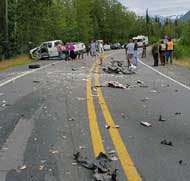
An accident involving a travel trailer and two pickup trucks shut down the Sterling Highway at Milepost 54 on the Kenai Peninsula, Alaska, on Monday. The trailer was a recent purchase of a Washington state couple who were stopped about 80 miles short of their Ninilchik destination by an oncoming pickup truck that swerved into the side of the tow vehicle and their RV, totaling all vehicles. Gwin’s Lodge staff and others helped the couple pack up belongings and sweep up the debris … including a ruptured black water tank that spilled across the highway. No serious injuries were reported. From Keith Mantey, Gwin’s Lodge, Kenai Peninsula, Alaska
Some of the best things in an RVer’s life are free — or, they used to be. Castle Rock, Wash., sports a free dump station, but town officials say the station is just too costly to maintain in addition to causing traffic backups and security concerns. Come September 10, no more dump station.
Police looking for a travel trailer stolen from a nonprofit group in Oklahoma City, Okla., found it – and a funny story to go along with it. The group restores RVs and mobile homes to lend out to victims of disasters. When police located the trailer they found a 23-year-old man inside — sleeping. The man’s grandmother asserted the man had just come home from the hospital, “found” the trailer parked near the house, and had just gone into it to sleep. The “funny” part is it was hooked up to water and electric, all directly to Grandma’s house. She has “no idea” how that happened.
Agri-tourism in Kelowana, British Columbia, may take a hit, as city lawmakers have shut down the acceptance of further requests to create new RV parks on farm land. Previously, agricultural producers could ask to put in RV sites for customers — and 16 presently do so. However, the practice has led some to question how much agricultural production is required to justify putting in RV spots; other issues involve frequent law violations by farmers with RV sites. City councilors say they won’t accept applications until the province clears up its own view on the practice.
As prosperity expands in China, so does the call for RV parks. The Chinese government will open 500 of them this year for about $5.2 billion (U.S. equivalent). China presently has fewer than 500 RV parks.
Keep up with RV Industry news throughout the week at RVbusiness.com.
Scotty, we need more power — solar power, that is! — Part 3
In the third article in the series on the new solar panels on his motorhome, Rich “The Wandeman” “debriefs” on his five-day trial run of his new solar charging system. To say that he is a very happy boondocker is putting it mildly. Read here why he is such a firm believer in solar power and why you, too, can use it without sacrificing anything at all.
When roads were made of wood
Early in the 20th century, when auto travel was the rage, Yuma, Ariz., was at a crossroads but with a big obstacle to the west — vast sand dunes. Throughout history, travel of any kind was severely inhibited by this great barrier. With the building of Yuma’s Ocean to Ocean highway in 1915, a way had to be found for autos to cross. A wooden plank road seemed the answer. Read more.
Prepare for steep grades For some of us, heading out to the amusement park and taking a ride on the roller coaster is just plain fun. But the last place you want to ride a roller coaster is when you’re behind the wheel of your RV. Hitting a steep grade unprepared is anything but fun – for too many, it’s deadly. Are you ready for steep grades — whether downhill or uphill? Learn how to safely handle them.
Sometimes an RV spare tire isn’t necessary
RV tire safety expert Roger Marble of RVtireSafety.com answers the question, “Do RVers need to carry a spare tire?” This applies to owners of motorhomes and other RVs that are towed. Watch the video.
Why boondock? Dave Helgeson, veteran RVer and boondocker, once believed boondocking was just about saving the cost of a campground. However, after becoming a boondocker out of necessity (lack of campgrounds in the backcountry areas he liked to explore), he discovered it was much more than just saving a buck. So why do RVers boondock? Well, lots of reasons. Find out some of them here, and if you haven’t tried it yet, this might just convince you to give it a try.
Dealing with RV repairs when money’s tight
Think your RV is a money pit? You might feel a little better about your situation when you read this tale of Russ and Tiña De Maris’ ongoing saga of RV problems, and why they sometimes find craigslist very helpful. (Russ says their friends don’t refer to them as “The De Maris Syndrome” for nothing. —Sorry, Russ. Couldn’t resist.) Read more.
What to consider before you change the RV tire size
When considering a change in tire size there are many different areas you should consider — many of which are critical. Roger Marble, RV tire expert extraordinaire, explains all the things to take into consideration for your safety and the performance of the tires. Learn more.
What an RV salesperson should ask a buyer In this short video from the Better Business Bureau, RV salesperson Susan Graham provides a few tips about what a good RV salesperson should ask someone who is interested in buying an RV. Watch the video.
Fighting mildew wars
Chris Dougherty is a certified RV technician. He received a letter from a reader while he was serving as RVtravel.com’s technical editor regarding combating mildew in a high-humidity area such as Florida. Here are his tips.
New and Interesting Finds at Amazon.com. This is fun!
This week in history Week of July 16-22 Compiled by Dell Bert
1916 — Boeing founded in Seattle, Wash., by William Boeing.
1933 — Wiley Post flies solo around the world.
1935 — World’s first parking meter installed (in Oklahoma City).
1955 — Disneyland opens in Anaheim, Calif.
1969 — Neil Armstrong becomes first Earthling to walk on the moon.
1995 — Amazon opens for business as an online bookseller.
1999 — John F. Kennedy Jr. killed in plane crash.
Clean your RV… with beastly-good results! Your RV’s not your car, it’s your “beast.”
Your RV’s large surface area makes it a beast that collects more bugs, grit, grime, soot and industrial pollution than your car does. And it may have different surfaces of paint, fiberglass, vinyl and aluminum. Click on the video to watch Wade clean everything with Beast Wash as it cuts through slime and grime. You’ll see the difference. SALE! 5% off – Use code:Catclean15when ordering.
RV Clubs Here are some RV clubs from our extensive directory which you may be interested in:
Holiday Rambler Recreational Vehicle Club
Club members all own a Holiday Rambler recreational vehicle or one manufactured by Holiday Rambler and live throughout the United States and Canada. There are also several special interest chapters. The Eastern International Rally is July 17-23 (now) and registration is still open.
Rainbow RV
“North America’s largest Gay and Lesbian recreational vehicle camping club. In existence since 1997, Rainbow RV has attracted over 7,000 members and completed more than 1,000 camping events. Our members are LGBT couples and singles with tow or drive recreational vehicles, off road jeep and tent backpack equipment.” Lots of events and resources. Annual West Coast Rally coming up in September.
National Serro Scotty Organization
The National Serro Scotty Organization is a strong network of vintage trailer aficionados with hundreds of members in every state and in Canada, Denmark, and Germany. It was credited in Douglas Keister’s book “Teardrops and Tiny Trailers” as the reason Serro Scotty trailers “continue to thrive and survive.” “Cute trailers, friendly people and awesome adventures.”
Unique RV overnight stops at wineries and farms With membership in Harvest Hosts® you can stay overnight at 500 wineries, farms and attractions across North America. Harvest Hosts offers an exciting alternative to traditional overnight stops where you can meet interesting people and learn about their lifestyle. Learn more at the Harvest Hosts website, or watch an interview with the founders by RVtravel.com editor Chuck Woodbury.
Bumper sticker of the week
I don’t have a short attention span, I just … Oh, look! A squirrel!
Funny/clever business slogan
“The Answer To Your Hangups,” Art Laminators, Inc., Seattle, Wash. (a few years ago)
Have you seen a funny bumper sticker or business slogan? Send it to Diane(at)RVtravel.com
America’s LargestRV Consignment Dealer Buy or sell your used motorhome, diesel pusher, fifth wheel or travel trailer hassle free at PPL Motor Homes. And check our huge selection of parts! PPL is the largest RV consignment dealer in the USA, selling more than 24,000 consigned RVs since 1972. Visit the PPL website.
Upcoming RV Shows
See the Web’s best directory of upcoming RV shows for 2016.
Websites of the Week
We like these websites. Check ’em out. More next week.
Here’s a sample: 25 easy summer campfire recipes (that aren’t S’mores!) — Say what?!
Be sure to check out the rest of the list — lots of summertime stuff.
Good reading from RV123.com
• Complete your fire starting kit with Swedish FireSteel
• This hearty campfire meal looks absolutely delicious!
• Watch these YouTubers give their picks for the best RVs under 30 feet
Ask the RV Shrink
How to minimize “sound pollution” inside a moving RV
Dear RV Shrink: We just moved into our new motorhome. One thing I never gave much thought to was noise from all of our belongings banging around as we travel down the road. It drives my wife to distraction more than me. At first it was annoying — we could hardly talk in normal volumes. After locating and quieting the noisiest problems, we are now down to several more we are working on and some we have not been able to locate. Does everyone have to put up with this, or did we just end up with a rattletrap? —Looking for sound advice in Sacramento
Why have tankless water heaters become so popular at home, but failed to capture the RV market’s favor? One reason has been an inability to prevent temperature spikes that sometimes scald. Finally, a new hybrid mixing vessel technology in the Truma AquaGo® instant water heater has solved this concern, providing instant, constant, endless hot water. Learn more here.
Why you should not wait to live your dream The late Gaylord Maxwell, founder of the successful Life On Wheels Conferences, liked to tell a story about why we should not wait to start traveling by RV, specifically about traveling full-time if that’s our dream. Take a moment to watch this short video where Gaylord tells this inspiring story.
‘RV Death Spiral’ — Suppliers in a tough spot
In part three of his series, Greg Gerber discusses the predicament of RV parts suppliers. They may build the most durable products on the market but if a manufacturer says, “Now get the cost down 30 percent,” the supplier must comply or lose the sale. So wood becomes fiberboard and metal parts become plastic. If the supplier doesn’t comply, there’s always another company willing to provide a cheaper, often inferior product. Read more at RV Daily Report.
Handy tool easily fits in your pocket The stainless steel Leatherman Wingman includes needle nose pliers, spring action regular pliers, wire stripper, 420HC combo knife, spring-action scissors, package opener, ruler (1.5in, 3.8cm), can opener, bottle opener, wood/metal file, Phillips screwdriver and medium and small screwdrivers. Keep it in your pocket: you won’t believe how often you’ll use it. Learn more or order.
RV Tech Tips from Mark Polk
To help increase engine life, perform pre-trip checks
Before moving the tow vehicle or RV, make the following checks concerning the engine. Check all fluid levels in the power steering reservoir, engine coolant, engine oil, windshield washer and brake fluid. Check the transmission fluid while you are at it. Consult your vehicle owner’s manual for proper procedures to check and add fluids. Start the engine, allow it to reach operating temperature and check for proper readings on all gauges. Look under the vehicle for signs of leaks. Have any leaks checked out and repaired before using the vehicle.
Mark Polk is the owner of RV Education 101, the premiere source of educational DVDs about buying, maintaining and using an RV. Learn more.
Level your RV the easy way! Camco FasTen Leveling Blocks allow you to stack the interlocking blocks to the desired height for safe, easy leveling. Each block adds an inch to height. Use with single or double wheels; hydraulic jacks, tongue jacks, stabilizer jacks, 5th wheel jacks or tandem axles. Carrying handle easily pulls up for carrying or twists down for storage. Learn more or order.
Latest fuel prices Here are the latest U.S. average prices per gallon of gasoline and diesel fuel: Regular unleaded gasoline: $2.25 (on July 11). Change from week before: Down 4 cents; Change from year before: Down 58 cents. Diesel: $2.41 (on July 11). Change from week before: Down 9/10 cent; Change from year before: Down 40 cents.
This RV water hose never kinks This RV water-safe drinking hose self-straightens with a reflex mesh design to prevent kinking. Solid brass octagon female coupling ensures a tight no-leak connection. The highly rated hose is FDA approved with a limited lifetime warranty. Fed up withwater hoses that are always kinking? This is the answer. Comes in various lengths. Learn more or order.
RV Travel Reader Pets
Do you travel with a pet? We’d love to introduce your pet(s) to fellow readers. Send a photo or two of Fido or Boots and a 150-200 word description of your furry friend(s), along with your name(s) and hometown to Diane(at)RVtravel.com .
Click here to see the last issue of RV Travel Reader Pets.
Unbreakable glassware Perfect for the RV! Have you checked out unbreakable glassware lately? It’s beautiful — and perfect for RVs, too — lightweight, and there’s no fear of breakage when the going gets rough. Great for taking places (like swimming pools) where glass is not allowed. Check out the many types of glasses by clicking here. Wow!
The RV Kitchen with Janet Groene
Nuked Brownies Baked brownies in a “New York minute”
Can’t wait for the oven to preheat and bake a batch of chewy, chocolaty paradise? Don’t want to heat up the whole RV by running the big oven? You’re not alone. Here’s a way to make brownies in the microwave in five minutes, all in one dish. You won’t even have to wash a mixing bowl. Get the recipe.
SAVE MONEY! Don’t toss away good batteries! Most RVers rely on battery-powered devices while on the road, whether flashlights, radios or cameras. But sometimes you just can’t tell how much life a battery has remaining so you toss it to “be sure.” This small tester, for about $8, will alert you in an instant to the condition of your batteries, saving you money from needlessly tossing ones with plenty of life left! Works on AA, AAA, C, D and 9V and button-type batteries. Learn more or order.
RV Fire Safety Tip
Educate your guests, just in case
Show travelers (guests) how to unhook electricity (screw-on cords can be tricky) and how to close propane valves, in case either of these measures is called for. Courtesy: MacTheFireGuy.com
Editor’s note: Choose from a wide selection of fire extinguishers atAmazon.
Guide to RV Camping in State Parks Learn about more than 1,730 state parks, forests & recreation areas for RVers. Book includes maps, locator charts, reservation & fee info, plus contact details & website. Plus park location, directions, GPS coordinates, contact info, type of hookups, season, RV length limit & availability of showers, dump station, Wi-Fi, etc. Learn more or order.
RV Quick Tips
Send your tips to Diane (at) RVtravel.com
Easy and economical fire starters
Reader Ann Andrews, who describes herself as a “mature Girl Scout,” says forget about commercial fire starters. “I use cardboard egg cartons and the wax from cheese. Many of the snack cheeses are wrapped individually; other bulk cheeses are wrapped in a paraffin wrap. I remove the waxes and save them, and when I have a collection I put some into each egg holder. Then I cut them apart and store. We use a couple every time we start a campfire.” Saves money and reuses otherwise “wasted” items. Thanks, Ann! Handy, long-lasting cold water to drink
Hankering for cold water during your days of travel? Toss a few small bottles of water in the freezer. [Leave some room in the bottle for expansion.] Once opened, it will take several hours for the water to completely melt, and you will have ongoing sips of cold water. Thanks to Helen and Ken!
Easy tip to really shine up your wheel covers
Wheel covers on your RV look a little dull? Here’s a tip from David Norris: “After cleaning the wheel covers on my RV, I wipe them off with a chamois dampened with a vinegar-and-water solution. There are no water spots and the vinegar brings out the stainless steel shine!” Thanks, David!
Pocket Fisherman works great! Many RV parks have lakes where you can fish without a license. That’s when this handy Ronco Pocket Spincasting rod and reel comes in handy! The double-flex rod is hinged into closed position when stored. Simply unfold until it snaps into its extended position. So go ahead, catch that trout or bass! And for only $15? You kidding me? (nope). Learn more or order.
Ask the RV Doctor The RV Doctor, Gary Bunzer, answers your questions
What’s causing fluctuating line voltages in RV?
Dear Gary,
I have 2013 Endeavor 43RFT. The Power Control System Central Monitor Panel is showing that the L1 and L2 voltages are fluctuating 3 volts every one to five seconds, (e.g., 118v then 121v then 118 then 121, etc.). Per Monaco Help Line, I have tightened all the screws in the distribution panel and in the transfer switch. This occurs whether I am on shore power or generator (but not when inverting). Monaco Help Line could not offer any other help — how about you? My inverter is a Magnum MS-2812 and the transfer switch is Surge Guard 41260. —Jim L., near Huntsville, Texas
Headed to Alaska? Let this be your guide! This is THE mile-by-mile guidebook for RV or auto travelers headed to Alaska, the Yukon Territory, British Columbia, Alberta and the Northwest Territories. First published in 1949 as a guide about traveling along the Alaska Highway, today’s Milepost includes more than 600 pictures, more than 100 maps and details every place travelers might eat, sleep or pull off the road for scenic viewing. Learn more or order.
Gizmos and Gadgets
Run your generator in any weather with GenTent
If you’ve been concerned with the safety of your portable generator in wet weather, GenTent® makes a variety of Safety Canopies — easy-to-install weatherproof covers for safe operation of portable generators in virtually any wet weather conditions. For RVers and other outdoor enthusiasts, the GenTent XKi expands the popular GenTent safety canopy application with mounting on any sized inverter generator or fully enclosed portable generator. Learn more.
Add an extra RV living space for less than $80
Here is a great way to add an extra “room” to your RV for less than $80. Sound impossible? Well, it’s not, and if you have an awning on your RV you’re more than halfway there. With an awning shade net, you can shelter most of the area underneath your awning to create a cool, comfortable and private patio. Read more.
Extend your battery life with LED lights If you haven’t switched your RV lights to LEDs, you’re tossing away energy. This is especially important when boondocking — when every amp counts. Watch this video for a demonstration of the huge energy savings with LEDs. In most cases, installation is as easy as screwing out an old light bulb and replacing it with the new LED. Learn more or order at Amazon.com.
RV Short Stop
Johnny Cash and June Carter Cash’s Hideaway Farm Bon Aqua, Tenn.
Cash-Carter Hideaway Farm; Storytellers Museum
Country legend Johnny Cash once called his 107-acre farm in Bon Aqua, Tenn., “the center of my universe.” The old “dog trot” house and property were acquired by Cash and June Carter Cash in 1972. Built before the Civil War, Johnny and June retained the farm until their deaths.
Nearby is the Storytellers Museum, in an old general store which Johnny Cash used for local concerts. The farm and museum were opened to the public on July 12, 2016. “The Cash Hideaway Farm and the Storytellers Museum are Nashville’s newest tourist attractions and must-stops for anyone interested in country music and the region’s rich history.” —Storyteller Museum website
Eliminate gray water
tank odors for less than $8
Gray water tanks can produce nasty odors, too. Using the latest technology in quick dissolving biodegradable tablets, Elemonate deodorizes your gray tank, freshens sink and drain lines and dissolves grease and organic sludge buildup in the drain lines of your sink and gray tank. Learn more or order.
Visit our YouTube Channel.
More than 500 great videos about RVing!
Videos you’ll like
•A quick tip about slideout maintenance
RV tech Chris Dougherty offers good advice. Watch the video.
•How to sanitize a RV fresh water tank
The RV Geeks have been drinking directly from their tank for 12 years. Here’s how they can do it. Watch the video.
• Be sure you know this when buying a tire warranty
RV tire expert Roger Marble provides a valuable tip. Watch the video.
Random RV Thought On a dark night, when the night sky is ablaze with stars and you are camped far from the lights of the city, grab a pillow and a blanket and climb to the roof of your RV. Lie on your back and observe the heavenly spectacle above.
Trivia Collapsible car folded up in five minutes In 1928, Engelbert Zaschka built a three-wheeled collapsible car that he called the Zaschka. It could be broken apart within five minutes into three main sections so it did not need a garage. Maybe one of these would be handy for RVing: just keep it in a storage compartment when not needed. See pics.
Super clean your holding tanks! Extreme Cleaner by Happy Campers cleans, softens and helps dissolve and remove all types of sewer waste, toilet tissue, crud, sludge, light corrosion and scum buildup. Highest concentrated, most active (powerful) sewer tank and sensor cleaner on the market. Recommended for winterizing, annual clean out, and removing persistent odors caused by chemicals or medications obstructing your tank treatment. Often helps restore poor-working sensors. Learn more or order.
Worth Pondering
No human race is superior; no religious faith is inferior. All collective judgments are wrong. Only racists make them. —Elie Wiesel (9/30/1928-7/2/2016)
TODAY’S DEALS ON RV PARTS & ACCESSORIES AT AMAZON.COM. Click.
Readers’ Birthday and Anniversary Greetings
Happy Birthday! • July 21: To Ymama from Scott.Happy Birthday to my very special wife!!!
Happy Anniversary! • July 16: To Pancho from Babe. Love you with all my heart. Looking forward to many more years together.
• July 17: To Connie Sullivan from Daryl Sullivan. Happy Anniversary and thanks for 51 years of patience and happiness! Enjoy Alaska!
• July 18: To Thomas from Michael. 35 years ago you became my soulmate, best friend and love of my life. Many more adventures await.
• July 20: To John from Jan. Happy 43rd Anniversary, Honey! I thank God every day for you.
• July 21: To Bill from Melody.Happy Anniversary! Can’t believe we made it to 43 years, even after owning an RV almost every one of those years! Here’s to another 43, and hopefully, no more RVs!
RV Travel staff Editor and Publisher: Chuck Woodbury. Assistant editor: Diane McGovern. Contributing editor: Russ De Maris. Contributing writers: Bob Difley, Richard Miller, Richard Mallery, Janet Groene, Roger Marble, Greg Illes and Julianne Crane.
ADVERTISE on RVtravel.com and/or in this newsletter. Contact Chuck Woodbury at Chuck(at)RVtravel.com.
About the RVtravel.com editor Chuck Woodbury has explored America by RV for three decades. In the ’90s he published the quirky travel newspaper Out West, and was an “on the road” writer for the New York Times Syndicate. His book, “The Best from Out West” is available at Amazon.com. Woodbury’s RVing adventures have been profiled on ABC News, CNN, NBC’s Today Show, and in People Magazine, USA Today and in hundreds of newspapers. He is the host of the Better Business Bureau DVD “Buying a Recreational Vehicle,” the definitive guide to purchasing an RV the right way.
Everything in this newsletter is true to the best of our knowledge. But we occasionally get something wrong. We’re just human! So don’t go spending $10,000 on something we said was good simply because we said so, or fixing something according to what we suggested (check with your own technician first). Maybe we made a mistake.Tips and/or comments in this newsletter are those of the authors and may not reflect the views of RVtravel.com or this newsletter.
Our offices are located at 610 5th Ave. S, Suite F, Edmonds, WA 98020.
This website utilizes some advertising services. Sometimes we are paid if you click one of those links and purchase a product or service. Regardless of this potential revenue, unless stated otherwise, we only recommend products or services we believe provide value to our readers. Amazon and the Amazon logo are trademarks of Amazon.com, Inc . RVtravel.com is a participant in the Amazon Services LLC Associates Program, an affiliate advertising program designed to provide a means for sites to earn advertising fees by advertising and linking to Amazon.com.
RVtravel.com includes links to other websites. We cannot control the content and/or privacy policies of those sites. Please be aware when you leave this newsletter or any other section of RVtravel.com to read the privacy statements of any of those websites that collect personally identifiable information. Our own privacy policy applies only to RVtravel.com and its affiliated blogs.
The Man in Black’s Hideaway Farm in Bon Aqua, Tenn. (Storytellers Museum)
Country legend Johnny Cash once called his 107-acre farm in Bon Aqua, Tenn., “the center of my universe.” The old ‘dog trot’ house and property were acquired by Cash and June Carter Cash in 1972, five years after they married.
“It was love at first sight,” Cash wrote in his 1997 autobiography. (The farm was) “a place that moved into my heart immediately, a place I knew I could
belong.”
Johnny Cash & June Carter (Look 1969)
His daughter Cindy Cash was quoted as saying: “As soon as he’d come off the road he’d say, ‘I’m going to the farm,’ and he’d go spend three or four days there. … It had a lot to do with his spirituality, his love of nature, and the solitude he found here. This is where he found his serenity.”
Built before the Civil War, Johnny and June retained the farm until their deaths: June Carter Cash in May 2003, complications from heart surgery; Johnny Cash in September 2003, complications from diabetes.
In 2015, Brian and Sally Oxley bought the farm and then renovated a general store down the road for the Storytellers Museum.
The restored Storytellers Museum in Bon Aqua, Tenn. (Storytellers Museum)
On July 12, 2016, both the Cash farm and the Storytellers Museum were opened to the public. “Johnny Cash used (the old general store) as a place for local concerts. Visitors can see the historic ‘Little Stage’ where the ‘Saturday Night in Hickman County’ guitar pulls once took place,” according to the museum’s web site.
Hours:
Museum: Tuesday-Friday. 10:30 a.m.-5 p.m.; Saturday: 9:30 a.m.- 5 p.m.
Farm: Tuesday-Saturday. 11:30 a.m.-5 p.m. Admission:
Museum: $16; museum/tour of farm: $22.
Senior citizens, students 10 and older, and residents of Hickman and Dickson counties: $6 for museum; $7 for the museum/farm tour.
Free for active duty military and children 9 and younger.
All tickets are available at the Storytellers Museum only. Directions: Take I-40 to TN-46 S (Exit 172), turn south at light, proceed 5 miles to Church St. (Dollar General on left), turn right. Continue about 1.5 miles. Museum on the left.
RVC Outdoor Destinations (RVC), a provider of high-quality outdoor resort properties, has recently made a significant foray into the care, cultivation and colony protection of one of America’s most important natural resources: honey bees.
According to some estimates, approximately half of all honey bees in North America are dying every year — a troubling statistic that RVC and others believe is evidence of a deeper ecological disturbance.
Beginning this month, RVC, best known for its nationwide network of RV resorts, has established new, state-of-the-art hives at ten of its resort properties. “We are looking to educate ourselves and the wider community” says RVC CEO Yale Spina. “Something’s wrong, and humans need to pay attention. The planet has been witnessing a serious increase in Colony Collapse Disorder over the last few years, which is why we’re acting with some urgency. This has really devastating effects on our ecosystem and ultimately affects human life as well as 33 percent of our diet.
“Because we care about the bees, we are going to provide great homes for bees at our properties and educate our staff and guests about the plight of the bees. Since RVC Outdoor Destinations are located in diverse ecosystems, our hope is that the honeybees will thrive here and help us be good stewards of our land and the overall environment.”
RVC is using hives developed by Flow Hive, (www.honeyflow.com) which allow for easy viewing of the bees at work, as well as simple extraction of honey. The company is partnering with local beekeeping associations to manage the hives and provide the bees with proper care.
RVC’s investment in bees will be accompanied by educational resources intended to illuminate some of the causes of Colony Collapse Disorder — and some possible remedies. The initiative, dubbed “The RVC BEECause,” invites RVC guests to plant bee friendly gardens and use organic growing methods, bring awareness to products that are bee friendly, and be mindful of the pesticides used at home – as well as eat more honey.
RVC will donate proceeds from honey sourced from the Flow-Hives to support local beekeepers and bee-friendly causes.
RVC Outdoor Destinations BEECause hives are currently at the following resort locations:
●Garden of the Gods, Colorado Springs, CO ●Catherine’s Landing, Hot Springs, AR ●Medina High Point Resort, Medina, TX ●Live Oak Landing, Freeport, FL ●Pine Mountain, Pine Mountain, GA ●Mountain Springs, Asheville, NC ●Lake Raystown Resort, Entriken, PA ●Carrabelle Beach RV Resort, Carrabelle, FL
The BEECause project will expand to other RVC locations throughout 2016.
Here is a great way to add an extra “room” to your RV for less than $80. Sound impossible? Well, it’s not, and if you have an awning on your RV you’re more than halfway there. With an awning shade net, you can shelter most of the area underneath your awning to create a cool, comfortable and private patio.
Awning shades are popular because they provide a simple, cost effective way to expand your private RV living area. With an awning shade in place, your existing patio awning suddenly becomes the foundation for a whole new room. And it’s a truly private area because you can see out but others can‘t see in!
Add some indoor/outdoor carpet and patio furniture, and you have a comfy space, protected from rain and sheltered from other elements.
An awning shade slips on quickly and easily into an RV awning‘s utility slot with standard awning light hangers. When it place it not only provides extra living space, but blocks 80 percent of the sun’s harmful rays, not to mention much of its heat. A typical kit comes with spiral hooks to attach into ground and bungee balls.
Various sized awning shades are available at Amazon.com and Camping World.
We use cookies to ensure that we give you the best experience on our website. By continuing to use our site, you consent to accepting cookies. We NEVER have or will sell reader's data. For more info, please see our privacy policy page.


 Dear Gary,
 Indeed, those tapered leveling blocks are your best bet, as well as raising the front axle only. Never allow the tires to leave the ground, especially the rear tires. The emergency brake must be engaged and the transmission in Park, both of which affect the drive axle, so keep those rear tires on the ground.
 After a recent rainstorm I found a pool of water on my makeup table in our motorhome bedroom. There is a small window there and my husband says it checks out fine. He looked at all the seals inside and out and says they are fine.


 “One item I feel is important and should be passed along to the readers concerns the use of leveling boards/blocks and the grounding of a trailer. While taking a class on electrical issues involving fifth wheels, motor homes, pop-ups and trailers it was noted that campers should NOT place their metal leveling jacks in direct contact with the ground be it earth, gravel, sand, blacktop or concrete. This will in effect ground the trailer through that action. A camper should only be grounded through the electrical plug only.
 But what do you do if you are on a tighter budget and can’t afford campgrounds that have excess funds to spend on advertising and camper magnets like swimming pools, recreation halls and golf courses? Or you would just like a little more space for yourself and don’t need a bunch of amenities?
 The easiest thing to do is confirm the AC power is getting to the element terminals, which requires using a multimeter and removing the cover from the electric element. With the power on if there is power at the element, then the element has burned out, and can be easily replaced. A water heater element wrench is needed to get the element out of the empty tank, and can be purchased at your local home center. The replacement element for your water heater can be purchased online or from your local RV service center or parts supplier.


 Featured categories
 Is reading this newsletter worth a dime to you?
 Our staff works hard to bring you this newsletter every week. A number of grateful readers (thank you!) help make it possible with voluntary subscriptions. Without their support, we’d probably switch to publishing monthly, not weekly. Even a pledge of $5 a year is appreciated — that’s




 RV accent lighting is all the rage! Just look around the RV park! Enter Boogey Lights®! These robust, super-bright, state-of-the-art LED lights with hi-tech controller technology represent the next generation in LED lighting for RVs. The AWNING & UNDER-GLOW LIGHT KITS are specifically designed to withstand harsh operating environments. Don’t waste your money on junk! Get Boogey Lights! You can even control them with your Smart Phone!
  U.S. motorhome sales slowed but still continued upbeat in May, according to Statistical Surveys Inc. Overall, registrations of new motorhomes were up a little more than 5 percent in comparison to May 2015. Class C motorhomes saw an almost 15 percent gain, while Class A sales dropped nearly 4 percent.


 Police looking for a travel trailer stolen from a nonprofit group in Oklahoma City, Okla., found it – and a funny story to go along with it. The group restores RVs and mobile homes to lend out to victims of disasters. When police located the trailer they found a 23-year-old man inside — sleeping. The man’s grandmother asserted the man had just come home from the hospital, “found” the trailer parked near the house, and had just gone into it to sleep. The “funny” part is it was hooked up to water and electric, all directly to Grandma’s house. She has “no idea” how that happened.
 Keep up with RV Industry news
 When roads were made of wood



 Unique RV overnight stops at wineries and farms
 America’s Largest



 Handy tool easily fits in your pocket
 Camco FasTen Leveling Blocks allow you to stack the interlocking blocks to the desired height for safe, easy leveling. Each block adds an inch to height. Use with single or double wheels; hydraulic jacks, tongue jacks, stabilizer jacks, 5th wheel jacks or tandem axles. Carrying handle easily pulls up for carrying or twists down for storage.


 Guide to RV Camping in State Parks
 Pocket Fisherman works great!

 Add an extra RV living space for less than $80



 Super clean your holding tanks!




 According to some estimates, approximately half of all honey bees in North America are dying every year — a troubling statistic that RVC and others believe is evidence of a deeper ecological disturbance.