

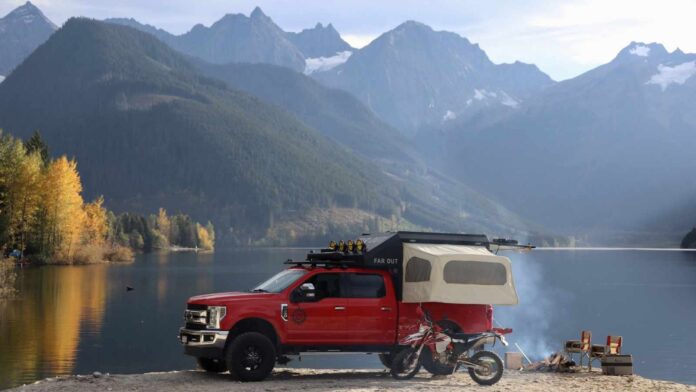
Today’s RV review is of the Far-Out Campers, a rather unique take on the pickup camper for full-sized pickups. Far-Out Campers makes a variety of lengths of camper for just about any full-sized pickup on the market.
I will say this is definitely a camper for adventurous people rather than those looking for something luxurious. In other words, this isn’t something like the Host Mammoth truck camper, but it also lets you continue to use your pickup as a pickup.
In fact, this might be one of the best features of the Far-Out Camper—for many travelers one of the downsides to pickup campers is that you no longer have a pickup most of the time. Instead, you have sort of a Class C RV without all the space of a Class C RV.
What are the Far-Out Campers?
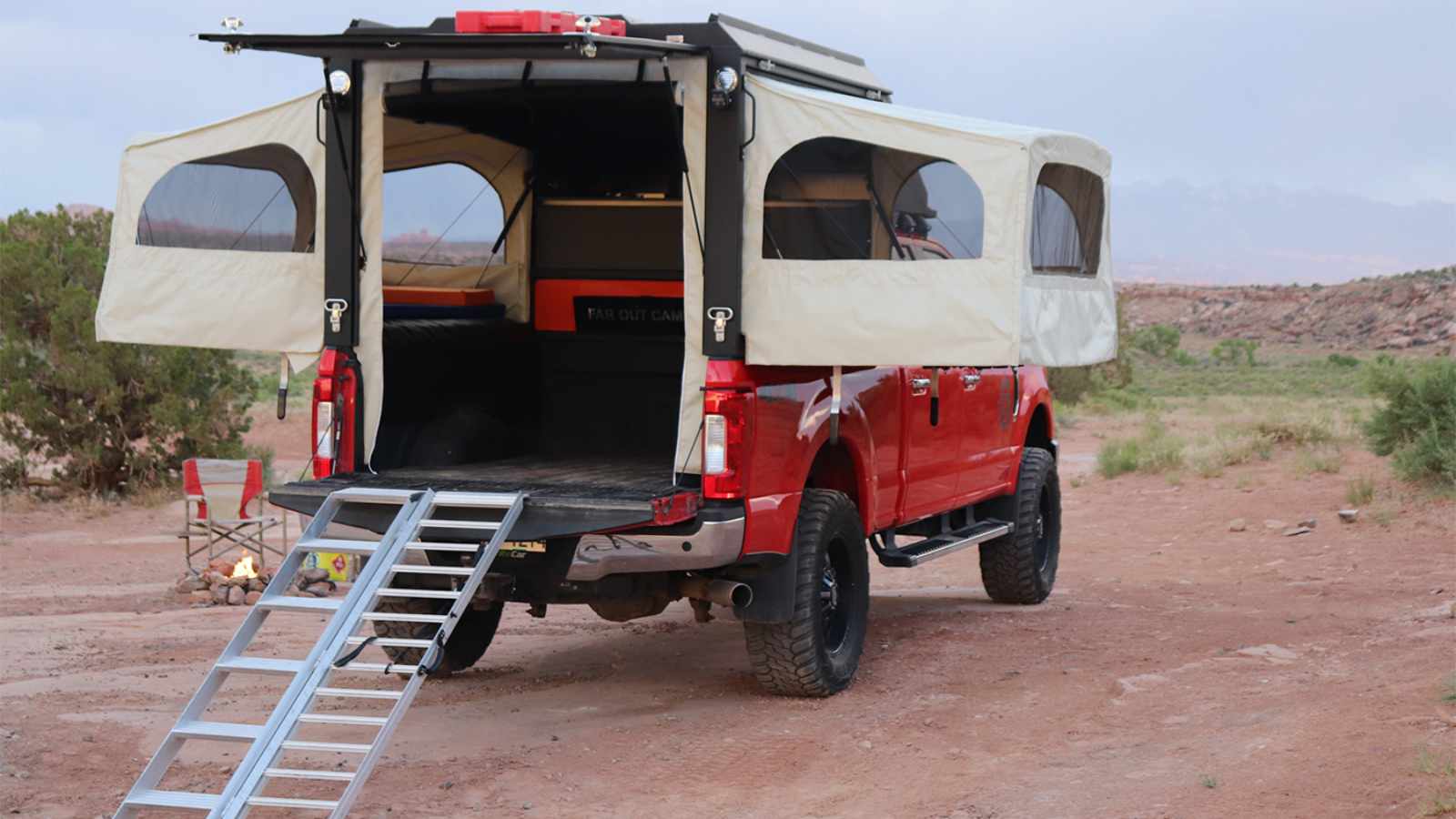
The Far-Out Camper is built of a welded aluminum frame with drop-down sides that become the beds. There is a drop-down side on either side of this rig. The hinges and other hardware are stainless steel, so the combination of build materials should result in a very, very long-lasting camper.
The structure is rigid, unlike something like the Four Wheel Campers Hawk Pop-Up Camper, so it remains the same height all the time. That height affords a 6’5” interior standing height.
The main structure of the camper is welded and then powder-coated aluminum. That results in a very strong but also relatively lightweight build. How light? The 6.5-foot model weighs about 730 pounds, and the eight-foot unit just 770 pounds. Pretty light.
I know one of the first questions many of you ask is the price. I think they’re pretty reasonable, given the build quality, starting at $18,600. Of course, there are a few options—but you could be just fine with the basic model, depending on what you want to accomplish.
When the sides are dropped down there is a tent that folds out and the base of the side becomes the bottom of the bed. Cushions go onto the surface to become the bedding base. But I wonder how comfortable these are, since they’re pretty thin. But then you could bring a roll of memory foam or an inflatable mattress to overcome that. These are easy, easy problems to solve.
Once you’ve dropped down the side, the tent attaches to the body of the camper with hook-and-loop fasteners. There’s a pole that presses in to give the top of the tent a bit more rigidity.
Interestingly, since this is a pickup bed that you’re camping in, it’s possible to sit on the beds that have been dropped down and put a folding table between them—and now you have a dining area.



Power to the people
The camper build includes interior lighting. All of the lighting is powered by an included portable power station that’s charged either with the truck’s alternator or a solar panel on the roof of the camper.
Sometimes RV companies can really make things super complicated—that’s not the case here. If you ever do need more power or you want to use the portable power station for something other than the camper, you can just carry it out with you.
What more can you do?
While you’re camping, you can also take the portable power station and power things like a 12-volt cooler, or an induction cooktop. In fact, this is how we use our Flated Air-Topper when we use it to go camping. It’s simple enough to bring along a Alpicool 12-volt cooler and Duxtop induction cooktop, and bing, bang, boom, I now have everything I need.
If you have a folding table that goes between the sides of the bed, many of these offer height adjustment so you can use it inside the camper or take it outside to make a kitchen. I still really, really want a SylvanSport Dine O Mite camp kitchen. That would be the perfect thing for this camper. I already have the Dometic GO portable hydration jug with a powered faucet, so there’s that.
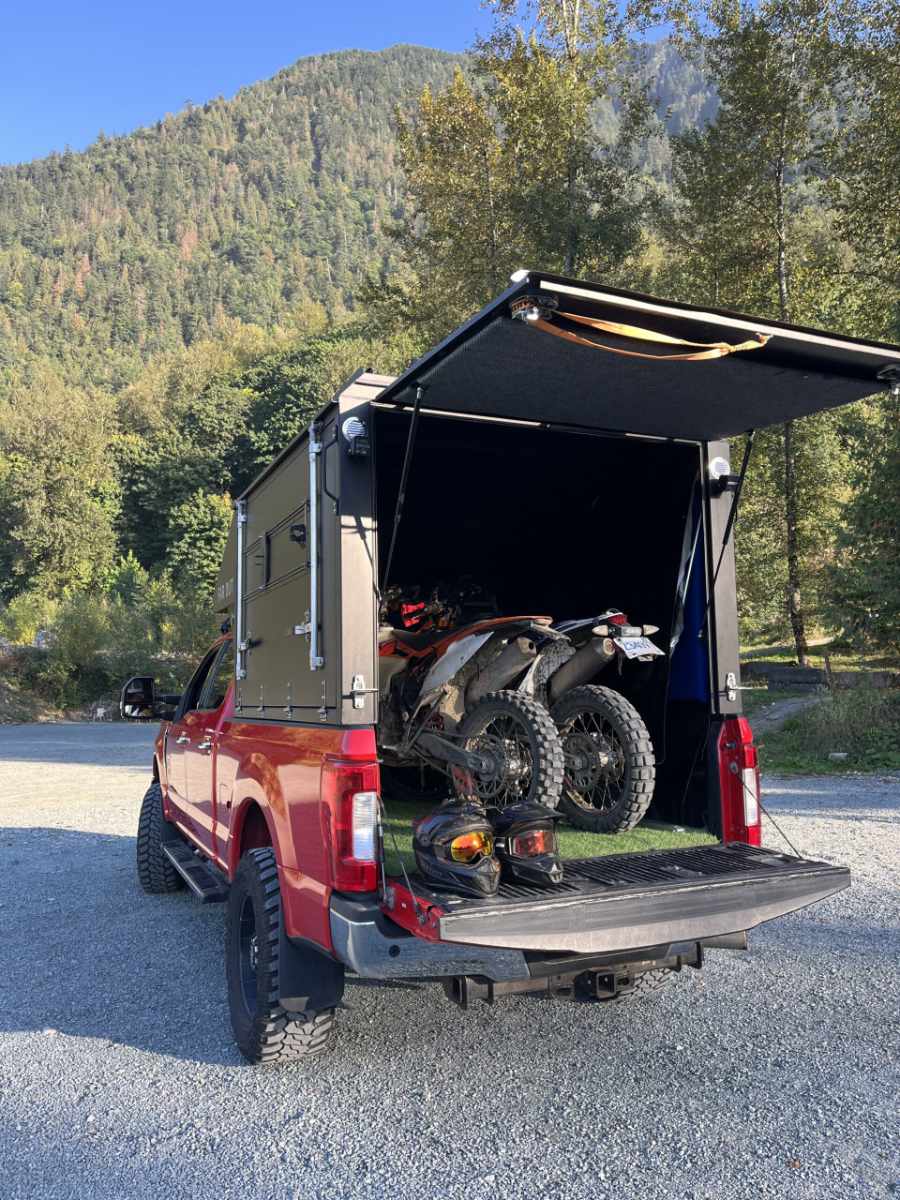
Interestingly, with the sides folded in there is a vinyl cover that drops down over the tent. So you could bring along things like dirt bikes or e-bikes and not worry about them damaging the tent material. Those flaps can also cover the tent opening so that you can have privacy while sleeping.
For storage, the space over the cab of the truck is there to bring along stuff. There is also the provision to have Far-Out Camper install molle racks on the sides of the camper, so you could hang things there. You can get L-track on the back door of the camper, as well.
There are also various options for interior storage including netting and cubbies.
What’s not in the Far-Out Campers
I’m sure you’ve gathered that this doesn’t have a kitchen and there’s also no bathroom. That’s a problem I’ve solved in our own pickup camper with a SylvanSport Privy Bivy and Camco portable toilet.
I’ve already solved the kitchen problem in the paragraph above, and there are all sorts of portable propane-powered heaters available. I would imagine that cracking a door on this would provide sufficient ventilation to operate one of those, should you even need it.
One of the nicest things about something this nimble is that you just go where the weather suits your clothes. I’m sure there are some people who would use this for winter camping and, bonus, since there’s no water system, there’s nothing to really winterize.
But you could also seek out places where the day and night temperatures are comfortable enough not to need heat and air conditioning. Or bring along someone who likes to snuggle and a good sleeping bag.
Things that are simple, not expensive, and really well-made appeal to me. I had assumed that my tent camping days were over, but last summer we tent camped a number of times and the relaxation of not worrying about systems was incredible. So, yeah. I’m an RVer who loves the creature comforts of our RV, but I also really dig taking my four-wheel-drive pickup to places and venturing to where the Wi-Fi can’t find me.
The Far-Out Camper or the Four Wheel Pop-Up Camper or even the Flated Air Topper that I own really do open up a different world of adventuring. So what say you? Is there still adventure in your future?
More about these RV reviews
These RV reviews are written based on information provided by the manufacturers along with our writer’s own research. They are based on information from a single unit and may not reflect your actual experience. Shop your RV and dealership carefully before making a buying decision. We receive no money or other financial benefits from these reviews. They are intended only as a brief overview of the vehicle, not a comprehensive critique, which would require a thorough inspection and/or test drive.
Tony comes to RVtravel.com having worked at an RV dealership and been a life long RV enthusiast. He also has written the syndicated Curbside column about cars. He also works closely with a number of RV manufacturers to get an inside look at how things are done and is a brand ambassador for Rockwood Mini Lite with his wife, Peggy.
You can also check out his RV podcast with Peggy.
##RVDT2548


At 700 lbs+ how does one get it on and off the truck?
The pics don’t show any legs to drop down to lift it up. With the height, it won’t go in a normal garage, so for those who want their truck garaged, they either need a very tall one or to remove the camper when not being used.
How do you git it off?
You don’t!
That’s why you bought it so you can go “FAR OUT” CAMPING!
Won’t fit in a normal garage.
IF you buy one of these you are not normal anyway therefore you already have a tall garage at home in which it will fit!
Legs?
That something you worry about on your wife or girlfriend!
See. These problems you have with this camper are easily overcome!
Looks like a truck camper using the same objective and design as the small InTech Flyer travel trailers. A very simple toy hauler with fold-out “tent trailer” beds and an open load floor for toys, just replacing the single axle with an existing truck bed. However, there is a considerable difference in price, with the trailer $10-12,000 more expensive.
In the Rockies where I would use a camper like the Far-Out, I would like to have the canvas sides further off the ground. Bears like “people food” (not “people for food”!), which is why some National Park cgs. don’t allow tent trailers. So, I would prefer the Four-Wheel Project M camper that pops up, not the “Far” that pops “Out”.
Did you see the article a while back where Four Wheel Pop-Up Campers loaned me one of their rigs for 10 days? I’m with you – they make a good product and there are places where tent-style campers are banned due to we two-legged adventurers make our way into the bear’s back yards.
Thank you, Tony. Essentially is an off-the-ground tent, or did I skim too much and scan too little? 🙂 Happy new year and safe travels! 🙂
No, I don’t think you missed anything. That’s essentially what this is. However the good thing is you can use this for work-related purposes and you don’t lose a lot of a pickup’s functionality as you would with a more traditional camper. Plus I know that some people like this more simple type of rig.