


It doesn’t take much to make a parked RV feel like it’s floating. Even with RV wheel chocks in place, that slow rocking can still show up.
Somebody walks from the kitchen to the bedroom. A gust of wind hits the sidewall. Maybe you just shift your weight in the recliner. And there it is—that subtle, slightly annoying motion that makes you wonder if something’s not quite right. Is it in your head—or your feet? Most folks assume it’s a leveling issue. Fair guess. But often, the rig is level.
What’s missing is control of the one kind of movement that leveling doesn’t really handle: that gentle forward-and-back creep in the tires.
What’s actually moving under you
Even when your trailer looks perfectly planted, the tires can still shift just a bit. It could be a little give in the suspension, a touch of soft ground, or just the natural play between tandem wheels.
That motion travels through the frame, and you feel it inside as that familiar wiggle.
Leveling jacks and blocks aren’t built to stop that. They’re doing their job just fine. They’re just not meant to handle this particular kind of movement.
The chock most RVers know—and the one many don’t
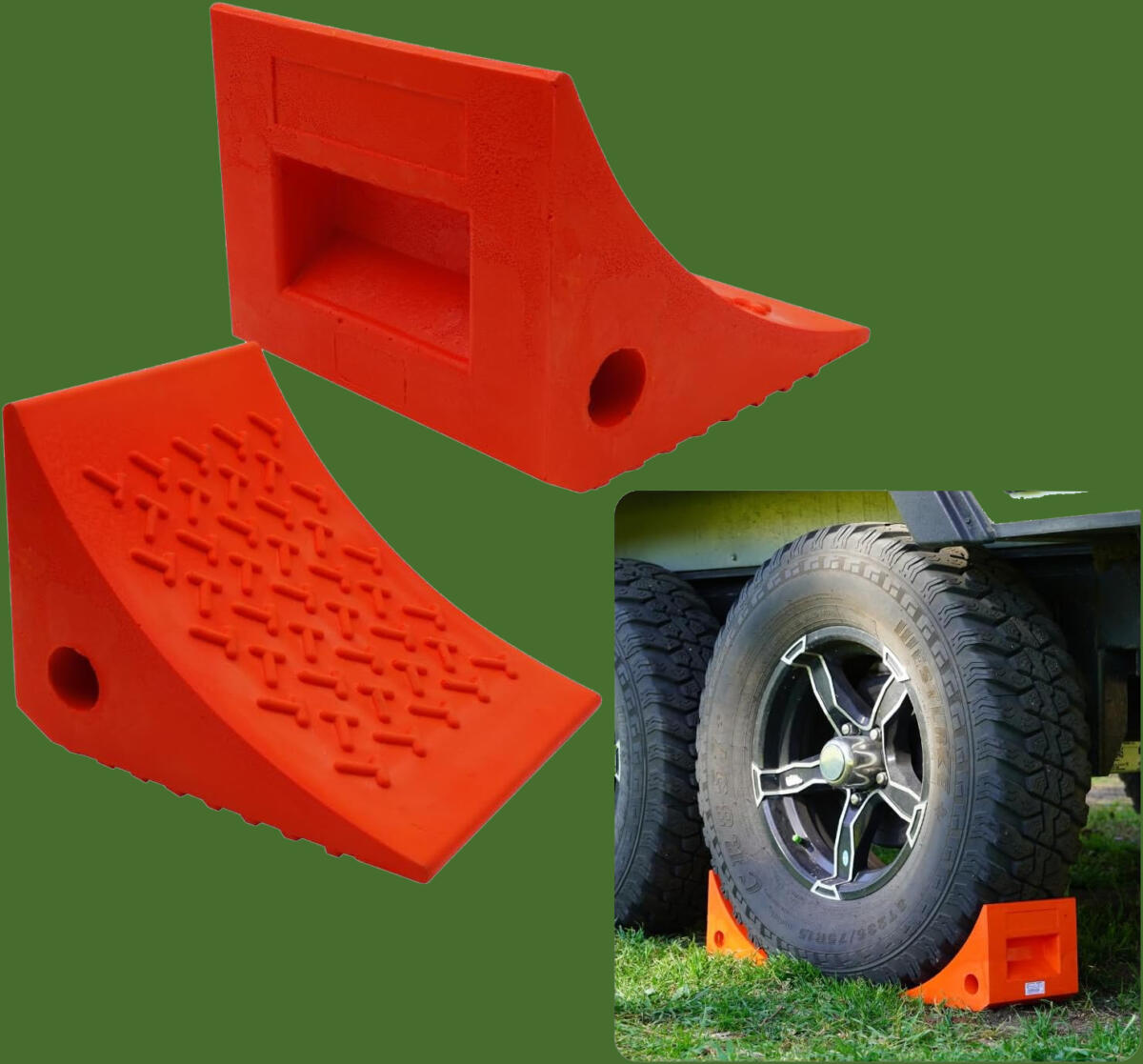
Most of us start with the basic wedge chock. You kick it under the tire, maybe front and back, and call it good. And, to be fair, those do exactly what they’re supposed to do: keep the rig from rolling.
But they don’t do much once you’re already parked.
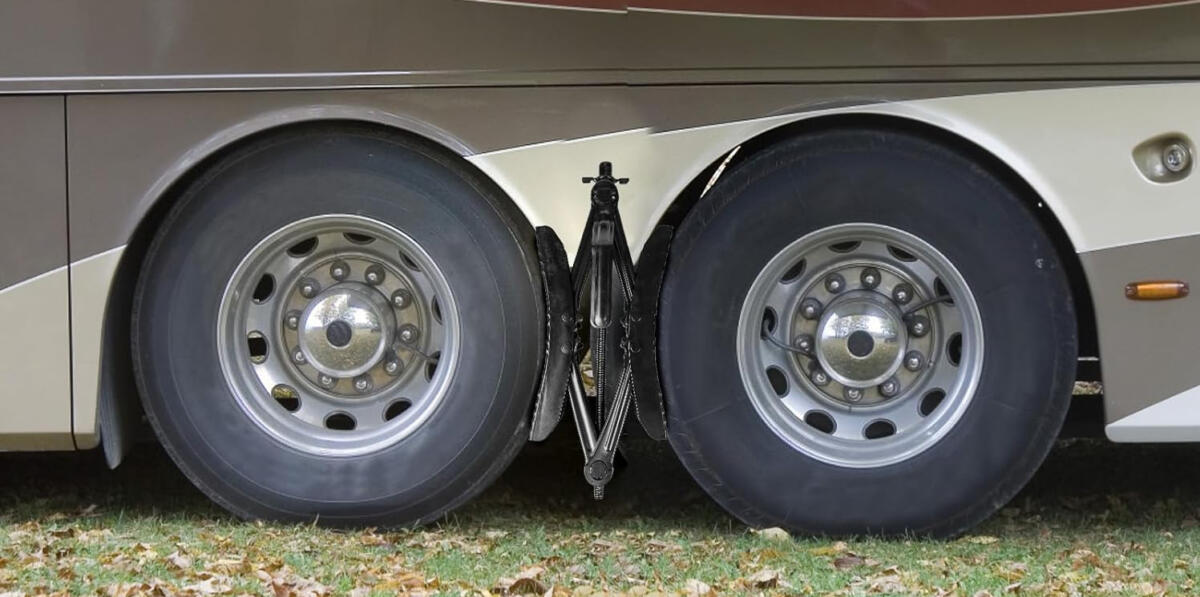
That’s where the other style of RV wheel chocks come in—the kind that fits between tandem tires and presses them apart. Instead of stopping the tire from rolling, it stops the small amount of movement between the two tires. There can be a bit of play between tires and the suspension, and that can give you those queasy feelings.
It’s a small difference in concept. Big difference in how the RV feels.
The first time you use them, you may notice it right away. That “walking around inside a rowboat” feeling settles down. The floor feels firmer. The whole rig just feels planted.
“If these work so well, why bother with wedge chocks?”
Fair question—and one a lot of folks ask after that first solid-feeling setup.
It comes down to this: They’re solving different problems.
Between-the-wheel chocks tighten things up by locking the tires against each other. That’s what gets rid of the rocking. But they don’t actually anchor the RV in place.
On level pavement, you might not notice. Everything feels solid. But introduce even a slight slope, maybe a little gravel or desert dirt, and the whole rig can still creep. Slowly, silently, but just enough to matter.
And when it does, the between-the-wheel chock goes right along with it.
That’s where wedge chocks still earn their keep. They’re what stop the RV from rolling in the first place.
“Do I really need to chock both sides?”
Another fair question—and another place where people tend to cut a corner.
If you’re on flat, hard ground, chocking one side will often seem to work just fine. The rig isn’t trying to move, so nothing does.
But that’s the catch. It works when nothing is pushing against it.
Add a slight slope, a bit of settling, or just people moving around inside, and the weight of the trailer starts working in one direction. With chocks on only one side, you’re relying on a single point of contact to hold everything in place.
Most of the time, that just means a little creep. Maybe things feel slightly different a few hours later. Maybe your setup isn’t quite as tight as it was.
Chocking both sides takes that variable out of play. It spreads the load, keeps things centered, and helps the rig stay where you put it.
Our own experience with the “chock the one side, it’ll be OK,” proved to be a bit of folly that nearly frightened us to death. We’d chocked the one side, unhitched, and as the “camp set up man” was taking care of the outside details, the trailer tried a madcap runaway down a slope. It didn’t get far, just a couple of feet on one side, but enough to give the inside woman a near heart attack. No more! Both sides go into lockdown for us now.
Picking what works without overthinking it
This doesn’t need to turn into a gear obsession.
If you have a single-axle trailer, wedge chocks are your only option. But with tandem axles, adding between-the-wheel chocks can make a noticeable difference in how the rig feels.
With RV wheel chocks, fit matters more than brand. You want something snug between the tires—not forced, not sloppy.
And if you spend time on softer ground, say, desert sites, gravel lots, places where things shift, a solid base under the tires makes everything else work better.
So how much difference does it really make?
It’s not magic. Your RV won’t suddenly feel like it’s poured in concrete. But it will feel more settled. Less sway when someone walks through. Less of that subtle shifting that keeps reminding you you’re not quite as stable as you’d like to be.
For a simple piece of gear, it’s one of those upgrades you notice every day.
A simple setup that just works
For most tandem-axle trailers, a straightforward approach does the trick. Use wedge chocks on both sides to keep the rig from rolling. Then add a locking chock between the tires on each side to take out the movement. That combination handles both jobs—safety and comfort—without much fuss.
Our new triple-axle destination trailer is solidly fixed with two wedge chocks on each side. A little more costly, but it’s a lot more stable.
Bottom line
RV wheel chocks don’t get much attention. They’re not flashy, and nobody brags about them around the campfire. But when your RV stops rocking every time someone walks across the floor, you’ll notice.
And once you do, you’ll wonder why you waited so long.
RELATED
- The best RV wheel chocks and how to properly chock your RV
- Did you know that wheel chocks expire? They do!
- Trailer users – Here’s a front/rear leveling tip
- Know Your RV: Take care of your stabilizer jacks
RVT1256

I went from a rock solid class A to a very noticeable TT movement it drove me crazy every time the dogs (two Labs) changed position or got up for water I knew it. I got X-chocks and regular chocks and even steadyfast system which made it rock solid. With that said over the years I have stopped using and removed the steadyfast don’t use but still carry the X-chalks and just use standard rubber chocks both sides. It seems like when I was in the Navy I have adjusted to the movements and no longer wake up in the night.
One problem with the regular wheel chocks is they are made as “one size fits all”.
Not true.
Depending on the size of the tire, none of these chocks really make contact with the entire surface.
I made my own using pressure treated 2X’s screwed together. I traced the curve of the tires and cut the chocks to fit. Made a huge difference.
Bob, I’d like to see a picture of those. I like home style fixes.
No way to post a picture here. Plus, they are in the trailer in storage at the moment.
I cut a 2X6 into three 6X8 pieces and screwed them together. Traced the profile of the tire and transferred to the wood. Used a band saw to make the cut.
They fit the curve of the tire exactly.
BTW, I tired 3 different commercial chocks and they were either too steep or too shallow.
We put them on my Daughter’s trailer. I really don’t notice any difference. She claims they work.
X-chocks do help a lot. But you will still get bounce and sway. When stopping overnight or a few days we just deal. But when stationary for longer periods, I want stability! A pair of these frame stabilizers help even more. They only stabilize in a single direction, so the pair must be installed perpendicular to each other. For our 34′ TT we use 3. One on each long side and the 3rd on the cross member behind the rear bumper.
Xchocks are NOT chocks, they are stabilizers. They can and do pop out without regular chocks. Regular chocks ARE required with them and must be installed before the xchocks and not removed until the trailer is connected to the tow vehicle. Putting chocks on only one side allows the trailer to pivot on that side. Regular chocks MUST be used on both sides. You may have done it differently and not had a problem…..yet! DO it right.
We use Fastway ONESTEP Wheel Chocks. When inserted between the tandem tires, they press snugly against the tires and prevent rotation of both wheels. They do the job of separate wheel chocks and x-stabilizers.