


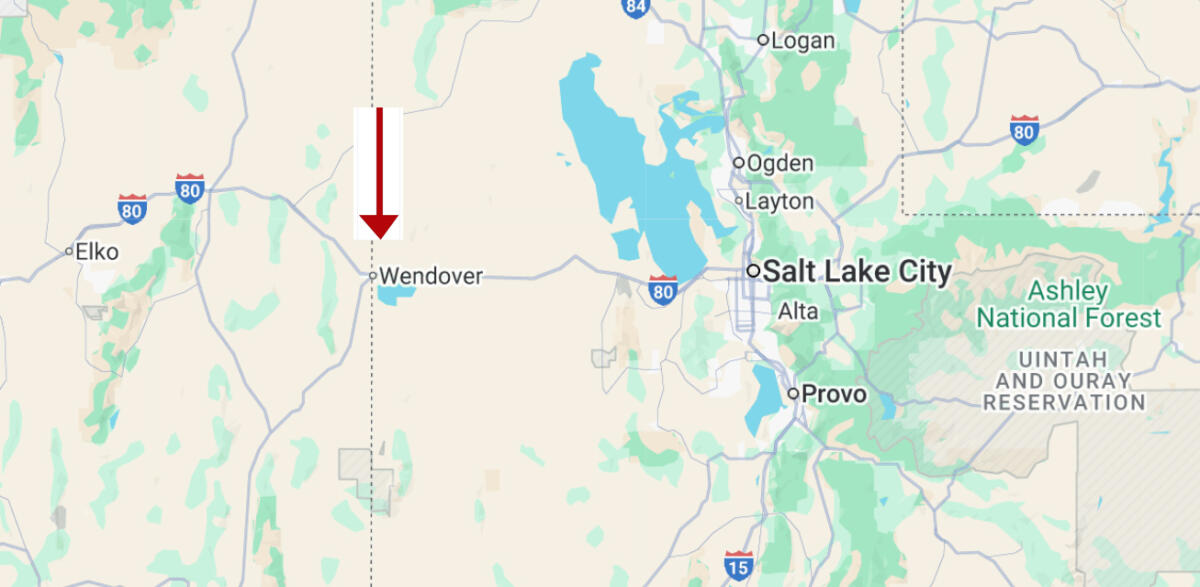
WENDOVER, Utah — A pickup truck towing a travel trailer was blown over during a sudden windstorm on Saturday evening, Oct. 11, highlighting the importance of RV wind safety for anyone traveling on open highways. Powerful gusts can turn an ordinary drive into a dangerous situation in seconds.
This incident serves as a stark reminder for RVers to take high-wind conditions seriously. Read on for safety suggestions.
Understanding RV wind safety on the highway—the news

According to the Wendover Police Department, gusts caused the trailer to overturn on I-80 near mile marker 2 around 5:40 p.m. The impact snapped the ball hitch connecting it to the tow vehicle, sending the trailer into a semi-truck parked on the shoulder. The RV was destroyed but, happily, no injuries were reported.
Crews from the Wendover Fire Department reminded drivers to use extreme caution during high winds, especially when towing large or lightweight trailers. Weather data from the Wendover Airport showed steady winds in the upper 30-mph range with gusts as high as 55 mph less than an hour before the crash. Police did not release the wind speed at the exact time of the accident.
Elementary physics takeaway: Wind versus trailer

A travel trailer behaves like a giant sail on wheels in strong crosswinds. Gusts of 50 mph or more can hit with the force of more than a thousand pounds pushing sideways. That shove can roll a trailer, especially if it’s light, tall, or unevenly loaded. Even heavier rigs can sway, drift, or pull the tow vehicle off course.
When high winds are forecast, the safest approach is to slow down or wait out the storm. Proper loading is critical: Keep 10–15 percent of the trailer’s total weight on the hitch and pack heavy items low and centered. Using a sway-control or weight-distribution hitch adds stability, and leaving extra distance between vehicles helps avoid collisions if sudden gusts push your rig sideways.
Before hitting the road, check tires, brakes, and hitch components, as any weakness is magnified in high wind. If gusts approach 50 mph, pull into a sheltered area—behind buildings, terrain, or other barriers—until conditions improve. Avoid stopping on the highway shoulder, where passing traffic can buffet your trailer even more.
Simple steps to keep you upright
The takeaway: Gusts near 50 mph aren’t just inconvenient—they’re dangerous. Slowing down, balancing the weight in your rig, and knowing when to wait can make the difference between a safe trip and a totaled rig. For RVers, practicing RV wind safety is not optional—it’s essential.
It reminds us of the time we pulled over at a rest stop during high winds. The state patrol had flagged all commercial trucks in, and told them to stay put for the time. We asked the trooper if that applied to us, towing our RV. He said, “Technically, no. But if I find you rolled over in the ditch, I’m writing you a citation. For “speed too fast for conditions.'” ‘Nuf said.
Sources include KUTV.com and National Weather Service data
RELATED
- Trailer sway: Causes, cures, and avoiding a disaster
- Fifth wheels, truck campers, and travel trailers: Who can legally ride ‘in the back’?
- Safe towing speed—How fast is too fast for towing?
- How vehicle wheelbase decides safe towing length
- If you can’t answer these questions, you shouldn’t be towing
RVT1231b


I drive a 32,000lb DP and a 50MPH gust can cause you to question your decision to buy an RV.
Interested to know why the truck was on the shoulder. His shoulders were probably signaling the time to stand down. Been there – done that! We had some pretty dangerous winds across the Red River Valley of ND a couple days ago. Nearly lost a willow tree in the front yard – est. 55-60 mph gust from the south.
Wondering if it was a travel trailer or a 5th wheel? Crazy the way the ball sheared off.
Looking at the debris that looks like a 5th wheel front cap and the sheared ball, that
looks like an Anderson adapter without the red funnel piece. The darker circle is the pin on the pinbox.
Kinda thought the same thing, it looks like sheared aluminum.
We just spent 5 hours at the Wyoming welcome rest stop on I25, waiting for the winds to die down on I80 west. When we parked, I couldn’t even open my drivers door into the wind! Pretty soon we had a group of RVers in the parking lot telling stories of wind blown vehicles including tractor trailers! I’m glad we waited!
My rule, if winds or gusts hit 45 mph (70 kph), it’s time to stop. Or, if those winds are forecast for your day of travel, don’t even go onto the highway.