

By Cheri Sicard
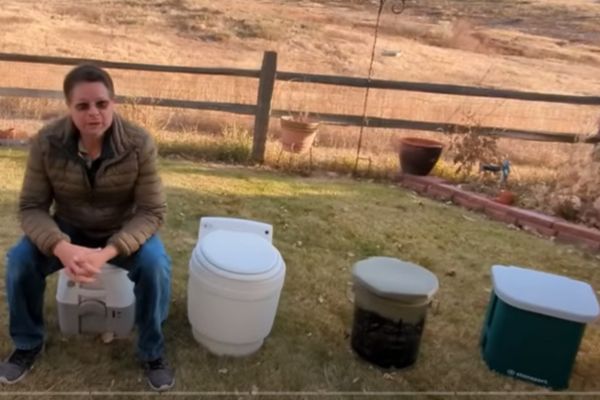
If you are confused about all the options available for portable toilets, this van toilet comparison will sort it out with the pros and cons of five different types.
Our host, John from Whitewater Vans, compares and contrasts the toilets to help you decide what’s right for your RVing style and budget. He also shares the toilet that he put in his own camper van and that he uses in the camper vans that he builds. Spoiler alert, it’s NOT the most expensive one!
Portable toilet comparison, which van toilets are evaluated?
#1 Dometic 5-gallon toilet: John says this is a good toilet and one he used for several years.
Pros:
- It works like a regular toilet. You pump water, then just flush it.
- The seal works to keep odors out of the van, although it does not work in hot weather.
- At under $200, it’s relatively inexpensive.
Cons:
- Because it has water in it, in winter you need to think about winterizing the toilet along with the rest of the van.
- Despite the seal, in very hot weather, odor became an issue with the toilet.
- If you have (or if you buy) this toilet, be sure to watch the video as, if you drive to a higher altitude it can become pressurized. (Why am I envisioning a scene from the next Jackass movie?) John shows you how to safely relieve the pressure before using.
#2 Laveo Dry Flush toilet: John changed from the Dometic to a dry flush toilet in his van. John says this portable toilet functions much like a “Diaper Genie”—with a long tube carrying the waste away into an airtight system. While it is a good toilet, he no longer uses this one either.
Pros:
- There is no water, so it needs no winterizing.
- John says there is no smell, even in hot weather—the reason he switched.
Cons:
- At about $1,000, it’s pricey.
#3: Five-gallon bucket with toilet seat lid: After the first two toilets, John went super low-tech with a 5-gallon bucket outfitted with a toilet seat lid, and was amazed at how well it worked for van life. Watch the video to see how John uses a “pee bucket” with a funnel inside the larger bucket. This makes urine collection neat and easy and works for both male and female anatomies. He also goes into how to use this simple setup for pooping.
Pros:
- Simple, low-tech, nothing to break.
- The lid seals odors in.
- Low cost, about $30.
- Liquids are contained and not sloshing around.
Cons:
- Really nothing, other than it’s not fancy and you are using a bucket as a toilet.
#4 Stansport toilet: This is a ready-made set of the toilet John created in #3, so it pretty much works the same way.
Pros:
- Most of the pros of #3 apply here with an important exception—read on!
Cons:
- John’s homemade version is not only less expensive, it functions better because it is easier to separate liquids and solids, and you do not have liquids sloshing around.
#5 Bucket and funnel: This one really isn’t different, just a pared-down version of #3 consisting of a bucket, lid, and a funnel.
Pros:
- It’s quick, easy, and cheap.
Cons:
- Easier for guys to use than women.
##RVDT2232
I have used the five gallon toilet for years in my Aliner, bought it from Sears. Before that it was in my Coleman Gettysburg popup.
What about compost toilets, are they affective?
They can be but they have their own pros and cons. Check out this post for info on composting toilets.
https://www.rvtravel.com/video-pros-cons-rv-composting-toilet-1918/
Thank you, Cheri! Perhaps overly expensive, but why not use RV antifreeze instead of water with #1 in extremely cold (i.e., freezing) temperatures? Also, perhaps it was due to expense, but I find it surprising that composting toilets were not included. Thanks again and safe travels! 🙂