

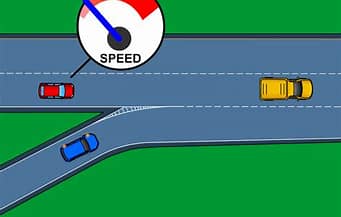
Yield signs are placed wherever traffic streams meet without a full stop.
On a recent RV trip, we approached a roundabout yield sign, slowed briefly, and immediately heard angry honking coming from the car behind us. I wondered, “This is a yield sign. What are we doing wrong?”
A quick history
The modern yield sign has a surprisingly recent origin in U.S. traffic history. The very first yield sign in the U.S. was put up in Tulsa, Oklahoma, in 1950. Police officer Clinton Riggs placed it to manage a dangerous intersection.
The sign caught on and was later added to the national standards. The federal Manual on Uniform Traffic Control Devices (MUTCD) adopted the yield sign in the 1950s and then refined its look and use over the following decades.
Appearance and changes

Historically, yield signs were yellow with black text. The color standard shifted to the red-and-white look used now during changes to the MUTCD in the late 20th century.
The yield sign’s signature shape is an upside-down equilateral triangle. Today, it’s a red border with a white interior and the word YIELD in red. The signs are retroreflective, so they’re visible at night.
Yield sign’s purpose
A yield sign assigns right-of-way without forcing an automatic stop. Its goal is to prevent crashes and unnecessary delays by telling a driver to slow, look, and give way when needed, but to keep moving if the way is clear.
You’ll commonly see yield signs at freeway on-ramps, merge lanes, and roundabout entries where a full stop would hurt traffic flow more than help it.
Why yielding correctly matters for RVers
RVs and trailers need more room, more time, and more planning than passenger cars.
• An RV’s greater mass increases stopping distance and reduces the margin for error when you merge or enter a roundabout.
• Abrupt braking can stress trailer brakes, create sway, or even lead to a jackknife in tow setups.
• Federal guidance for larger vehicles recommends extra following distance and time to react. RV-specific driving resources stress matching speeds and using the full acceleration lane when merging onto an express highway.
• Obeying yield signs correctly helps you avoid hard braking, sudden maneuvers, and collision risk.
Practical tips for non-highway yields
• Slow down gradually as you near the yield at a roundabout or crossroads so you can assess traffic and pedestrians without an emergency stop.
• Use mirrors and a quick shoulder check to make sure a small car isn’t hiding in a blind spot before you turn or merge.
• Adopt a longer time-based cushion (add seconds beyond the usual three-second rule for passenger cars) so you can react without hauling the whole rig to a hard stop.
• When towing, be mindful of trailer momentum. Accelerating smoothly and braking early reduces the chances of trailer swaying or overloading the tow brakes.
Tips for safe interstate yield at on-ramps
On interstate highways, use the acceleration lane on the on-ramps to match traffic speed before merging. Check your surroundings. Find a gap in traffic and check your blind spot for safety. Use your turn signal and signal early so others can adjust. Merge smoothly. Enter when safe, keeping your speed steady. Avoid merging too early or across the solid line.
Also, watch for trucks that may be towing a boat or a low trailer. You may not see it at first, so be mindful before you merge.
Stop or go?
A yield sign does not mean “stop.” If approaching traffic is clear and there are no pedestrians, you may proceed without stopping once you’ve confirmed the way is safe.
If there’s any doubt (e.g., poor sightlines or a pedestrian crossing), treat the sign as a full stop and then go when it’s safe. Missing this judgment call is where most collisions happen, which is why the MUTCD explicitly tells drivers to be prepared to stop at a yield sign.
Do it correctly
Failing to yield can mean a citation, points on your license, higher insurance premiums, and, if a crash happens, liability for property damage and injury.
Insurance and driving guides emphasize that “failure to yield” is a common contributing cause in intersection and merge crashes. So, for both legal protection and peace of mind, it’s worth taking the extra second or two to do it properly.
The other guy
What about that other driver?
• What happens when the driver ahead of you stops at an interstate yield sign? Obviously, you’ll also have to stop. It may take you longer to get up to speed afterwards, so be patient. Really patient. Wait until there is a generous break in the traffic, signal, and then work to get up to speed as quickly and safely as you can.
• What about when the other guy, currently driving on the interstate, won’t “let you in” or move over to the left lane so you can get onto the highway? He is not obligated to do so. You must get up to highway speeds and merge when traffic allows. Don’t assume someone will let you in or move over to allow your merge. Be prepared to make adjustments.
• What should I do when the guy driving next to me on the entrance ramp (to my right) tries to speed up to get ahead and cut in front of me? Continue to build up your speed to match the traffic on your left while keeping a close eye on the driver attempting to pass on your right. Signal your intention to merge and speed up or slow down to avoid an accident.
Your turn
Do yield signs and the way other drivers react to them upset you? Go ahead and sound off in the comments below.
MORE POSTS ON SAFE DRIVING
- Blowing in the wind: Truckers’ tips for safe driving
- Watch in horror as this truck slides down the highway. Know these safe driving tips
- Tips for safe driving around big rigs
- Tips for safe RV driving on snow or ice
- Driving safety: What we’ve learned from highway mishaps
RVT1243

I am truly surprised this topic hasn’t elicited a mountain of responses! It seems to me the overall amount of angst at intersections has increased dramatically, just as in every other arena of social interaction. Folks are mighty impatient and mighty vocal. If they even chose to obey the traffic signs at all!
My biggest rub is drivers that won’t move over when they have a clear lane so you can merge. Big trucks normally do, RVs and cars are not as often.
I move over when I can for large heavy vehicles attempting to merge, but drivers in nimble autos should be looking at freeway traffic ahead of time and envisioning, then executing a merger into that traffic. Instead, 90% come down the ramp, never looking, and then expect others to accomodate them. I can’t count the number of times I’ve moved over, the auto merges in alongside me, then seems to do everyyhing possible to stay alongside forcing me, with 65′ of large MH & Toad, to stay in a lane I should not be in. So, I keep my speed and lane with autos. They can time in ahead or behind…their choice.
I really become iritated at those drivers driving at low rates of speed on Interstate ramps. Match on coming traffics speed.
It’s amazing how many people do not know how to enter the highway from a ramp.
Instead of increasing their speed to that of the traffic flow, they actually slow down, making the situation worse for vehicles behind them and also the ones in the main flow.
If I see a vehicle on the ramp, I try to move over, or slow down and flash my lights to allow them to merge. But again, some do not speed up after they enter the road.
I was recently honked at repeatedly for not turning right when there was a very large lighted No Right Turn sign lit up even when the traffic light was green. I didn’t give in or break the law! Too bad they had to sit there a few more seconds. The reason for the No Right Turn light is to protect pedestrians who may be crossing the roadway. Once the crosswalk sign finishes, the large No Right Turn sign turns off. I am waiting for the day when some ignorant driver approaches my window and sees something they don’t want to be looking at.
Happens all the time near us! We have quite a few intersections where the lights rotate for each direction. Only one direction goes green, and there may be green turn arrow for the opposing traffic.
I just let the idiot behind me blow his horn and then meet him at the next light. They get nowhere fast!
I believe that a majority of accidents are caused by idiots who feel as if the road is placed there simply for them. The feeling of entitlement has become supreme.
One of the rules from my driver’s ed was to “be predictable in traffic”. But that requires the driver to actually observe what traffic around him or her is doing. I don’t think it is just inexperience; I believe it is a cultural change. Drivers 1.5 to 2 generations after me seemingly are wearing blinders – just like buggy horses used to wear in crowded areas. No situational awareness.
When I learned to drive, around 1970, we were also told you had an obligation to avoid an accident! I was in an accident once in a parking lot when, waiting to turn, someone backed into me. The passenger got out of the snow covered car and said they expected a horn! I just don’t understand some drivers.
What bothers me is when I’m coming down an on ramp to get on the freeway and the idiot behind me cuts over as soon as the grass ends and tries to pass me on the left because I’m using the full length of the ramp to get my speed up to merge, god some people are just ignorant!
No idea why so many folks think slowing down when entering an Interstate is the correct action. It is the responsibility of the driver entering the Interstate to speed up to match the speed of the drivers already on the interstate so they can “merge” into the travel lane.
If I’m in the right lane, I don’t move over to let traffic in entering the interstate. Many people speed in the passing lane. My car got hit once because when I looked no one was there. Then when I started moving over a speeding car hit me. Then you have those who pull in front of you. Then slow down. Seems like lots of people in Pa think stop signs mean the same as yield signs.
They should go back to the old signs that say “Yield the right of way” since most people don’t seem to know what yield means. Yield means ” give up “. Give up the right of way means stop if you can’t merge safely.
One of the problems with many roundabouts is that the engineers design in large visual obstructions in the middle of them…mostly trying to make them look pretty. Another is many are too small.
If designed correctly, a driver approaching should be able to see and start judging traffic flows in, and coming into, the circle well in advance. This would smooth the flow of traffic and minimize slowing down materially when nearing the entrance just because one can’t see pertinent traffic flows in advance.
Now, drivers that STOP and sit at the entrance when clearly nothing is coming will get a little tap of my horn to prompt them to move along. 🙂
Those drivers that stop and sit at the roundabouts are the reason that I would love to have an airhorn on my RV van conversion
It isn’t the engineers that design in the obstructions, but the engineers should ensure that the sight distances are still appropriate for the speed the roundabout is designed for. But, even with the appropriate guidelines, most of the engineers have never driven a large, heavy vehicle so the requirements are theoretical, and they don’t have a good feel for whatever the average RV driver needs.
You didn’t address the increasing problem of entering vehicles on the on ramp expecting you to yield for their entrance. I know you mentioned the entering driver is required to yield. However, the entering drivers get really upset when you won’t yield for their entrance.
Thank you for explaining what the @#$%! ahead of me is thinking when he comes to a stop at a roundabout when it’s perfectly clear. ARG!! More time to practice patience.
And freeway on ramps when tweedle Dee and tweedle dumb in the lead make no effort to get to speed!!! God help us!
.I just remembered my cousin who has always been a reluctant driver. She never uses the freeway. Her reason–“I don’t merge.” Too bad many more people who don’t merge correctly don’t follow her example.
Hi, Cynthia. That reminded me of someone I read about years ago who always chose to drive on the freeway in Seattle during so-called rush hour traffic (when it was the most crowded and slowest). When asked why she timed her trips that way, she replied that she didn’t like to drive fast.🤣 Have a good night. 😀 –Diane at RVtravel.com
My pet peeve (1 of many!) is merging drivers who are oblivious to what is beside them until the merge lane is almost finished then look left and are obviously shocked to see a vehicle beside them. I’m 75′ long for crying out loud! How can they not see me sooner?
I haven’t seen much problem with roundabouts. Merging onto a freeway or highway is something else, and worse where the onramp is very short. At busy times, no way can the freeway person move over to the left.