


Fact or fiction? Your RV’s tank covers should never be removed, unless you are filling up with propane or changing them out.
Answer: Fiction
There is no danger from leaving the tank cover removed from your LP tanks (technically cylinders), while stationary or while in transit. This is assuming you even have a tank cover, as they are not required by law or for safety reasons. For years travel trailers and tent trailers were manufactured and shipped to RV dealers without propane tank covers. If an RVer wanted a tank cover, they could purchase a soft vinyl cover as an optional accessory from an RV parts store. RV manufacturers didn’t even offer LP tank covers as an option back in the day. To my recollection, it wasn’t until the mid-1980s or later that manufacturers began to supply them with trailers.
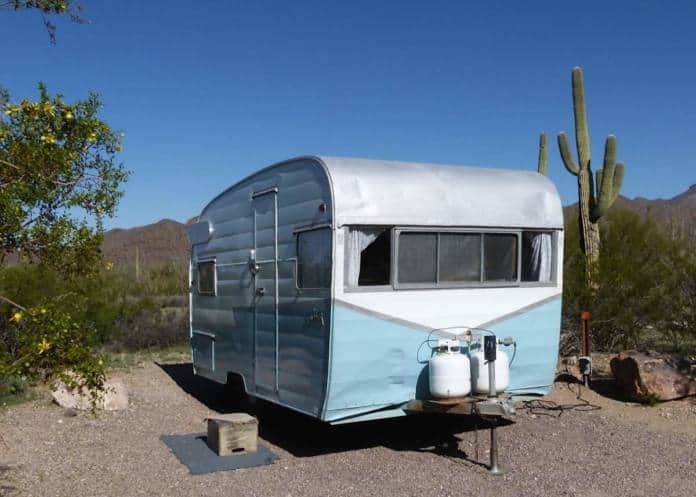
LP tank covers are useful but not required
LP tank covers are useful in keeping road grime, tree droppings and the weather off your LP tanks, but other than slowing down rust on steel LP bottles, they provide little in the way of safety regardless of your RV being parked or going down the road at 70 mph. The DOT (Department of Transportation) sets the standards for the DOT-approved tanks (cylinders) used on towable RVs under their Hazardous Materials Requirements, including transportation.
The DOT regulations are a little boring, so if you don’t want to read the DOT report watch this video from the National RV Training Academy, the largest hands-on RV training academy in America. The host, Tom, has read the DOT regulations concerning transporting LP on travel trailers and condensed it into a short video on how to legally transport LP tanks. As you will see, there is no mention of needing to cover your LP tanks with a cover or a warning indicating “Your RV’s tank covers should never be removed, unless you are filling up with propane or changing them out.”
More references concerning the legal transportation of LP tanks:
Tank cover on, off or none at all, the choice is yours.
Hope you found this information useful and factual. Safe travels.
Dave will be speaking at the 2023 America’s Largest RV Show in Hershey, PA, September 13th – 17th. He would love to meet RVtravel.com readers there. Feel free to introduce yourself after one of his seminars.
Now, some questions for you:
- Is there a reoccurring half-truth you keep seeing online that you would like to see addressed?
- Were you taught something by other RVers that turned out to be bad advice?
- Have you recently read something that left you wondering, is that true?
- Do you know something to be true, but none of your RVing friends believe you?
Please share your comments using the comment box below and we will do our best to provide the facts in a future Fact or Fiction entry.
Test your knowledge some more with these previous Fact or Fiction questions:
- A propane furnace emits lots of moisture
- If you see these on your RV, do not use it in winter!
- Outside temperatures can be too cold for an RV refrigerator to cool
- Never plug in with a 20-amp extension cord
- Doing THIS is the number one cause of RV fires on highways
- Propane gas has no odor
- New RV refrigerators are not designed to operate on propane above 5,500ft altitude.
##RVT1114

A lot of the “never do” items really fall under “better safe than sorry” category. I turn off the propane system when traveling. Many miles have been racked up with propane on and no incidents. Only takes 1 “KABOOM” and it has happened. From a plumber.
Actually in my opinion tank covers probably cause more heating of the tank due to the color black. The standard color of white tanks would tend to reflect more sunshine heat than the black covers. Maybe in colder climates it might help the gas flow if the tank cover is in place, but I live in the south so it wouldn’t help me.
I have a customer in my campground with an RV that came from the factory with a black, hard plastic tank cover. One day she contacted me to say she could smell propane. I investigated and discovered, to my horror, that the heat generated inside that black cover had softened her propane connecting hose to the point that the pressure had pushed it off the crimped fitting.
We replaced the hose and ordered a white vinyl cover. We use the white vinyl cover during the warm months and switch to the hard, black plastic one through the winter. She has not experienced any problems since then.
I would also add that any good propane supplier would never advise you paint a propane tank a dark color. Most of them arrive painted white or cream. Why would an RV manufacturer put a black tank cover on knowing it could be a problem ??