

By Dustin Simpson
Many of us enjoy tackling our own maintenance and repairs—whether it’s greasing bearings, checking suspension components, or diagnosing brake issues. But before diving under your RV, ask yourself one question: Are you using the right jack stands?
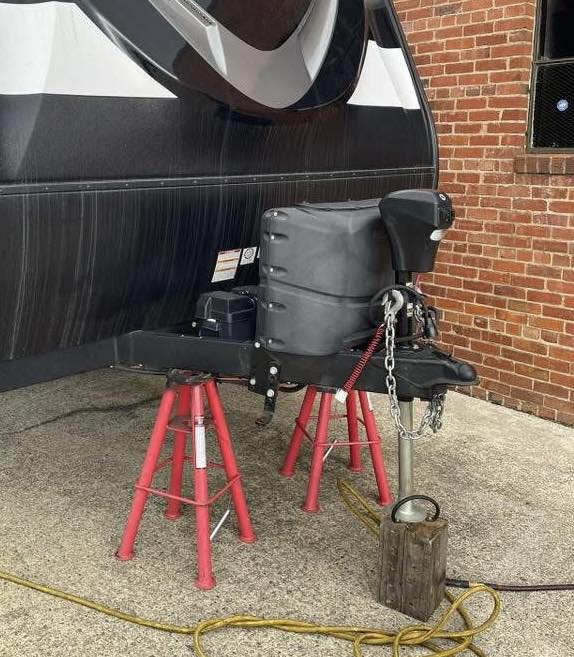
Working on your RV without the correct equipment can have serious and even deadly consequences. Your safety, the stability of your rig, and the longevity of the RV all depend on using jack stands rated and designed for the task.
At California RV Specialists, we’ve seen our fair share of poorly supported rigs in driveways and even some unsafe attempts in professional settings. That’s why we highly recommend using high-capacity jack stands, like those from Sunex, which offer both safety and peace of mind.
Safety first: Your life depends on it!
When you’re under a 10,000–15,000 lb. RV, the idea of using low-grade, rusted-out, or improperly rated jack stands should make you nervous, and for good reason. Jack stands are engineered to hold the full weight of your vehicle once it’s lifted off the ground.
Unlike hydraulic jacks, which are meant only to lift, not hold, jack stands provide long-term stable support. Without them, the risk of your RV shifting or collapsing during a repair increases dramatically. Every year, people are injured (or worse) due to collapsed vehicles caused by improper support. Here’s one of those recent, tragic stories.
RVs are heavy—Use the right tools
Most RVs are significantly heavier than cars or pickup trucks. That means a standard 2- or 3-ton jack stand just doesn’t cut it. We recommend a minimum of 10-ton jack stands, especially if you plan on working under the RV or removing wheels and axles.
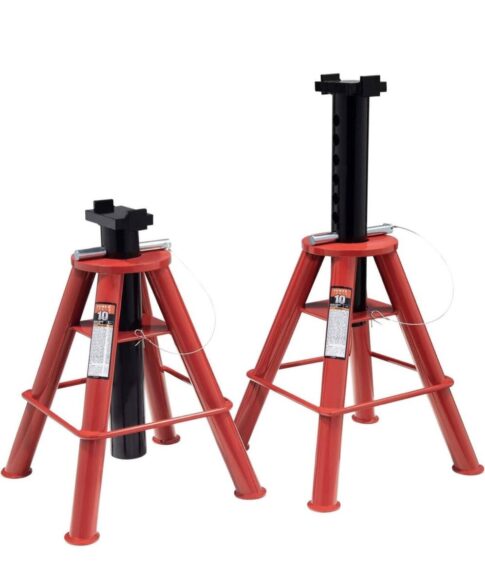
The Sunex 10-Ton Jack Stands are a prime example. Designed with RVs and heavy-duty applications in mind, they can confidently support your rig and give you the stability you need to work safely.
Built to be stable, even on uneven ground
The Sunex jack stands come with a four-leg steel base for maximum stability. Unlike the traditional V-shaped or stamped-metal designs, this base helps distribute weight more evenly and minimizes tipping, especially if your driveway or surface isn’t perfectly level. (And let’s face it—how often is it?)
When you’re under an RV, stability isn’t optional—it’s critical.
Easy to adjust and stay in place
One of the standout features of the Sunex stands is their pin-style height adjustment. The pins are thick, easy to insert, and won’t slip under load. Unlike some rack-and-pawl designs that can wear or slip with age, the pin style ensures that your height setting stays firmly in place.
Plus, the multiple height settings allow you to get the RV exactly where you need it: level, comfortable, and safe to work under.
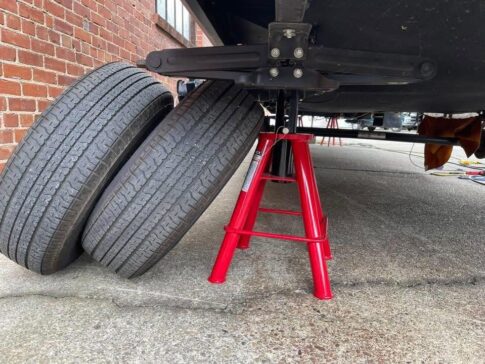
Durability that lasts a lifetime
These stands are made from heavy schedule pipe steel, which means they’re ready for daily shop use and years of wear and tear. These are built for professional environments where reliability matters.
And little things make a big difference, like the retained adjustment pin that stays attached to the stand so it can’t get lost or misplaced.
The large saddle with locating lugs ensures that the stand seats securely on the RV’s frame or axle without causing damage. It’s common to see bent components or cracked underbellies from improperly placed jack stands. The wide, contoured top of the Sunex stands spreads out the weight evenly to protect your investment.
Choose the right tools—It pays off
Using the correct jack stands is not only a matter of safety, it’s also a matter of protecting your RV and making your maintenance process smoother. Choosing a trusted brand like Sunex gives you confidence that the tools you’re relying on won’t fail when you need them most.
Working on your own RV can be empowering, but never let speed or cost-cutting take priority over safety.
Final thoughts
Before you crawl under your rig to service your brakes, suspension, or axles, stop and ask yourself: “Am I trusting my life to the right support?” If not, it’s time to upgrade.
Pro Tip: At California RV Specialists, we recommend scheduling routine inspections of your suspension, axles, and brakes at least once a year—or every 12,000 miles. Whether you’re DIY-ing it or bringing it to a shop, make sure the tools under your RV are as solid as the road ahead.
Order the Sunex 10-Ton Jack Stands here.
More from Dustin
Make sure you check out my website, California RV Specialists, and our YouTube channel for more helpful information, and see our published articles on RVtravel.com and other social media pages.
RELATED
- Don’t ignore the danger—A slipping trailer jack foot could ruin your trip
- Know Your RV: Take care of your stabilizer jacks
- Trailer jack blocks broke. Why?
- Don’t use a jack to change your tire; do this instead
RVDT2716

Other point- Know the proper places for lifting and using jack stands! Most trailer axles are hollow tubes and not a place to lift. And yet I have seen mechanics roll their floor jack under the axle. If the axle is above the spring, you might be able to lift from the bottom of the spring. In most cases the proper spot is the frame just outside the spring shackle. With dual axles you may be able to push/pull one tire up a ramp to raise the other tire – but still use a jack stand on the frame. I see Dustin showing a jack stand under an unextended stabilizer. Great for stabilizing but this might not be a good spot for holding the RV weight to change a tire.
Hi Dustin: Researching on Amazon, the jack stands this article refers to I noted references to “Air Jacks” with what appears to be rubber lifting pads similar to Sumo springs. Do you have any experience with them or recommendations otherwise? Thanks.
Doug.
Thank you for the warning to always safely support ones RV when working under it, Dustin! We certainly do. That the tech who does all the services and repairs on our rig always does. Have a great week and safe travels!
Recent campout, Gooseneck livestock hauler w/ rv/living area, family member working wiring box at front bottom of frame w/ both legs under rig. Less than 3-minutes after completing and getting up, spring-loaded front jack pin fails, slamming frame to the ground. Would have been a 2-limb amputation, and prayers of gratitude were said by all.