


A preliminary report from the National Transportation Safety Board (NTSB) shows just how hard it was for firefighters in California last month. It took 50,000 gallons of water to put out a Tesla vehicle fire. The fire involved a Tesla Semi. While no RVs exist on a similar platform, it does raise some interesting questions.
Off the interstate and into the trees
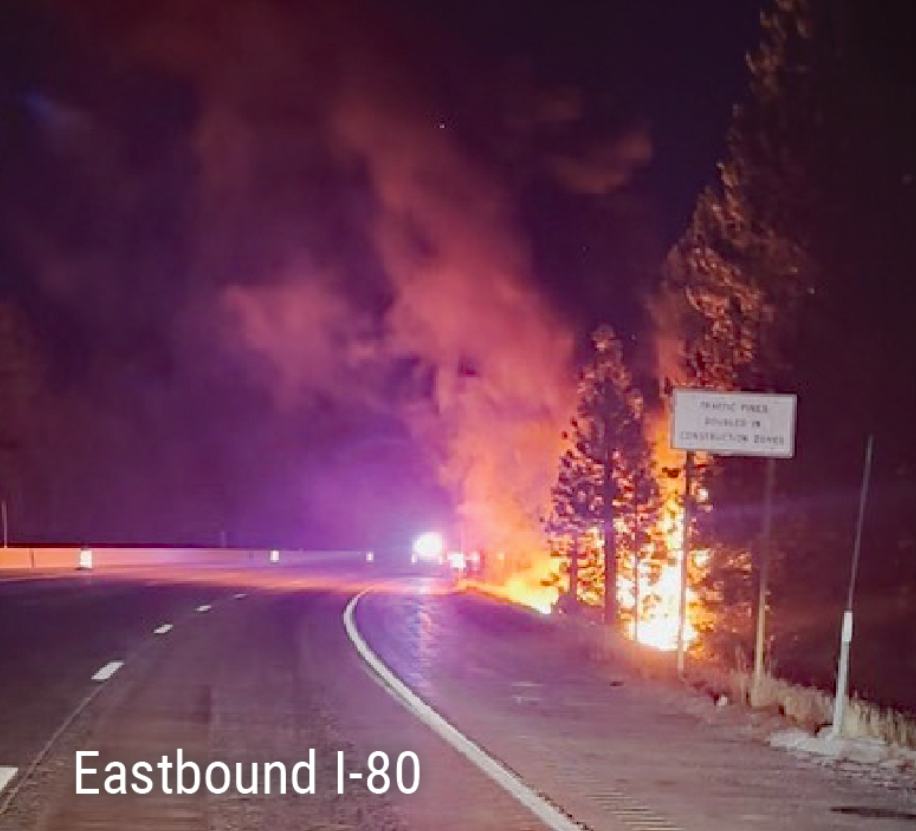
The accident with the Tesla Semi happened in the early morning hours of August 19, 2024. The driver, a Tesla employee, was navigating the battery-electric rig along Interstate 80 near Emigrant Camp, southwest of Yuba Pass. The rig was heading from Livermore, California, to a Tesla facility in Sparks, Nevada.
For whatever reason, the Semi left the roadway, swerving to the right on a right-hand curve while headed upgrade. The rig hit a steel post, then a tree, and careened down a slope, coming to a stop against several trees. A fire broke out in the lithium-ion battery system, but the driver was able to get clear of the rig and wasn’t hurt.
50,000 gallons of water to douse Tesla vehicle fire
First responders included the highway patrol, the state’s department of transportation, and units from CAL FIRE. Tesla sent in one of their experts to help assess just what hazards could be involved, both the high voltage of the battery system (about 1,000 volts) and issues related to the fire itself.
Fire crews report nearly 50,000 gallons of water were needed to put out the flames and to cool the wreckage. CAL FIRE also called in an aircraft to dump retardant on surrounding areas to reduce wildfire risk. Crews checked for air quality, and a thermal scanner noted the battery fire temperature.
Both east and westbound traffic on the interstate was shut down for 14 to 15 hours. When the fire was completely out, the remains of the rig were hauled off to a site in Nevada. It was left out in the open and monitored for 24 hours. Reignition of lithium battery fires is not uncommon.
What about Tesla’s so-called “Autopilot”? Was it involved in the crash? The NTSB says the rig was equipped with Tesla’s Advanced Driver Assistance System, but it had no bearing on the crash. The system wasn’t operational, and the driver could not use it.
Comparing a Tesla semi to an e-RV
Will this have any effect on the future of battery-electric motorhomes? Winnebago is already working on the development of electric rigs. Their prototype eRV2 is a comparatively minuscule Class B unit. It has, at present, a 108-mile range.

Winnie does have a bigger player in the market. They’ve already developed a “fully electric commercial vehicle platform,” in 33- and 38-foot lengths. The battery bank capacity here is 280 kWh, with a claimed range of 200 miles. In the California Tesla incident, there’s a big difference. Tesla Semis are equipped with a battery capacity of 900 kWh. That’s a lot more battery to have to snuff out if it catches fire.
Still, if any RV manufacturer wants to appeal to RVers, something much greater than a 200-mile range is needed. Winnebago’s commercial platform is rated at 26,000 pounds—including the weight of its heavy batteries. It’s said the average weight of a Class A motorhome is 30,000 to 36,000 pounds, with much lighter weight fossil fuel engines. At the end of the day, for a big motorhome to make it on the road, you can bet battery capacity will have to be much closer to a Tesla Semi’s.
Could this affect future electric RVs?
This begs the question: Firefighting agencies are still coming to terms with putting out fires in passenger-sized EVs. Admittedly, there are fewer fires in EVs than in conventional fuel vehicles, on a proportional basis. But when it comes to EV battery fires, the bigger they are, the harder they are to put out. Could this create opposition from some on the matter of fire safety?
On the other hand, the public’s acceptance of the higher cost and the shorter range between fueling may just make the issue of big, electric Class A RVs moot.
RELATED
- Tesla Cybertruck tows futuristic Pebble Flow trailer
- All-electric RVs: Boon or bane for boondockers?
##RVT1174b


50,000 gallons for one fire. That is enough water for my house for a whole year.
You might be able to afford that electric motorhome or the fire insurance but most likely not both.
Thank you, Russ and Tina! 😉 Wow! That is a lot of water! 🤔😯 I thought that electrical fires (is a battery fire an electric fire?) needed a different fire retardant than water. Not so? Thanks again have a great day, safe travels, and safe stays! 🙂
3 Teslas on fire at a San Diego dealership reported earlier today.. more info on the cause and what it took/ takes to extinguish said fires in a report to follow we hope..
Also another battery storage facility fire reported.
A never ending story..??
4 Tesla vehicles, fires out but possible battery reignition.
Also possible arson caused…
Thanks for the update. 😎
3rd. storage facility fire in the last few months in San Diego county…😵💫
What will affect the future of electric RVs is that no one will buy them…
Given that a spark from a dragged chain can ignite a 50,000 acre forest fire does anyone really think a battery powered camper at Yosemite or Yellowstone is a good idea?
I would wager that campground owners will not allow RVers with EV RVs into their parks within a few years. A single inextinguishable fire could wipe them out and millions of acres of forests that they may sit on.
The way to save our natural environment is not to burn it down while proving virtue.
I wish the article would have explained the extent of hazardous waste that resulted from the fire and the cost of disposing of the waste. Maybe these battery operated vehicles need an onboard halon fire suppression system (or similar) to quickly snuff out the fire.
I like EVs, for local commuting, where I can run my errands about town and then recharge at home overnight. An RV that can’t make more than 200 miles without an hour or more of recharging (assuming a “fast” charger can be found) is pointless IMHO.
And once these things start torching off fast swaths of the landscape, public tolerance for these will evaporate, and give governments another excuse to bar off-grid camping.